• TalkBass has been independent since 1998. Add your voice.
    Create a free account to reply to discussions, view embedded media, and browse with fewer display ads.
    Join freeLog in
    Want zero display ads or expanded classifieds tools? Compare plans.

Double Bass awful setup help

Hi there, I have several questions. I have a 40 year old Czech bass, front and edges are wood, back is plywood. It doesn`t have any cracks or so...Luthier told me that (I don`t know the exact word in english) the beam that runs under the front desk, from the top to the bottom, is 1.5cm wide, and it should be 2.5cm wide.

Question 1: Could this cause any problems, and how can it affect the sound?

There is also a problem, that the fingerboard is too thin (its not ebony), at the nut it is only 3mm, and at the bridge about 5mm. Also, the tailpiece is shorter than it should be, the previous owner probably broke it or I can`t imagine what could be done to it - so the wire has to be longer to maintain the measures. Also the endpin is of very low quality. Strings are low, the height is about 5 to 6mm. Still, the DB has quite nice color of the tone, high volume, vibrates the whole room, but it is kind of thin tone, it`s not very solid. And is terrible to play, very floppy. :hmm:

Question 2: How each of these components (fingerboard, tailpiece, wire, endpin, mechanics) affect the sound of the DB, and the comfortability of playing?

Question 3: Can I expect better sound and comfortability, after replacing these parts?

(Sorry for the length...)
THANK YOU! for any advice
 
Hi there, I have several questions. I have a 40 year old Czech bass, front and edges are wood, back is plywood. It doesn`t have any cracks or so...Luthier told me that (I don`t know the exact word in english) the beam that runs under the front desk, from the top to the bottom, is 1.5cm wide, and it should be 2.5cm wide.

Question 1: Could this cause any problems, and how can it affect the sound?

There is also a problem, that the fingerboard is too thin (its not ebony), at the nut it is only 3mm, and at the bridge about 5mm. Also, the tailpiece is shorter than it should be, the previous owner probably broke it or I can`t imagine what could be done to it - so the wire has to be longer to maintain the measures. Also the endpin is of very low quality. Strings are low, the height is about 5 to 6mm. Still, the DB has quite nice color of the tone, high volume, vibrates the whole room, but it is kind of thin tone, it`s not very solid. And is terrible to play, very floppy. :hmm:

Question 2: How each of these components (fingerboard, tailpiece, wire, endpin, mechanics) affect the sound of the DB, and the comfortability of playing?

Question 3: Can I expect better sound and comfortability, after replacing these parts?

(Sorry for the length...)
THANK YOU! for any advice

FatJazzCat:
The "beam" you are referring to is the bass bar. It runs down the front or "table". As for the width, I'm not sure what it should be but there are plenty of knowledgeable folks on this forum that could help you.

As for all the other items, yes if they were corrected you'd have a much better playing experience. It's all a matter of having a good luthier do the work, and of course, money.

Sounds like a cool bass. Maybe you can post a picture?

Ray
 
Although a 15mm wide bar is narrower than most, it's lasted 40 years. Nothing to worry about, unless the there are cracks in the top or the top has excessive sinking. Are there any cracks in the top/belly of the instrument near the bass bar? Does your luthier think the top is sinking?

You can expect an easier to play and better sounding bass with an ebony fingerboard that is properly planed and dressed. Get a new nut, as well. An ebony or rosewood endpin with cork lining, also properly fit, will tighten up the low end, and keep the bass stable and solid when you are playing. If you have the extra money, get an ebony tailpiece that fits your bass, along with a flexible aircraft cable tailwire.
 
Thanks,
...the bass doesn`t have a single crack, and the top isn`t sinking...so I think it should be o.k. as you say.
...and here are those pictures...
 

Attachments

  • DSC_0013.jpg
    DSC_0013.jpg
    23.8 KB · Views: 117
  • DSC_00017.jpg
    DSC_00017.jpg
    18.2 KB · Views: 110
It does look like a nice bass. The profile shot looks like the bridge is upside down. The angle should be 90 degrees (square) on the tailpiece side and sloped slightly on the fingerboard (top) side. My old Czech bass was like that when I first got it. So you might need a new bridge or turn that one over and refit it. Just one observation.
 
This bass looks almost identical to one of mine. They're probably "brothers", made by the same maker (or in this case: manufactory). I think they are German, not Czech.
My bass sounds *very* good, too, and I have no problems with the bassbar at all. If you can afford it, get a ebony FB installed and change the tailpiece: the bass seems to be worth this expense.
 
It does look like a nice bass. The profile shot looks like the bridge is upside down. The angle should be 90 degrees (square) on the tailpiece side and sloped slightly on the fingerboard (top) side. My old Czech bass was like that when I first got it. So you might need a new bridge or turn that one over and refit it. Just one observation.

Yes, I know how the bridge should be placed...From this angle it looks like you say, but it is like you said it should be...
 
This bass looks almost identical to one of mine. They're probably "brothers", made by the same maker (or in this case: manufactory). I think they are German, not Czech.
My bass sounds *very* good, too, and I have no problems with the bassbar at all. If you can afford it, get a ebony FB installed and change the tailpiece: the bass seems to be worth this expense.

Yes, it was made by a manufactory, and yes, I think there are pieces from Germany too, they were made in the same "Schonbach" form (model). The bass bar is a mystery to me, maybe it was just an experiment, maybe lack of material, I really don`t know....But until there are no cracks, it`s ok I hope...
 
My "brother" bass has a regular bass bar.

Yes, every model of this kind has a regular bass bar, as my luthier told me, but my bass doesn`t, and the reason why it doesn`t will remain a secret :)...it has been ok for 40 years, and I hope it will be for at least another 40...
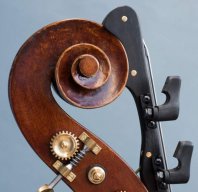
p.s. I visited your webpage jonas, and I`ve found out, that not long time ago, I`ve bought a pickup from you :) ...delivered to Slovakia (Macaj), I was very satisfied, so let me thank you through TB too :) ...

I`ve also seen a double bass there, is that your bass you`re talking about? Yes, it seem`s to be the same, only the ribs (c-bouts) are a bit different. What`s the history of this bass?
 
p.s. I visited your webpage jonas, and I`ve found out, that not long time ago, I`ve bought a pickup from you :) ...delivered to Slovakia (Macaj), I was very satisfied, so let me thank you through TB too :) ...
I'm glad you like it.
I`ve also seen a double bass there, is that your bass you`re talking about?
Which photo do you mean?
 
Also I would like to ask, if anyone knows, if there has been a serious research done ( like this one made for bridge height adjusters [Invalid or Expired Link Removed] ), on how various types of DB parts (type of endpin, type of wire, type of fingerboard ) affect the sound of DB...
...just wondering....
 
Even if you were able to scientifically isolate and measure the effect of those variables on a bass, surely the conclusions or generalisations you would come up with would only really apply to the basses in the test. How can you really compare these things scientifically? To do that you'd need a control, a standard to compare to. But can you think of a more un-standard instrument than a double bass?

That leaves broad empirical generalisations, hunches, tradition and wacky new ideas, some of which just might work ...

MT