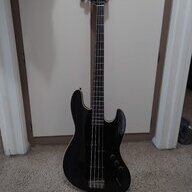
Tryin to eliminate (if poss.) the "vibration" of the B string on my Pro II 5 string Jazz Bass. Stock strings on it now, but I want flat wounds. D'Addario Chromes? T-I, JF345 flat wounds?

Enjoy the benefits of a premium membership!
Upgrade Account
-
TalkBass has been independent since 1998. Add your voice.
Create a free account to reply to discussions, view embedded media, and browse with fewer display ads.
Join free Log in
Want zero display ads or expanded classifieds tools? Compare plans.
You are using an out of date browser. It may not display this or other websites correctly.
You should upgrade or use an alternative browser.
You should upgrade or use an alternative browser.
B String vibration?
- Thread starter Wally Glanz
- Start date
More options
Who Replied?

Tryin to eliminate (if poss.) the "vibration" of the B string on my Pro II 5 string Jazz Bass. Stock strings on it now, but I want flat wounds. D'Addario Chromes? T-I, JF345 flat wounds?
What "vibration" is out of the norm? Let's address that before you dump 30+ bucks on a new set.
Riis


Tryin to eliminate (if poss.) the "vibration" of the B string on my Pro II 5 string Jazz Bass. Stock strings on it now, but I want flat wounds. D'Addario Chromes? T-I, JF345 flat wounds?
One thing to keep in mind... When it comes to flatwound B strings, "stiffer" (= "less vibration") may not necessarily be better for tonal quality.
Between the D'A Chromes 132B and the TIJF 136B, the D'A is the stiffer of the two, but is it better in terms of clarity and definition? Not necessarily.
I want flat wounds. D'Addario Chromes? T-I, JF345 flat wounds?
What kind of tonal quality are you looking for? Something traditional and "old school" or something a little more "modern" that would match up with the Jazz bass better?
A couple of people have already recommended the Ernie Ball Cobalt Flats (2816), which is a good option for something modern with a roundwound-like brightness. If you want something more traditional, you can try the Ernie Ball Stainless Steel Flats (2810). They both come with a .130 for the B, which is not the stiffest, but they do get good reviews for their tonal quality.

Ric5
Inactive
- Jan 29, 2008
- 29,772
- 30,452
- Disclosures
- I like 5, 8, 10, and 12 string basses


what do you mean by vibration? Sympathetic vibration when playing other strings? If so, get a fret wrap or something similar to help control it
can you describe what kind of "vibration" you're trying to eliminate?
what do you mean by vibration? Sympathetic vibration when playing other strings?
I kind of assumed the OP's talking about the "floppiness" of a typical B string, which tends to vibrate with greater "excursion" due to its relatively lower tension compared to the other four.
Maybe the OP can clarify it for us.


Eliminating the vibration of the B string turns it into a thumb rest. Maybe that's what they want? ;-)aren't strings supposed to vibrate???

B strings just don't quite feel right to me unless it's a 35 or 36 inch scale. If I ever got back into 5 or 6 strings, I'd want mine to be multiscale. I've picked up one multiscale 5 string in store, and it played like a dream on all strings.
Otherwise, as others have recommended, assuming you're looking to de-flop the B string, bump the gauge up if you can. That isn't my favorite solution, but it will accomplish de-flopping.
Otherwise, as others have recommended, assuming you're looking to de-flop the B string, bump the gauge up if you can. That isn't my favorite solution, but it will accomplish de-flopping.
Ric5
Inactive
- Jan 29, 2008
- 29,772
- 30,452
- Disclosures
- I like 5, 8, 10, and 12 string basses
B strings just don't quite feel right to me unless it's a 35 or 36 inch scale. If I ever got back into 5 or 6 strings, I'd want mine to be multiscale. I've picked up one multiscale 5 string in store, and it played like a dream on all strings.
Otherwise, as others have recommended, assuming you're looking to de-flop the B string, bump the gauge up if you can. That isn't my favorite solution, but it will accomplish de-flopping.
I have 30", 32", 33", and 34" low b strings ... most of them work very well.

Yet another weird question from a brand-new account that doesn't return to clarify what they meant.

Without vibration, there is no sound.Tryin to eliminate (if poss.) the "vibration" of the B string


Give him time, This place moves so fast that newbies (like me - to this forum) often have trouble keeping up.Yet another weird question from a brand-new account that doesn't return to clarify what they meant.
As to his problem, yes, more info needed, I usually just use the B string as a thumb rest until I want to play it.

I think the OP is asking about unintended vibration/noise/open note from the B string when intending to play other notes.
If this is the case, the answer is to develop damping and muting techniques or use a mechanical device to stop it.
If this is the case, the answer is to develop damping and muting techniques or use a mechanical device to stop it.
I think the OP is asking about unintended vibration/noise/open note from the B string when intending to play other notes.
If this is the case, the answer is to develop damping and muting techniques or use a mechanical device to stop it.
This is the answer to most B string questions IMO...
Get strings you like and PLAY the B string. It isn't supposed to be a thumb rest.


