• TalkBass has been independent since 1998. Add your voice.
    Create a free account to reply to discussions, view embedded media, and browse with fewer display ads.
    Join freeLog in
    Want zero display ads or expanded classifieds tools? Compare plans.

Double Bass Baby bass in BG

I noticed the other day watching the Baily and Vincent show Darein is useing a baby bass. Does anyone know if Ampeg or clone? If couldnt see it would have thought it a Kay!
There are some who look down on anything not full sized, but listen with the ears, not the eyes.
Saw another group useing a NX type.
Proper use and mixing makes the differance.
In a small live venue there may be someone who could distinguish a small differance.
 
Ampeg hasn't made a Baby for 50 years. They did sell rebranded Azolas for a year or two in the 1990s. If it looks new and shiny, it's probably a clone.

The NS basses are getting pretty popular in bluegrass. It solves the transport/rental issues for a road band. My banjo playing college roommate told me the guy in his bluegrass band in the 1960s played a Baby, so using an EUB is not a newfangled idea.
 
I have used a NS NXT in BG for seven years now, replaced the stock strings with Obligatos which work very well on a solid body instrument. Using synthetic gut core strings on these makes a huge difference. It does not sound 100% like an un-amplified DB but it does give a good thump and has attack and sustain that comes close and works in BG well (have also used it in Gypsy Jazz with very good results.) I think it fits in BG much better than a electric.
 
I remember the first time I saw Special C, Dan Eubanks was using some sort of electric upright. Sorry I don't know EUBs - it was tall and thin, on a tripod stand. The show was an anniversary show w/ all the different lineups playing, and Dan was the only bassist playing electric. I thought it looked odd, but sounded fine.

Since then, I've seen Special C several more times, and studied/hung w/ Dan at a couple of camps. Each time, he was using an old Kay. Next time I see him, I'll ask what his electric rig was. I imagine the primary purpose was ease of travel.

Probably shouldn't have a preference other than sound, but anything non-wooden upright sure LOOKS odd to me in a BG/trad setting.
 
  • Like
Reactions: AGCurry
I may ruffle feathers with this post. Let me say first that I have nothing against playing any kind of music with any instrumentation. It's all MUSIC.

But is it Bluegrass music?

We all have to make compromises sometimes. IMO, an electric bass of any kind is a compromise in Bluegrass, but I tend to agree with strict definitions and constraints. Sure, an electric instrument can sound good, but its use stretches the boundaries of the genre ... and there's only so much stretching any definition can take before it becomes obsolete.

I find it interesting that the name of the genre was NOT "Bluegrass" until the late 1950s, even though the name came from "Bill Monroe and the Blue Grass Boys," a band name from 10 years previous; it was known as "Hillbilly" beforehand. With the genre's new name, instrumentation was restricted to guitar, fiddle, mandolin, banjo, bass, harmonica, and dobro - all acoustic.

So there are two directions that Bluegrass can be stretched: Instrumentation (do we want to hear Molly and Tenbrooks played on synthesizers?), and style (how about Whole Lotta Love played on banjo and fiddle?). Either one, IMO, makes the term "Bluegrass" less useful to describe the genre.
 
I dunno. I saw Hot Rize on BG Underground. I thought the bassist looked kinda silly playing guitar, but I would be hard pressed to call what they were playing anything other than BG. (Which, it seems, is unusual for that show! :()

Similarly, I'm pretty comfortable saying Special C is just about as BG as it gets.

I think you are being a tad restrictive in your definition. Would you rule out electronic pick-ups, or to play BG do the players have to gather around a single mic (my preference BTW, but no one has been inviting me to play in any large auditoriums!)?
 
  • Like
Reactions: AOBASSMAN
Two thoughts on defining genres (very paraphrased):

Wynton Marsalis once gave a very strict definition of Jazz, had to be acoustic based, preferably horns, have some swing, come from a blues background, come from and reflect the African-American experience, etc. etc. Seemed ridiculous to pigeonhole a genre that was all about innovation and exploration. We are making it up as we go along, substituting notes, changing the timing, melody and harmony but you still have to do it within these parameters?

Pat Metheny once was asked about the future of jazz and instrumentation. He said he could envision some cat coming into a jam with some kind of box or electrical musical device, something not yet invented. And he said, if it sounds good and was musical, cool.

if it sounds good, cool.

or as he put it another way:
I don't worry too much about the fundamentalist principles that are in almost any discussion about jazz.

The other factor is that there is no way a DB is going to fit into my Miata.
 
  • Like
Reactions: Cheez
I think you are being a tad restrictive in your definition. Would you rule out electronic pick-ups, or to play BG do the players have to gather around a single mic (my preference BTW, but no one has been inviting me to play in any large auditoriums!)?

I'm not against playing any kind of music any way you want (I think you get that). I'm arguing for the preservation of terms we use to describe particular genres, so that the terms retain their usefulness. I'm frustrated sometimes when I use a correct term to describe something, only to find out that common usage has caused the term to lose its specificity.

When I first started playing Bluegrass in 1975, the "governing body" of Bluegrass restricted instrumentation to a specific set of instruments. I don't remember what the governing body was, but I would wager that it followed the wishes of Bill Monroe, a powerful but pretty crusty guy (he scolded me and my friends once for the way we were dancing - we "ruined the waltz").

My band warmed up for the New Grass Revival in 1975 or 76 (John Cowan was their bass guitarist). Of course they were great, but at the time it was not considered Bluegrass - they didn't play [traditional] bluegrass pieces, and they had (gasp) a bass guitar. And, judging from what they called their band, it wasn't really Bluegrass to them either. Last year, they were inducted into the "Bluegrass Music Hall of Fame," so obviously the "genre constraints" had loosened over 45+ years (or said hall of fame had run out of the more obvious candidates... halls of fame have to keep going, right?).

Regarding pickups - as I said, we all have to compromise sometimes. I'm not aware of any rule dictating what means of amplification can be used, and since a pickup is in effect a specialized microphone, I would be lenient should I be asked to rule on the matter (an unlikely event). But like you, I'll always like the old-fashioned way better. It's harder to get that high, lonesome sound when you're wired up.
 
Last edited:
@AGCurry thoughtful post as always - I play in a band that does both traditional bluegrass and NewGrass, and while I prefer my acoustic DB, we usually play outside (its really hot here in summer!) so most of the time the Eminence gets the nod. With big-rig pa systems, the sound is indistinguishable to me. You haven't lived until you've played bluegrass through a 3,000 watt pa with 2- 18" subwoofers (we did it a few weeks ago and it was actually kinda fun :D
 
@AGCurry thoughtful post as always - I play in a band that does both traditional bluegrass and NewGrass, and while I prefer my acoustic DB, we usually play outside (its really hot here in summer!) so most of the time the Eminence gets the nod. With big-rig pa systems, the sound is indistinguishable to me. You haven't lived until you've played bluegrass through a 3,000 watt pa with 2- 18" subwoofers (we did it a few weeks ago and it was actually kinda fun :D

My band had the last slot at the Telluride festival in 1977 (or was it 1978), and we had a bluegrass set. Listening to the recording of that show, I can tell you I would have sounded much better with your Eminence!
 
  • Like
Reactions: marcox
My band had the last slot at the Telluride festival in 1977 (or was it 1978), and we had a bluegrass set. Listening to the recording of that show, I can tell you I would have sounded much better with your Eminence!
That must’ve been a ton of fun – it’s a beautiful place! I do know that our big old basses don’t particularly like being amped up to super high volumes, but the Eminence handles it just fine.
 
  • Like
Reactions: AGCurry
Well, this is a general subject that's been beaten to death over many years but I'll get in a whack or two for myself.

In my opinion, there's a certain general sound that works well for "traditional bluegrass" songs and styles (think Monroe, Flatt/Scruggs, etc.). If you've got the space, the hauling, and can manage dynamics and amplification, the double bass gets the bass sound for that the easiest. HOWEVER, you can closely approach it using bass guitar, Baby Bass, etc. My two cents - if you are playing traditional notes in a traditional way and you're getting more or less the traditional sound, it's perfectly OK to play traditional bluegrass with a bass guitar. If you start playing it non-traditionally (which you can, much more easily, because the technical limitations of the DB largely disappear) then you're not doing right by the music and you're changing it to something else. That "something else" may well be beautiful and meaningful music of high quality, but it starts departing from "traditional bluegrass". I would rather hear traditional bluegrass with the bass part covered by an EB played sensitively and in the traditional way, than no bass at all.

If you're being paid and the bandleader tells you to play upright, you play upright, of course.
 
For an example, here's a video of bluegrass with electric bass. Sounds just fine to me. He's playing the same kinds of things, in the same way, as if it were an upright. Fits the style just fine. I wouldn't kick him off my stage.

 
For an example, here's a video of bluegrass with electric bass. Sounds just fine to me. He's playing the same kinds of things, in the same way, as if it were an upright. Fits the style just fine. I wouldn't kick him off my stage.


Yeah, it works there, a slow 2/4.

A friend who teaches at Berklee has criticized me for being a purist snob ... and I own that. But I imagine Lester and Earl and the Foggy Mountain Boys performing that song on their TV show, singing into one microphone ... and it's a lot better. Jim and Jesse were great, but they went a little too Nashville for me sometimes. I saw them in 1975 and again in 2003, and they were a little more "high lonesome."
 
All right - continuing even further off topic - what's w/ the resonator guitar picker off to stage left? The only show him briefly in some shots, and the leader introduces the song as a quartet (presumably WRT vocals.)

Anyone recognize the mystery picker?
 
I think "quartet" just means vocal quartet.

AG, I won't argue that the song might sound better to your ears and my ears with the Foggy Mountain Boys Quartet singing it and Cousin Jake playing bass and singing tenor. But I'm not really talking about "best", I'm saying that the electric bass there sounds appropriate to me.

I guess to me "Bluegrass" is a lot more about the whole overall impression of the sound than the exact details of instrumentation. How far does bluegrass evolve till it's something else? That's a question that will never have a single consensus answer. I think it needs to be allowed to breathe a bit, it's not Mozart, and the original players of this music (and what it's derived from) a lot of the time made do with what they had. Heck, Bill Monroe had an accordion in the first Blue Grass Boys band. It's almost one of those questions like "define a dog" - well it's a four legged carnivore... - so if it has only three legs it's not a dog any more? If a dog's owner feeds it no meat, is it not a dog any more?
 
I guess to me "Bluegrass" is a lot more about the whole overall impression of the sound than the exact details of instrumentation. How far does bluegrass evolve till it's something else? That's a question that will never have a single consensus answer. ...
It's almost one of those questions like "define a dog" - well it's a four legged carnivore... - so if it has only three legs it's not a dog any more? If a dog's owner feeds it no meat, is it not a dog any more?

Great points ... it's why we have taxonomies and objective definitions and are able to define a dog as "a member of the species canis familiaris" ... and why one objective way to define bluegrass music is by the instruments it's played on. Bill Monroe and fellow purists might have hated hearing Led Zeppelin songs played on banjos and fiddles, but they couldn't have barred that music from sanctioned Bluegrass festivals using their own rules.
 
I made a trade of an unused amp for a 1/4 sized student upright about 6 months ago. I have yet to play in public with it but I am enjoying myself quite a bit. Do I play upright bass? Don't know what others think but...
If I enjoy it and find people who enjoy playing with me as well I really don't care, if they have a problem with the instrument I play i would most likely not find them enjoyable to play with either, problem solved.
 
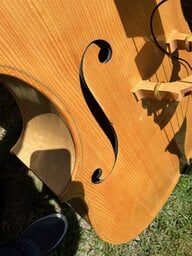
I recently picked this up. An Azola Baby Bass. Going to add it for a couple songs in my country band. Playing thru my EB rig. Not sure I’ll play Bluegrass on it. But I could some day.
2BA55D47-771A-4692-8F2A-37D96D44CCDF.jpeg
 
  • Like
Reactions: quickfix and marcox