Had one gig with the Backbeat the Saturday before Christmas, wanted to lay out an initial review in two parts - at home and at the gig.
-----------------
First-look review summary:
4.5/5.0
Amazing innovation. Creates a transformative in-ear monitor experience.
Half a point deduction for cable logistics and unwieldiness. An admittedly unfair deduction because both issues are unavoidable and inherent to a unit with all the included features.
-----------------
At home:
I'd received the unit the day before and messed around with it at home for a few hours. It was really cool using it as a practice amp, playing directly into it using headphones (Sony MD7506) and in-ears (Shure SE215). It was certainly powerful - just over halfway up on the 'Thump knob' seemed to be more than enough - and I definitely could sense the notes a lot better with it than without. And using the aux jack to have playing along music was really neat, overall a better experience than routing through the small 4 channel mixer I usually use.
The response is most significant in the lowest two octaves or so on my 5 and 6 strings, and reduces quite a bit above that until about the 12th fret G on the G string at which point most of the thump is from right hand finger thump (such as from a rest stroke) rather than a note vibration. To be expected since that's the top end of the BB's frequency response. It absolutely slams in the lowest octave and the feel and response on the fundamental notes on the low B of both my extended range basses was unlike anything I've felt through an amp or PA.
But I'll admit to not being totally blown away by the at-home experience. I did not love the "localized" thump feel on my back. I found myself thinking, 'will I really want this thing buzzing on that one spot on my back for a 4 hour gig?' The cable management is a bit of a PITA, having to run a cable from the bass to the unit, from the music source (phone or computer) to the unit and a headphones from the unit to my ears. Then, having to run out of the unit to my amp if I needed. That's a lot of cables. Admittedly, my use doesn't necessarily require me to run to my amp, but it's still a lot of cables to deal with every time you strap the bass on or take it off. Unavoidable with this particular routing (I used an alternate routing at the gig that is better, discussed below), but still a PITA.
Then there is the "wrecking ball" effect the Backbeat/strap combo. The weight of the unit causes the strap to swing around anytime the bass is moved, resulting in the BB almost always getting whipped back towards the bass body due to its attachment to the strap. I learned quickly that the BB must be directly held in the hand that is holding the strap while the bass is being taken off a stand, put on my body, taken off my body or being put back in the stand. I was lucky not to put any significant dings in any of my basses. This too is unavoidable, the unit has to weigh
something, and it is very light for what it is and does. With some behavior modification on the player's part it ultimately will be a non-issue.
A more minor issue I had was with the attachment clips. I have a thick padded strap - Gruv Gear Neo Solo - and the clips were super difficult to get onto the strap. I actually had to use a flathead screwdriver to get them open enough to slip on to the strap. And slip on is the wrong language, ham-fisted finagling is more like it. But the good news is that sucker ain't coming off. I usually gaff tape my wireless packs to my strap at the gig, there is no need for tape on the BB. I've decided that the BB is going to stay on my strap semi-permanently, even during transport, so I don't have to wrestle with it each gig. And in this case I can wrap the BB in the strap so that the strap acts as a kind of padded cover for the unit, which transports either my gig bag pocket or separate small gear bag.
On the gig:
As I mentioned in the OP, my main band runs a silent stage - in-ear monitors, no amps, electronic drums. We do lots of weddings and corporate parties and the FOH volumes are such that I do not get much (or any) tactile feedback from the subwoofers. This was a rare club gig for the band - a rowdy live-music college bar - probably holds a few hundred people at capacity. Big ol' JBL PA hanging from ceiling, plus a group of 2x18" subs under that stage. The monitors and drum fill pictured were not in use. They tend to mix kick heavy at this place, meaning most of the time the bass guitar is buried in the mix and I absolutely cannot count on getting any feel from the FOH system which can be frustrating.
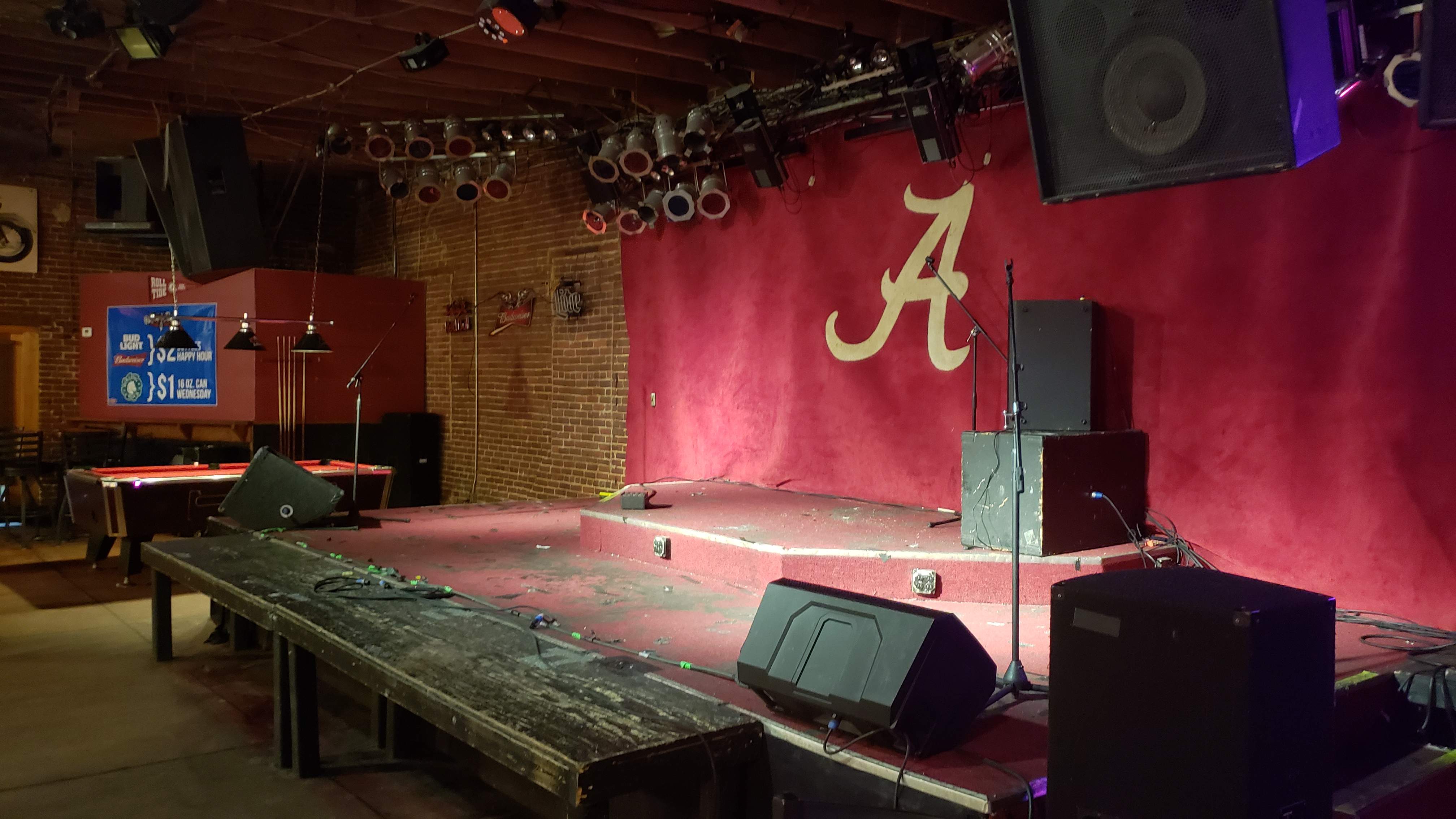
Using the BB completely transformed that experience. It felt as if there was a stack of 2x18"s behind me the whole night. Actually better, because this thing was solid down to the low B, which is an amazing feeling and unlike playing with almost any amp. Yeah, the vibrating was localized on my back but it did not bother me in the way that I expected it to. It created an immersive experience where my bass was truly the foundation for the mix I was hearing in my ears, not just part of it. In my mind's eye I felt like my bass was a flowing river, with all the other instruments floating on top. The kick drum was making waves that I could lock into at will. I felt like I got back my ability to apply subtle dynamics with the right hand in particular and moving from light finger-style to thumb muting, to slap/pop and double thumbing to aggressive FS all had the significant feel changes I was not getting on in-ears alone.
My cable routing for the show was simpler and more effective than at home. We are completely wireless for the gig so I've got a instrument transmitter, in-ear monitor receiver and the BB clipped to my strap. I run a cable from my bass to the transmitter to get into the PA. Then I ran a 1/8" TRS - 1/4" TRS cable from the receiver into the BB (the red input) and out of the 1/8" jack with my earbuds. It's still a lot to juggle but easier than dealing with all the of the cables hanging from the bass when I used it at home.
Running the entire mix through the single input (rather than the aux input) allows the thump intensity knob (L) to adjust both the bass thump and kick thump. I then adjusted the balance in my mix to suit my taste. It was great being able to
feel the kick again on stage. I could also feel the toms a bit, which made the whole mix feel more musical.
I definitely went overboard with the thump knob most of the night. It was difficult to find just the right knob position to get the feel I wanted without excessive vibration. I never pushed it more than 60%, which was overwhelmingly thumpy. In terms of gain staging I found it best to run the headphone volume knob (R) almost all the way up and then regulate the mix volume via the volume knob on my in-ear receiver pack, which was between 50 and 80% most of the night. I never quite found the perfect balance between overall mix volume and thump, but more gigging will give me time to sort that out.
It's not an easy task to adjust knobs on the BB since where it's positioned my strap the unit cannot be reached with the bass on. I'd have to remove my ear buds (and hold onto them so they don't get tangled in the strap), then rotate the neck-side of the bass down until the strap rotates the BB unit to a reachable position on my left shoulder for adjustment. That's like a 20 second process minimum, and I cannot test or feel the result of any changes I made until the bass and in-ears are back in place. So I really can only truly tweak my thump during sound check or between sets. I'm considering recruiting the drummer to twist some knobs between songs in a pinch, but we'll have to come up with hand signals to make sure he knows what and how to adjust.
I've got three gigs this weekend, two weddings and a New Year's show on a big casino stage, so I'll report back some more after all that goes down.
See below for a diagram of all the Backbeats knobs, jacks and indicators.