• TalkBass has been independent since 1998. Add your voice.
    Create a free account to reply to discussions, view embedded media, and browse with fewer display ads.
    Join freeLog in
    Want zero display ads or expanded classifieds tools? Compare plans.

Backbow options....?

Apr 4, 2021
2,067
4,036
PA.
I have this Jazz bass where the truss rod is completely relaxed (meaning its unscrewed to the point where it contacts the body – no movement left). If I screw it the other way, it appears to be working. It does turn rather freely though, but I can see it moving itself inward, then gets to a point that feels like its building up tension and seems to be working. The problem is in setup. I only have like .006 relief. I need just a couple thousandths more but I don’t have it. I’m so close right now that its insane. What would you do?

I’ve thought about heavier strings. I have “Pure Blues” (45-105) on there now and I do have a small collection of DR strings stored up. (Lo-beam/Hi-beam/Fat beam). Which have the most tension?

Or would I have to go up to a heavier gage. Meaning a .110 vice a .107 “E” string?

Are there any home remedies. Considering how little movement I need I’d listen to them.

Is there anybody in the Philly area who straightens necks? Jez…. That just sounds expensive.
 
  • Like
Reactions: Zooberwerx
Not a scenario involving truss rod issues, but a few times I've had luck simply propping the instrument against a wall by the headstock (in your case the back of the headstock) with the body about 2 feet away from the base of the wall for a few days until it gave in the desired direction.
 
  • Like
Reactions: DrBnz
I’ve had a similar situation-strings with higher tension is a low cost experiment that may work. DR makes a 50-130 set in Pure Blues. I’ve also found GHS Pressurewound to be great at adding some tension to pull the neck forward without affecting playability - and they sound great.
 
  • Like
Reactions: DrBnz
Are there any home remedies.

Not a "recommendation", but;
I've successfully heat-treated 2 necks with the same condition you describe.
I did it the "natural" way; in the car-in the sun, on a hot day!

Cliff Notes version:
I clamped the neck into a forward bow (3/8" or so IIRC)
I monitored the temperature using a remote grill thermometer (140 + degrees was my target), so it has to be at least 90 & sunny out.
I left them clamped up for an additional week (minimum) before re-installing.

The change wasn't "extreme", but significant enough that both basses now maintain at least "adequate" relief through seasonal changes - 2 years and counting. (both wear EB cobalt flats.)

Wood will always find its equilibrium - so depending on the cause, it may or may not work.
In both my cases, I believe the basses sat for long periods of time without string tension - I know that for sure one of them sat in its case for 10 years without being strung up.

I only have like .006 relief. I need just a couple thousandths more
A shim will not change the curvature / relief of the neck.
 
Last edited:
  • Like
Reactions: Ewo
I have this Jazz bass where the truss rod is completely relaxed (meaning its unscrewed to the point where it contacts the body – no movement left). If I screw it the other way, it appears to be working. It does turn rather freely though, but I can see it moving itself inward, then gets to a point that feels like its building up tension and seems to be working. The problem is in setup. I only have like .006 relief. I need just a couple thousandths more but I don’t have it. I’m so close right now that its insane. What would you do?

I’ve thought about heavier strings. I have “Pure Blues” (45-105) on there now and I do have a small collection of DR strings stored up. (Lo-beam/Hi-beam/Fat beam). Which have the most tension?

Or would I have to go up to a heavier gage. Meaning a .110 vice a .107 “E” string?

Are there any home remedies. Considering how little movement I need I’d listen to them.

Is there anybody in the Philly area who straightens necks? Jez…. That just sounds expensive.

I'd remove the neck and pull the TR nut. Re-install the neck, re-string, and tune a 1/2 step high. Re-check the relief in a day or so. You've essentially created a "poor man's" jig...crude but potentially effective.

A shim helps when the bridge saddles have reached the limit-of-travel...they do not introduce addt'l relief.

Riis
 
  • Like
Reactions: JLS
A reverse shim perhaps? They are usually used to lower the action but turn them around and they could fix a back bow issue. To get your neck in a position where the truss rod can correctly engage and correct the bow.
A shim will not fix a bow. It only changes the angle of the neck to the body.
 
A shim will not fix a bow. It only changes the angle of the neck to the body.
Exactly. It would be like changing a tire because your car overheated. It’s a legitimate fix, but for a completely different problem.

Your easiest solution is the one you suggested in your OP: try a set of strings with slightly higher tension. Manufacturers publish the tension of their string sets. You can also check in with Jason at Fret Nation (no affiliation) as I believe he posts the tension of all the string sets he sells.

If a set with slightly higher tension gets the neck to bow forward just a bit, snug the truss rod to that point and then back it off 1/8 turn. This will leave the neck unsupported by the truss rod and it will, in time, develop a permanent bend until it reaches where the truss rod is set. At that point the rod will properly support the neck.
 
As others have said, the shim won’t add “relief” but the OP said he is just looking for a few thousandths. So changing the geometry just a tiny bit, might do the trick.
Also changing the angle of the neck to body will change the leverage on the neck and help add relief.
 
Last edited:
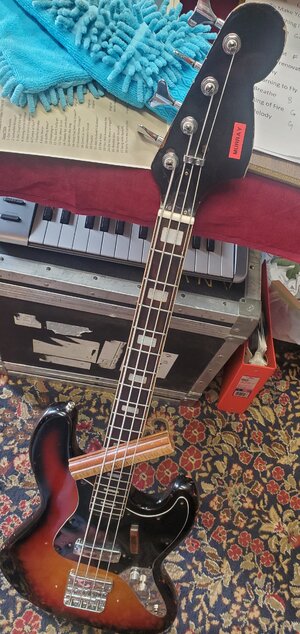
I have had this happen on a handful of basses, a 4001, an Aria pro 2, a Turser, and my latest guy Murray (a Tiesco of sorts)!

What I have done has been to loosen the truss totally, tune to pitch or a little higher, and put something midpoint (ish, really where I wanted the backbow to get worked out) under the strings to create a more dramatic angle to pull the neck back in to alignment.

20240817_092948.jpg

On the Ric, it was just an old cassette box and it took under a week to get back into shape, on the Aria and Turser it was a direct box, and I also had to apply heat with a heating pad, that took a few weeks, Murray has been a stubborn boy, and has taken about a year and quite a bit of heat, but had an EXTREME backbow.
 
A shim will not fix a bow. It only changes the angle of the neck to the body.
If the shim was big enough, it could create more mechanical advantage for the pull of the strings, but I would be concerned about stress on the neck body join. Also, it wouldn't be playable, just a corrective procedure.

Best is to rest the neck on a cradle block at the nut and a flat block at the heel and apply tension in the middle with a big clamp as others have mentioned. Heat will definitely help the process
 
The OP is talking about a very small adjustment.
He should definitely try the shim before jumping into heat bending the neck.
If it doesn’t work, then more drastic measures may be needed.
But he should try the shim first.
Takes 10 minutes.
 
  • Angry
Reactions: /\/\3phist0
The OP is talking about a very small adjustment.
He should definitely try the shim before jumping into heat bending the neck.
If it doesn’t work, then more drastic measures may be needed.
But he should try the shim first.
Takes 10 minutes.
A shim WILL NOT fix a backbow. Adding a shim is the equivalent of raising the saddles, which also will NOT fix a bow, neither forward nor back bow.
 
A shim WILL NOT fix a backbow. Adding a shim is the equivalent of raising the saddles, which also will NOT fix a bow, neither forward nor back bow.
Respectfully, without examining the instrument, it’s really impossible to tell exactly what the issue is. The OP states that he has some relief, just not quite enough. Tipping the neck forward a tiny bit might solve the problem and get the action where he wants it.
Again, it takes a few minutes and is totally non-destructive, unlike heating and bending or just forcefully bending the wood into a shape it doesn’t want to be in.
 
I have had this happen on a handful of basses, a 4001, an Aria pro 2, a Turser, and my latest guy Murray (a Tiesco of sorts)!

What I have done has been to loosen the truss totally, tune to pitch or a little higher, and put something midpoint (ish, really where I wanted the backbow to get worked out) under the strings to create a more dramatic angle to pull the neck back in to alignment.

View attachment 7007642

On the Ric, it was just an old cassette box and it took under a week to get back into shape, on the Aria and Turser it was a direct box, and I also had to apply heat with a heating pad, that took a few weeks, Murray has been a stubborn boy, and has taken about a year and quite a bit of heat, but had an EXTREME backbow.
Not sure how you feel about doing a full fret job on your Murray, but the real fix for that kind of backbow is to pull the frets, put the soulscrew to the middle of its travel (extreme backbow), then re-radius the board and re-fret.
Its seems extreme, but its the right fix and will take much less than a year, and wont be trying to mush a 60 year old cut of wood into a shape it obviously doesn’t want to be in.