• TalkBass has been independent since 1998. Add your voice.
    Create a free account to reply to discussions, view embedded media, and browse with fewer display ads.
    Join freeLog in
    Want zero display ads or expanded classifieds tools? Compare plans.

Badass Bridge Stories

It's hard to believe that this innocent little piece of hardware that hasn't changed much in nearly 40 years can make such an impact on tone, sustain and playability.

I have a Carvin 50th Aniversary 5 string fretless and about 10 years ago, I replaced the bridge to a badass 5 and replaced the electronics as well. To say that I had a new bass on my hands would be an understatement. It was as though the craftsmanship of that Carvin was in solitary confinement and those mods released it from prison. I'll put that Carvin to the blindfold test against basses that cost 10 times as much. I've played enough 10K+ basses and few to none sing the same way.

Last week, while refinishing my long forgotten '90 Squire Bullet P-Bass, I decided to purchase a Badass II for the bridge replacement. It was as though I went to my local shop and bought a new American P-Bass. Sustain for days and perfect action right out of the clamshell. It's the best $82 I ever spent.

Glen Quan, you are a genius. If anyone else has a story like this, do tell. Peace -E

Be sure to get the bass version of Monster cables too; they'll make your bass sound even better.
 
Well, there are a lot of things that could be going on.

A lot of bridges are crappy in ways that are clearly mechanical—their problems effect the sound because they get in the way of setting up the bass. I set my instruments up every time I get a new set of strings, and that often means changing the string height. On my Schecter C-5, I can't get the string height to where I want it, because the saddles don't move as high or as low as I want them to. (Sometimes I have to get a rubber mallet to knock the saddles back into their slots, and those little adjustment screws just aren't getting the job done.)

I've also heard of people who have intonation problems on the high string. I don't have that problem because I use a high C string, but people have said that they can't seem to move the saddle far back enough.

Moral of the story: sometimes your bridge gets in the way of your bass sounding its best, but not because it doesn't have enough "sustain."

(The same goes for cables. I want instrument cables that are reliable, attractive, durable, and easy to repair. It's also important that cables sound good, but all that means is that they're well shielded and low capacitance—no interference from equipment and no "tone suck". These are low requirements. :D )
 
But then again… if your old bridge is a shabby bridge, then string vibrations won't be as efficient as they could be. (For example, if your saddles don't make proper contact with the rest of the bridge, that can have a dampening effect or it could make clanking noises.)
 
T
But then again… if your old bridge is a shabby bridge, then string vibrations won't be as efficient as they could be. (For example, if your saddles don't make proper contact with the rest of the bridge, that can have a dampening effect or it could make clanking noises.)

Well, I can see replacing an old beat up bridge that you are having problems with, but that's not the primary thing I am seeing with BA II's(and other aftermarket bridges, to a lesser extent0. The majority of stories I'm seeing are people talking about replacing brand new bridges
on brand new basses, a lot of times before they even have the bass in hand to determine if they actually NEED a new bridge. I get left with The distinct feeling the only reason they think of doing this is because they heard that it's what they are supposed to do as it will vastly improve the sound of the bass. That makes no sense to me.
 
..............and plug into the Passive side of your amp.

It'll make you feel better for wasting all that money and time on a BA.

I didn't think posting this would put me in such a defensive posture but what the hell.

The fact is a bridge is a VERY intrinsic part of any string instrument but it's just part of the larger scope. The way a bridge is constructed and the the molecular makeup of the components do make a big difference.

Ten years ago, after being so impressed with the difference the BA made on my fretless, I spoke to Glen Quan (Leo is a fictitious name) on the subject. There were great efforts on his part in finding the perfect metals, processes and saddle shapes for a truly transparent bass bridge. Through his acoustical research and development, the BA bridge was created.

The operative word is transparency so that's just it. A great bridge is one you don't hear, instead you hear the character of the instrument. If you play a bass that was poorly crafted with sub-par electronics, the bridge is going to make those flaws more apparent. This is similar to the way a high-end set of speakers or headphones is going to allow you to hear flaws in a poor recording. On the other hand, if a bass is well constructed, with decent electronics, the BA unlocks the true tonal nature of the instrument.

Waste of money? I consider something I can hear and feel to work exceptionally well a bargain for under $100.

How much more money to we all here waste on things like inlays and highly figured wood grains that CLEARLY do nothing but make us feel better?
 
I didn't think posting this would put me in such a defensive posture but what the hell.

The fact is a bridge is a VERY intrinsic part of any string instrument but it's just part of the larger scope. The way a bridge is constructed and the the molecular makeup of the components do make a big difference.

On a chunk of wood (which is the black hole for tone since sound goes in and don't come out) there's nothing on that scale happening at all. Macroscopically or microscopically, there's no way to drag bridge molecules into this argument.

Molecules and their influence as you stated it means nothing in this situation. We don't play or hear music on the molecular level.

To say something like that is parroting marketing hype and created needs for - and bragging rights of - and desires for needing a HM verses a stock bridge thereby falling into the mystique.

The days of alchemy are dead. The reasons for a HM is in the same time warp, since black magic and voodoo - although pervasive and still existent today - are not sufficient grounds for good establishing musical quality.

Wood is dead and unless you're are trying to improve the tonal voicing of a Strad or any other acoustic box with strings - then a slab of wood on a bass only responds with electronics and magnetic attraction.

It's molecular structure isn't a nasal secretion worth an argument for a BA bridge or any other HM sparkling device.

I may have to create a new Tink here.
 
It's hard to believe that this innocent little piece of hardware that hasn't changed much in nearly 40 years can make such an impact on tone, sustain and playability.
and now you see why, plenty of folks don't believe it.

the BII is a well-designed, stable and solid bridge (when the notches are cut properly).

tone arguments aside, the playability thing had nothing to do with replacing the bridge.
 
I had Moses build me a graphite fanned fret neck for my jazz bass, but the stock bridge really didn't allow enough compensation travel to accommodate the multiple scale lengths.

Got me a bigger longer travelling BAII and now I can intonate properly. I love it!
 
Here's a badass story for ya!:)

A couple years ago I stumbled upon a baII for only 25 bucks.:bassist:

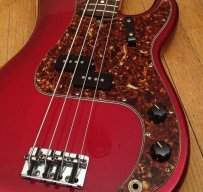
I always liked the aesthetics of the baII on a p or jazz bass so I decided to give it a try and it looked fabulous!:smug:

It sounded the same.:p

I must say I really like these bridges but it's because they look way more “badass” then an L plate, not because they sound any better.

To those of you pressing the op about his stance on the tonal changes involved, maybe you should consider that we are most likely dealing with placebo.

Placebo is a very, very powerful drug, it's been proven to do all kinds of crazy stuff.
I once read a story about a man with terminal brain cancer who was entered into a study for a new drug that would most likely save his life.

The guy had like a month to live going into the study.
Upon being fed sugar pills (aka placebo) for several years he continued to live.:)
Then his doctors eventually broke the news to him and his condition rapidly deteriorated and he died in the following months. :bawl:

Whats the moral here?
The moral is that if we keep telling the op that it makes no difference he may die!:eek:

~Samantha.:D
 
popcorn_10000.gif
 
I've put Badass II bridges on two of my basses back when they could be had for 50 bucks or so. I thought they improved tone and sustain but I was perfectly willing to admit that it might have been all in my head. I've since come to the personal conclusion that it really makes no difference.

I've left them on both basses because A) they certainly don't sound any worse and B) They say BADASS on 'em.

I am willing to remove them if anybody wants to offer me a ludicrous amount of money for them. :p
 
I've got BA'II's on both of my P's

Wither you like the sound of it or not is another story but I find it hard to believe anyone can say there is no difference between a badass & a stock L bridge.
Maybe it varies that much from bass to bass but on both of mine the difference was huge.

To tell the truth I don't like a Pbass as much without a badass on it.

Anything you do to a bass that changes the tone will change how you play it ... so of course changing the bridge effects playability.
 

Latest posts