
Enjoy the benefits of a premium membership!
Upgrade Account
-
TalkBass has been independent since 1998. Add your voice.
Create a free account to reply to discussions, view embedded media, and browse with fewer display ads.
Join free Log in
Want zero display ads or expanded classifieds tools? Compare plans.
You are using an out of date browser. It may not display this or other websites correctly.
You should upgrade or use an alternative browser.
You should upgrade or use an alternative browser.
Balanced string tension questions.
- Thread starter shawshank72
- Start date
More options
Who Replied?
- Sep 9, 2007
- 5,309
- 4,977
- Disclosures
- Endorsing Artist: Eventide, GHS Strings, G&L Guitars, NS Design, Tsunami Cables
I don't agree here. It's the length to thickness ratio, not the weight, that's the main contributor to the bright thin tone. The single wrap makes things worse though. The weight is the same for a pressurewound if you make it the right gauge, and you still get that improvement in tone. I think one would get similar results with a double wrap G, and it would be more marketable.
Yes and no. Making a compound wrap G is tricky, because in order to do it, you need to lower the core wire diameter as well as the final wrap to account for that extra cover that you're adding. And there is that point where the core wire (which really takes the brunt of the tension when tuned) is not going to hold up to that pitch and feel really loose, no matter how many covers are on it.

Yes and no. Making a compound wrap G is tricky, because in order to do it, you need to lower the core wire diameter as well as the final wrap to account for that extra cover that you're adding. And there is that point where the core wire (which really takes the brunt of the tension when tuned) is not going to hold up to that pitch and feel really loose, no matter how many covers are on it.
Don't make the core wire thinner.
Make the wraps really thin.

- Sep 9, 2007
- 5,309
- 4,977
- Disclosures
- Endorsing Artist: Eventide, GHS Strings, G&L Guitars, NS Design, Tsunami Cables
Don't make the core wire thinner.
Make the wraps really thin.
It won't work that way.
I've tried it.
Ah, OK.It won't work that way.
I've tried it.
Because it didn't sound right or because of durability problems?

Read my long post. Once a tradition has been set, it is very hard to change. Unless you are current Fender which has no institutional memory.So if even tension is a big deal, why don't all string manufacturers put out balanced sets period? Is it a cost thing? I'm not understanding as well as I should I guess.

- Sep 9, 2007
- 5,309
- 4,977
- Disclosures
- Endorsing Artist: Eventide, GHS Strings, G&L Guitars, NS Design, Tsunami Cables
Ah, OK.
Because it didn't sound right or because of durability problems?
A little of both. Not only does the tiny first cover have mixed results when the larger cover that's rollerwound is put on it, but it doesn't feel or sound as close as it was intended to be.
The only company I know that has done that is Thomastik-Infeld with one particular violin E string. And it turned out really strange. Depending on the instrument, it sounds either really, really good or really, really harsh.Don't make the core wire thinner.
Make the wraps really thin.
One thing not mentioned is that the core wire takes most of the tension stress, so if the core is too thin, the string won't be durable.
The only company I know that has done that is Thomastik-Infeld with one particular violin E string. And it turned out really strange. Depending on the instrument, it sounds either really, really good or really, really harsh.
This means Jon has to try the full size core with double wrap G again and send samples to all of us to evaluate on our instruments


So if even tension is a big deal, why don't all string manufacturers put out balanced sets period? Is it a cost thing? I'm not understanding as well as I should I guess.
just because we get used to "even sets", with differenced in .005" set to set.
many manufacturers make "odd" sets, using 43, 56, 68, 69, 89, 93, 104, 106, 107 and so on... Labella and Thomastik, for example, make almost only "odd" sets, which are more balanced, but everytime someone reads the gauges, he wonders why is not 45-105...
Fender used to make many "strange" sets, and people reading 45-60-80-95 thought it was strange, even without having used it.
"odd gauge?! I'll stick with my 45-105 and be sure!"
I know a lot of people that use only 45-105 strings, even from different sets, just because they are used to it. the best was a guy I met that used the standard gauge Rotosound Swing66 set, 45-65-80-105, and always bought a 85 A string to replace the 80. I asked him why, and he told me that he preferred that gauge. I asked if he noticed too much difference in tension, and he told me that he didn't ever used that 80, but always reaplced it with the 85...
for example, I find that the D'Addario 45-105 set is unbalanced, the GHS Bommers 45-105 set is way more balanced, the DR Hi Beam 45-105 has the A string too tight and the D too floppy, and so on for many sets.
but let's remember that probably the majority of players don't even know how to properly setup the bass, and are used to play with high action and bent neck... when you play that way, how could you even notice slight difference in tension?

I'm finding this thread fascinating, keep it up!
Also, for @Jon Moody, it looks like Bassics are "basically" Boomers that are tension balanced and have no silk. Any truth to that?
Also, for @Jon Moody, it looks like Bassics are "basically" Boomers that are tension balanced and have no silk. Any truth to that?

For me going from 80A to 105E was not to my liking.
So i decided on lighter gauge to get my balanced tension.
So i decided on lighter gauge to get my balanced tension.
- Sep 9, 2007
- 5,309
- 4,977
- Disclosures
- Endorsing Artist: Eventide, GHS Strings, G&L Guitars, NS Design, Tsunami Cables
I'm finding this thread fascinating, keep it up!
Also, for @Jon Moody, it looks like Bassics are "basically" Boomers that are tension balanced and have no silk. Any truth to that?
Bassically.
Originally when we still had mostly hand winding machines (and we still have a couple we use regularly), the Bassics were made on the first automated machine we had, so they tweaked the specs at the same time. So they were originally much different, but given the advent of technology, we built more machines and now both Bassics and Bass Boomers are run on the same machine, with just slightly different specs.
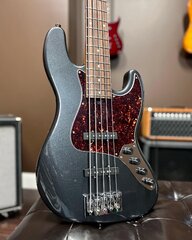
I don't know if it's the string tension, the tone, or some other factor, but I've used DR Sunbeams (45-65-85-105) for a long time, and love them. However, I recently put on a set of D'Aaddario balanced tension strings (regular light, 42 lbs) just to try the whole "balanced tension" thing. After trying them for two weeks, I've decided I'm not a fan. Is the tension from string to string more balanced than the Sunbeams? Definitely. But, for whatever reason, I still prefer the Sunbeams. So I just got another set of them to put back on.

I recently put on a set of D'Aaddario balanced tension strings (regular light, 42 lbs) just to try the whole "balanced tension" thing. After trying them for two weeks, I've decided I'm not a fan. Is the tension from string to string more balanced than the Sunbeams? Definitely. But, for whatever reason, I still prefer the Sunbeams.
I know what you're saying about the Sunbeams. Tension-balanced or not, they're one of the best-feeling rounds I've tried, thanks to their round-core suppleness and smooth texture.
This "balanced tension" thing is a fascinating topic, but at the end of the day, it's only one of the many factors involved in determining what feels and sounds best from a subjective standpoint. I try not to get too hung up on the numbers. (Not always easy for me as someone who lives and dies by the numbers.
 )
)
I know what you're saying about the Sunbeams. Tension-balanced or not, they're one of the best-feeling rounds I've tried, thanks to their round-core suppleness and smooth texture.
This "balanced tension" thing is a fascinating topic, but at the end of the day, it's only one of the many factors involved in determining what feels and sounds best from a subjective standpoint. I try not to get too hung up on the numbers. (Not always easy for me as someone who lives and dies by the numbers.
I'm a "live and die by the numbers" kind of guy as well. So my first instinct is to always go by statistics and measurements. I can't explain why, but I just love the DR Sunbeams more than any other string.
But, for whatever reason, I still prefer the Sunbeams.
try to make a set of singles Sunbeams like the D'Addario balanced tension.
on the DR I don't like the fact that the A string is too tight than the D string (in the 45-105 set). the 45-100 or 40-95 set is a bit more balanced for my tastes, but still not perfect.


