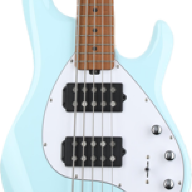
I’m pretty inexperienced with basses, but I just bought two new 5-strings. I’d like to get to know them really well and come to understand how they’re alike and how they’re different. I want to set them up and run them through identical string sets at the same time, for a few changes trying different strings as I go. I’ve decided to try a few DR sets, but a gauge and action question has come up.
Both are $1,099 five-string bolt-ons with roasted maple necks, nut width about 1-3/4”, 34” scales, top-loading bridges, active preamps. I’m keeping both in standard BEADG tuning for now.
The Charvel Pro-Mod San Dimas PJ V has a string spread of about 2.86” center-to-center at the bridge and is specified as a 12”-16” compound radius. The Sterling (by Music Man) RAY35HH is about 2.75” at the bridge and has a straight 12” radius.
Other than pickups and electronics, body shapes, one has 20 frets, the other has 22, the biggest differences to me as a player are the strings that came on them, and how it feels to play the top two strings. I want to set them up the same for a while, but I also wonder whether that would be counterproductive.
See, the set on the Charvel goes:
.045-.065-.085-.105-.125
That’s pretty gradual, and the jump between adjacent strings seems really natural and effortless. I like the string-to-string balance, and the low B does not sound like a joke.
The Sterling takes a different approach:
.045-.065-.080-.100-.130
I’m pretty sure they’re these:

Three things were interesting about this:
1.) First of all, the low B was a floppy, rattling mess. That seemed odd to me, since I thought that the heavier gauge would have more tension and not be floppy. But it was.
2.) I noticed that the bottom of that string down by the bridge was way closer to the body than it was for the E string next to it. I raised the B saddle - a lot - and it really did wonders for the rattling and made the whole string play drastically better.
3.) Raising the B so much accentuated something that you’re probably already thinking about: The diameter difference between the .100 E and the .130 B on the Sterling is 50% greater than the difference between the .105 E and the .125 B on the Charvel. After playing the Charvel for a while, switching to the Sterling makes for a jarring difference when I move between the B string and any other string. It sounds good, but it feels weird and awkward to play. It makes me think of the players who drill out the hole in a tuning post so they can put a bass string at the top of their 8-string guitars.
So, would it be pointless to try to set both these basses up with, say, a set like this?
.045-.065-.085-.105-.130
Would any normal person just set up each bass to play its best without worrying about whether a particular difference they noticed was due to the instrument or the strings and action? I don’t want to start developing nonsense ideas about the differences between two basses if I don’t know what those differences really are. I’m trying to pack a lot of solid learning into a short time, because I’m beginning to suspect that, like many people, I am not going to live forever.
I’m thinking about trying DR Nickel Lo-Riders, DR Pure Blues, and DR Sunbeams, if that means anything. How common is it to have a way bigger B string and raise the action to keep it from rattling? Could a different set of strings in the same gauges as what’s on the Charvel, work really well on the Sterling?
Both are $1,099 five-string bolt-ons with roasted maple necks, nut width about 1-3/4”, 34” scales, top-loading bridges, active preamps. I’m keeping both in standard BEADG tuning for now.
The Charvel Pro-Mod San Dimas PJ V has a string spread of about 2.86” center-to-center at the bridge and is specified as a 12”-16” compound radius. The Sterling (by Music Man) RAY35HH is about 2.75” at the bridge and has a straight 12” radius.
Other than pickups and electronics, body shapes, one has 20 frets, the other has 22, the biggest differences to me as a player are the strings that came on them, and how it feels to play the top two strings. I want to set them up the same for a while, but I also wonder whether that would be counterproductive.
See, the set on the Charvel goes:
.045-.065-.085-.105-.125
That’s pretty gradual, and the jump between adjacent strings seems really natural and effortless. I like the string-to-string balance, and the low B does not sound like a joke.
The Sterling takes a different approach:
.045-.065-.080-.100-.130
I’m pretty sure they’re these:
Three things were interesting about this:
1.) First of all, the low B was a floppy, rattling mess. That seemed odd to me, since I thought that the heavier gauge would have more tension and not be floppy. But it was.
2.) I noticed that the bottom of that string down by the bridge was way closer to the body than it was for the E string next to it. I raised the B saddle - a lot - and it really did wonders for the rattling and made the whole string play drastically better.
3.) Raising the B so much accentuated something that you’re probably already thinking about: The diameter difference between the .100 E and the .130 B on the Sterling is 50% greater than the difference between the .105 E and the .125 B on the Charvel. After playing the Charvel for a while, switching to the Sterling makes for a jarring difference when I move between the B string and any other string. It sounds good, but it feels weird and awkward to play. It makes me think of the players who drill out the hole in a tuning post so they can put a bass string at the top of their 8-string guitars.
So, would it be pointless to try to set both these basses up with, say, a set like this?
.045-.065-.085-.105-.130
Would any normal person just set up each bass to play its best without worrying about whether a particular difference they noticed was due to the instrument or the strings and action? I don’t want to start developing nonsense ideas about the differences between two basses if I don’t know what those differences really are. I’m trying to pack a lot of solid learning into a short time, because I’m beginning to suspect that, like many people, I am not going to live forever.
I’m thinking about trying DR Nickel Lo-Riders, DR Pure Blues, and DR Sunbeams, if that means anything. How common is it to have a way bigger B string and raise the action to keep it from rattling? Could a different set of strings in the same gauges as what’s on the Charvel, work really well on the Sterling?
Last edited: