
Enjoy the benefits of a premium membership!
Upgrade Account
-
TalkBass has been independent since 1998. Add your voice.
Create a free account to reply to discussions, view embedded media, and browse with fewer display ads.
Join free Log in
Want zero display ads or expanded classifieds tools? Compare plans.
You are using an out of date browser. It may not display this or other websites correctly.
You should upgrade or use an alternative browser.
You should upgrade or use an alternative browser.
Basic theory Question
- Thread starter Bassnninja
- Start date
More options
Who Replied?
Thanks for all the support guys. Compiling a bunch of stuff based on what you all posted, mixed with scotts, I should have enough to learn everything I need to learn.
Yes I would like to Re-learn note reading, I learned it way back in band back in high school, but like much everything else the ability was lost through the hustle and bustle of life...Is that the phrase..lol I will pick that back up at some point as well.
Now just gotta send back my new bass(other post), and pick out something a litttle more my style, though I thought that the trbx was my style, I was wrong...ahh well..
Yes I would like to Re-learn note reading, I learned it way back in band back in high school, but like much everything else the ability was lost through the hustle and bustle of life...Is that the phrase..lol I will pick that back up at some point as well.
Now just gotta send back my new bass(other post), and pick out something a litttle more my style, though I thought that the trbx was my style, I was wrong...ahh well..

Learning the notes of the fretboard and the corresponding numbers when practicing the shapes will be a huge help in understanding basic theory. For example, if someone says, "just play roots and fifths" knowing where the fifth is located in the scale shape is important 
Learning each note-- of each fret-- on each string-- can feel overwhelming. Being a visual learner, I put together a chart that helped me understand the fretboard, and maybe it will help you as well. The key here is to know that the blank areas in-between the notes are sharps & flats:
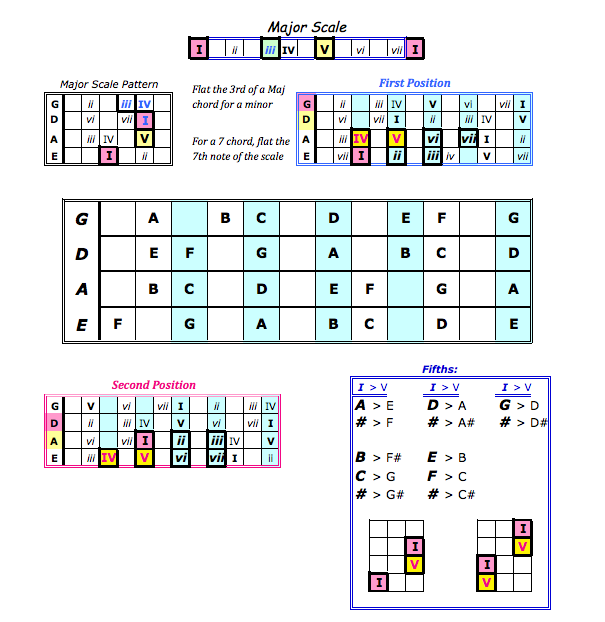
Learning each note-- of each fret-- on each string-- can feel overwhelming. Being a visual learner, I put together a chart that helped me understand the fretboard, and maybe it will help you as well. The key here is to know that the blank areas in-between the notes are sharps & flats:
That would be D major.For two weekd iv been slowelt try to learn some theory. I figured I should know it havinf played as long as I have. Iv been using scotts bass lessons website.
Heres my question.
C major scale. The pattern is C-Root then ,W W H W W W H
Tab:
A: 3 5
D: 2 3 5
G: 2 4 5
What happen when I apply the same Pattern to say a D root note two frets up?
A: 5 7
D: 4 5 7
G: 4 6 7
Is that a D major scale? Is it the Dorian mode of the C major scale? Is it something else entirely?
What I have been doing is applying that same pattern to every note in the C major scale up and down the fret board..Just trying to make dure im practicing wgat I THINK I know correctly.
You can apply that pattern to any of the 12 notes (counting enharmonic equivalences as the same note), not just the 7 notes of the C major scale.
For example if you slide the whole pattern up just 1/2 a step, that is the C# major scale, which has the same tones as the Db major scale. It is tempting to say C# major and Db major are the same scale/key, but turns out due to some intracate reasoning they are two different scales, but they are enharmonic equivalents. Which means they sound the same.
Modes are different patterns. I would focus on the major scale and learn a few different fingerings for it, really learn it before moving on. And I would learn triad and 7-chord construction before starting with modes and harmonizing the major scale.

Smooth_bass88
vaxx!
- Oct 31, 2006
- 12,122
- 16,793
- Disclosures
- have been on nationally released albums, charting on the Billboard 200
It always helps to know the actual notes as opposed to just the finger patterns.For two weekd iv been slowelt try to learn some theory. I figured I should know it havinf played as long as I have. Iv been using scotts bass lessons website.
Heres my question.
C major scale. The pattern is C-Root then ,W W H W W W H
Tab:
A: 3 5
D: 2 3 5
G: 2 4 5
What happen when I apply the same Pattern to say a D root note two frets up?
A: 5 7
D: 4 5 7
G: 4 6 7
Is that a D major scale? Is it the Dorian mode of the C major scale? Is it something else entirely?
What I have been doing is applying that same pattern to every note in the C major scale up and down the fret board..Just trying to make dure im practicing wgat I THINK I know correctly.
So you are realizing that scales, and chords as well, are actually collections of intervals - the distance between notes - moreso than collections of notes. The “pattern” is actually a pattern of intervals.
One reason learning the major scale cold is so important is because the names of the intervals come from the degrees of the major scale! A “major 3rd” is the interval between the first and third notes of the major scale - but it is an interval, which is important to remember. As such, the interval from the fifth note of the major scale to the seventh is also a “major 3rd”. Same interval: two whole steps, same as 4 half steps == major 3rd.
That example also alludes to a symmetry within the major scale, something called the “tetrachord”. Consider a major scale, for convenience I will use C major but since we are talking about intervals - the distances between notes - this is fully general.
Take C major and includ the octave, which is 8 notes: C D E F G A B C. The intervalic relationship of the first 4 notes, 1 to 4, is: W W H. This is exactly the same as the intervallic relationship of the last 4 notes, from 5 to 8, G up to the octave C: W W H. This pattern is the tetrachord. A major scale is
2 tetrachords separated by a whole step - the whole step from the 4th to the 5th degrees of the major scale. Just a glimpse of the harmonic symmetry that is embodied in the ubiquitous I, IV, V, I chord progression.
The intervals defined by the major scale are also important in the theory for building chords.
I would shed the heck out of the major scale before moving on. Learn some tunes where the entire bass line is covered by one major scale, like Clapton’s “Wonderful Tonight”, or Little Feat’s “Willin’”. Both have quite similar bass lines, especially harmonically similar. A trickier example would be Dire Strait’s “Sultans of Swing”, based on F major (really on D natural minor, but soon you will learn why F major and D natural minor are closely related - suffice to say for now the F major scale and the D natural minor scale have exactly the same notes: D C E F G A Bb C (D - octave).)
Remember the scales extend through all octaves up and down, we learn them within a single octave merely as a convention to simplify learning/teaching them.
One reason learning the major scale cold is so important is because the names of the intervals come from the degrees of the major scale! A “major 3rd” is the interval between the first and third notes of the major scale - but it is an interval, which is important to remember. As such, the interval from the fifth note of the major scale to the seventh is also a “major 3rd”. Same interval: two whole steps, same as 4 half steps == major 3rd.
That example also alludes to a symmetry within the major scale, something called the “tetrachord”. Consider a major scale, for convenience I will use C major but since we are talking about intervals - the distances between notes - this is fully general.
Take C major and includ the octave, which is 8 notes: C D E F G A B C. The intervalic relationship of the first 4 notes, 1 to 4, is: W W H. This is exactly the same as the intervallic relationship of the last 4 notes, from 5 to 8, G up to the octave C: W W H. This pattern is the tetrachord. A major scale is
2 tetrachords separated by a whole step - the whole step from the 4th to the 5th degrees of the major scale. Just a glimpse of the harmonic symmetry that is embodied in the ubiquitous I, IV, V, I chord progression.
The intervals defined by the major scale are also important in the theory for building chords.
I would shed the heck out of the major scale before moving on. Learn some tunes where the entire bass line is covered by one major scale, like Clapton’s “Wonderful Tonight”, or Little Feat’s “Willin’”. Both have quite similar bass lines, especially harmonically similar. A trickier example would be Dire Strait’s “Sultans of Swing”, based on F major (really on D natural minor, but soon you will learn why F major and D natural minor are closely related - suffice to say for now the F major scale and the D natural minor scale have exactly the same notes: D C E F G A Bb C (D - octave).)
Remember the scales extend through all octaves up and down, we learn them within a single octave merely as a convention to simplify learning/teaching them.

Ric5
Inactive
- Jan 29, 2008
- 29,772
- 30,452
- Disclosures
- I like 5, 8, 10, and 12 string basses
C major scale. The pattern is C-Root then ,W W H W W W H
none of my basses have a W or H no matter how I tune them
I thought I'd offer this after thinking about deleting it and not even posting but went through with it thinking it might help the op even though you're probably suffering from information overload already. This will be my last post about this.
Here's a suggestion (and definitely not the only way): use the websites I posted earlier to learn basic intervals first using a piano keyboard as a tool, after you do that and learn the note names on your instrument you can use interval formulas to build scales, then triads, then 7th chords etc. A good private bass instructor can help you with this stuff and committing it to memory will help.
Basic intervals using only the white keys of the keyboard:
all octaves are perfect
all unisons are perfect
all 2nds are major except for e-f, b-c which are minor
all 3rds are minor except c-e, f-a, g-b which are major
all 4ths are perfect except for f-b which is augmented
all 5ths are perfect except for b-f which is diminished
all 6ths are minor except for e-c, b-g, a-f which are minor
all 7ths are minor except for c-b, f-e which are major
as intervals are stretched larger by 1/2 steps they become augmented, contracted smaller by 1/2 step they become diminished. For ex. identify the interval C-E (it's one of the three exceptions so it's a M3), C-Eb (we know C-E without alteration is a M3 from the above chart but it's been contracted by a 1/2 step (Eb) so now it's a minor 3rd. Another thing, 2nd, 3rds, 6ths, and 7ths can be major, minor, augmented, or diminished. Octaves, unisons, 4ths, and 5ths can only be perfect, diminished, or augmented. So you can't have for ex. a major 5th or a perfect 3rd.
For ex. a major triad is built (in ascending intervals) Major 3rd (M3) + minor third (m3), a dominant 7th chord Mm7th chord) = M3 + m3 + m3, a major 7th chord M3 + m3 + M3 and so on. Get a basic college level theory textbook like any of the Kostka-Payne editions that cover basic theory fundamentals. Books by Chuck Sher, Rufus Reid, and Carol Kaye can be really helpful to apply this knowledge to the bass. Of course you can do everything by ear if you have a really good one.
Hendrix did pretty well without it but he had an unbelievable ear, sense of rhythm, and elite musical intuition. Having the combination of the two worlds (theory+ear) works best especially if you want to get work outside of just one band with your friends. You'll just be able to learn things faster and communicate with other trained musicians more easily. Good luck, just trying to help.
Here's a suggestion (and definitely not the only way): use the websites I posted earlier to learn basic intervals first using a piano keyboard as a tool, after you do that and learn the note names on your instrument you can use interval formulas to build scales, then triads, then 7th chords etc. A good private bass instructor can help you with this stuff and committing it to memory will help.
Basic intervals using only the white keys of the keyboard:
all octaves are perfect
all unisons are perfect
all 2nds are major except for e-f, b-c which are minor
all 3rds are minor except c-e, f-a, g-b which are major
all 4ths are perfect except for f-b which is augmented
all 5ths are perfect except for b-f which is diminished
all 6ths are minor except for e-c, b-g, a-f which are minor
all 7ths are minor except for c-b, f-e which are major
as intervals are stretched larger by 1/2 steps they become augmented, contracted smaller by 1/2 step they become diminished. For ex. identify the interval C-E (it's one of the three exceptions so it's a M3), C-Eb (we know C-E without alteration is a M3 from the above chart but it's been contracted by a 1/2 step (Eb) so now it's a minor 3rd. Another thing, 2nd, 3rds, 6ths, and 7ths can be major, minor, augmented, or diminished. Octaves, unisons, 4ths, and 5ths can only be perfect, diminished, or augmented. So you can't have for ex. a major 5th or a perfect 3rd.
For ex. a major triad is built (in ascending intervals) Major 3rd (M3) + minor third (m3), a dominant 7th chord Mm7th chord) = M3 + m3 + m3, a major 7th chord M3 + m3 + M3 and so on. Get a basic college level theory textbook like any of the Kostka-Payne editions that cover basic theory fundamentals. Books by Chuck Sher, Rufus Reid, and Carol Kaye can be really helpful to apply this knowledge to the bass. Of course you can do everything by ear if you have a really good one.
Hendrix did pretty well without it but he had an unbelievable ear, sense of rhythm, and elite musical intuition. Having the combination of the two worlds (theory+ear) works best especially if you want to get work outside of just one band with your friends. You'll just be able to learn things faster and communicate with other trained musicians more easily. Good luck, just trying to help.

Thanks! Of course I knew the 5 is on the next string down, same fret---but starting a scale on the A string (your second position) and then finding the rest of the scale on the E string never entered my mind. Guess I think up not down -
 - again thanks for calling this to my attention. Kinda opens up all kinds of opportunities.
Never thought what else this lets me do.

Last edited:

Thanks! Of course I knew the 5 is on the next string down, same fret---but starting a scale on the A string (your second position) and then finding the rest of the scale on the E string never entered my mind. Guess I think up not down -
Never thought what else this lets me do.
From the above post ^^.
View attachment 3866295
G major starting on the 2nd string; G, A, B, C then go down to the to the 3rd string for D, E, F#, G
Wow! Would have never seen that... Good to know.
We are risking going off topic a little, but as an extension of the concept, try this. All in one position, with no open strings other than the unavoidable open E in bar 6...
For a rock solid foundation on the fretboard learn C major scale from open E to B on the fourth fret of the G string, using only open strings and the first 4 frets. Play it slow enough to say or think the name of each note you play. As always when playing scales work on the notes sounding until the next note starts. And playing it as cleanly as possible.Modes are different patterns. I would focus on the major scale and learn a few different fingerings for it, really learn it before moving on. And I would learn triad and 7-chord construction before starting with modes and harmonizing the major scale.
Once you are comfortable with C, the next is the Gmajor scale. It has one sharp. Which is F#. Same procedure. Next is the key of D, with 2 sharps. F# and C#. Notice the root of each new scale is the fifth of the preceding scale. The sharps are added in the same method. This is the cycle of 5ths people have been talking about. If you just follow it round for 12 major scales you will have played every possible pattern of the major scale across 5 frets. In practice it would get confusing once you have added all seven sharps.
I have to cook the dinner now. And i know you won't have worked your way through All that before I'm finished. So I'll address the flat keys in another post. Unless someone else does it for me. I will say here though, that this exercise is the Swiss army knife of beginning bass. A good foundation in finger dexterity, note names and major scale theory.
I keep reading statements that learning all of the fingerboard is "overwhelming".
Come on!
If you take only the notes in the first octave, you have 4x13=52 notes (yes I know, there are 12 notes in an octave, but I count both the open string and the octave). That is as many as cards in a deck of cards, and I am pretty sure you know all the cards that are in a deck of cards, while you certainly did not spent any time trying to memorize them. Why? Because there is a system that is easy to understand and memorize, and a little playing is enough to learn that reliably. The 52 notes on the first octave of your fingerboard are also organized in a very simple system. So learning the fingerboard cannot be a big deal. If you are inclined to theory, buy a book, print a fretboard chart, and play and explore it. If you are allergic to theory, then open you ears and explore. Do that for a week, if you need that much time, and then you're done!
But I cannot get it that people say they have been playing for years and never got interested in exploring the possibilities of the instrument they use to practice their passion!
My 0.02€. (sorry for the rant).
Come on!
If you take only the notes in the first octave, you have 4x13=52 notes (yes I know, there are 12 notes in an octave, but I count both the open string and the octave). That is as many as cards in a deck of cards, and I am pretty sure you know all the cards that are in a deck of cards, while you certainly did not spent any time trying to memorize them. Why? Because there is a system that is easy to understand and memorize, and a little playing is enough to learn that reliably. The 52 notes on the first octave of your fingerboard are also organized in a very simple system. So learning the fingerboard cannot be a big deal. If you are inclined to theory, buy a book, print a fretboard chart, and play and explore it. If you are allergic to theory, then open you ears and explore. Do that for a week, if you need that much time, and then you're done!
But I cannot get it that people say they have been playing for years and never got interested in exploring the possibilities of the instrument they use to practice their passion!
My 0.02€. (sorry for the rant).
Love me a Thai red Curry.
So...if you follow the cycle of fifths adding one sharp at a time you come to the key of C#, commonly called Db. The last sharp you ad tomake a key with 7 sharps is B#, commonly known as C. Just as the previous sharp you added was E#. Or F. These are some of the enharmonics people have mentioned. They exist to keep the system consistent and it helps to think of them by their enharmonic name when used in that context. As mentioned above, we could continue around our cycle of fifths, making perfect sense to our ears. Instead, for the sake of the system we go back to C and begin the flat keys.
You might or might not be expected to practice C again at the start of the flat keys. I do because I'm largely self taught and shortcuts have never helped me with music. So after playing the c major scale from E to B and mentioning the note names again, we come to the key of F. Which has one flat, Bb. Every note from E to Bb up and down. Next comes the key of Bb, and the note that gets flattened to make it is Eb flat. You might notice we are now going the other way around the cycle. The root of the new scale is the 4th note of the previous one. And the flats are added in the same manner. Going round the cycle in this direction is sometimes called the cycle of fourths. And you can go all the way round to the key of Cb, including the note Fb.
If you count all the different scales you have practiced you will find you now know 15 scales. If you haven't already heard people talk about that in relation to reading music, you will. Once you can play all the scales, saying the notes as you go and being aware of the key you are in for each scale, you'll know how to play everything below the fifth fret. Where the cliche has it is where the money is. You can play all your modes in every key if you think about it. And you are well set up to learn to read.
There's lots more, like all the forms of minor scales and the rest of the neck. But you'll have made a comprehensive start.
So...if you follow the cycle of fifths adding one sharp at a time you come to the key of C#, commonly called Db. The last sharp you ad tomake a key with 7 sharps is B#, commonly known as C. Just as the previous sharp you added was E#. Or F. These are some of the enharmonics people have mentioned. They exist to keep the system consistent and it helps to think of them by their enharmonic name when used in that context. As mentioned above, we could continue around our cycle of fifths, making perfect sense to our ears. Instead, for the sake of the system we go back to C and begin the flat keys.
You might or might not be expected to practice C again at the start of the flat keys. I do because I'm largely self taught and shortcuts have never helped me with music. So after playing the c major scale from E to B and mentioning the note names again, we come to the key of F. Which has one flat, Bb. Every note from E to Bb up and down. Next comes the key of Bb, and the note that gets flattened to make it is Eb flat. You might notice we are now going the other way around the cycle. The root of the new scale is the 4th note of the previous one. And the flats are added in the same manner. Going round the cycle in this direction is sometimes called the cycle of fourths. And you can go all the way round to the key of Cb, including the note Fb.
If you count all the different scales you have practiced you will find you now know 15 scales. If you haven't already heard people talk about that in relation to reading music, you will. Once you can play all the scales, saying the notes as you go and being aware of the key you are in for each scale, you'll know how to play everything below the fifth fret. Where the cliche has it is where the money is. You can play all your modes in every key if you think about it. And you are well set up to learn to read.
There's lots more, like all the forms of minor scales and the rest of the neck. But you'll have made a comprehensive start.
For a rock solid foundation on the fretboard learn C major scale from open E to B on the fourth fret of the G string, using only open strings and the first 4 frets. Play it slow enough to say or think the name of each note you play. As always when playing scales work on the notes sounding until the next note starts. And playing it as cleanly as possible.
Once you are comfortable with C, the next is the Gmajor scale. It has one sharp. Which is F#. Same procedure. Next is the key of D, with 2 sharps. F# and C#. Notice the root of each new scale is the fifth of the preceding scale. The sharps are added in the same method. This is the cycle of 5ths people have been talking about. If you just follow it round for 12 major scales you will have played every possible pattern of the major scale across 5 frets. In practice it would get confusing once you have added all seven sharps.
I have to cook the dinner now. And i know you won't have worked your way through All that before I'm finished. So I'll address the flat keys in another post. Unless someone else does it for me. I will say here though, that this exercise is the Swiss army knife of beginning bass. A good foundation in finger dexterity, note names and major scale theory.
The organised way you presented the keys is the best way to go about this, although I would bring in F (1b) at the same time as 2#, along with relative minors.
Here's how I was taught the circle of fifths and how to generate the sequence of sharp keys from first principles (back in the dark ages).
1: The major scale is derived from a basic 4-note sequence called a 'tetrachord'.
2: The tetrachord used in the major scale has the interval pattern of tone, tone, semitone (T-T-S).
3: The major scale consists of 2 such tetrachords separated by a tone: "C, D, E, F" and "G, A, B, C"
4: To generate the next 'sharp' key, take the second tetrachord of any major scale and treat it as the first of the new key, then add another 'T-T-S' tetrachord on top, separated by a tone...
Excellent explanation, although you might have lowered the D and A scales by one octave, since among the people who need this information, many might be put off by 4 ledger lines on treble clef...The organised way you presented the keys is the best way to go about this, although I would bring in F (1b) at the same time as 2#, along with relative minors.
Here's how I was taught the circle of fifths and how to generate the sequence of sharp keys from first principles (back in the dark ages).
1: The major scale is derived from a basic 4-note sequence called a 'tetrachord'.
2: The tetrachord used in the major scale has the interval pattern of tone, tone, semitone (T-T-S).
3: The major scale consists of 2 such tetrachords separated by a tone: "C, D, E, F" and "G, A, B, C"
4: To generate the next 'sharp' key, take the second tetrachord of any major scale and treat it as the first of the new key, then add another 'T-T-S' tetrachord on top, separated by a tone...
View attachment 3866356
Excellent explanation, although you might have lowered the D and A scales by one octave, since among the people who need this information, many might be put off by 4 ledger lines on treble clef...
Thanks. I considered that, but on balance I thought leaving them as I did illustrated the point that the top half of one is the same as the bottom half of the next more forcefully. I also thought about using key signatures but thought that the accidentals again made the point more clearly.
The same idea applies to the flat keys. Place a T-T-S tetrachord a 5th below the current tonic and as if by magic a new flat appears (or a sharp gets removed) at the new subdominant.
Last edited:
Another hack for this kind of thing is to remember:The organised way you presented the keys is the best way to go about this, although I would bring in F (1b) at the same time as 2#, along with relative minors.
Here's how I was taught the circle of fifths and how to generate the sequence of sharp keys from first principles (back in the dark ages).
1: The major scale is derived from a basic 4-note sequence called a 'tetrachord'.
2: The tetrachord used in the major scale has the interval pattern of tone, tone, semitone (T-T-S).
3: The major scale consists of 2 such tetrachords separated by a tone: "C, D, E, F" and "G, A, B, C"
4: To generate the next 'sharp' key, take the second tetrachord of any major scale and treat it as the first of the new key, then add another 'T-T-S' tetrachord on top, separated by a tone...
View attachment 3866356
just sharp or flat all the notes the same number of times as the key switch
C#minor has 4 sharps
C# D# E F# G# A B
Cminor is C#minor if you flat all the notes a semitone
C D Eb F G Ab Bb
I found memorizing the circle of fifths easier than your method. My hack just was helpful so I had to memorize the one half and the other half was more automatic.
Another hack for this kind of thing is to remember:
just sharp or flat all the notes the same number of times as the key switch
C#minor has 4 sharps
C# D# E F# G# A B
Cminor is C#minor if you flat all the notes a semitone
C D Eb F G Ab Bb
I found memorizing the circle of fifths easier than your method. My hack just was helpful so I had to memorize the one half and the other half was more automatic.
What I describe isn't a hack, it is actually traceable to the roots of western music founded in ancient Greece.
Hack has come to mean anything that makes something easier. Your hack is still a hack to understand musical relationships. Thanks.What I describe isn't a hack, it is actually traceable to the roots of western music founded in ancient Greece.


