• TalkBass has been independent since 1998. Add your voice.
    Create a free account to reply to discussions, view embedded media, and browse with fewer display ads.
    Join freeLog in
    Want zero display ads or expanded classifieds tools? Compare plans.

Double Bass Bass Bridge Adjuster Help

jamesmboston

Guest
Feb 23, 2016
4
0
26
Hi,

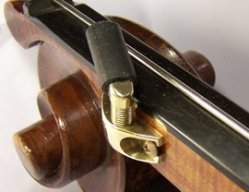
I have a Shen 3/4 bass with bridge adjusters. When I went to raise one of them, I was unable to turn the adjuster. When I would twist the adjuster, the foot moved with the adjuster. I believe that the adjuster is jammed, but I do not know how to successfully turn the adjuster. The other adjuster on the other side works perfectly fine. Any help would be appreciated. Thanks.
 
The best real solution is to remove the bridge (making sure not to drop the sound post), and then lubricate the adjuster threads with paraffin. When I had this problem, I made the mistake of lubing mine with a scented candle. Now my bridge smells of cinnamon, but the adjusters turn easily. :)
 
The best real solution is to remove the bridge (making sure not to drop the sound post), and then lubricate the adjuster threads with paraffin. When I had this problem, I made the mistake of lubing mine with a scented candle. Now my bridge smells of cinnamon, but the adjusters turn easily. :)

If I take the strings off while keeping the bass on its back, will the sound post be ok?
 
If I take the strings off while keeping the bass on its back, will the sound post be ok?

I'll let others with more knowledge describe the preferred method of not dropping the post. But the paraffin/candle trick was suggested to me by several luthiers here, and has turned out beautifully. I absolutely hate it when the bridge feet turn with the wheels, and that doesn't happen any more... even when I turn them with full tension on the strings.
 
  • Like
Reactions: Jake deVilliers
To hold the soundpost in place, people have often put a couple of heavy books on the top when laid on its back.

But please, only lay it on its back with the neck over the edge of the table.

IMHO, you shouldn't ever lay a bass on its back on the floor (and this includes when traveling) - most pegboxes extend further back than the bass back, so laying it down flat "triangulates" the pegbox and the body, with the shoulders lifted off the floor. So you'll be putting a lot of downward pressure on the neck joint; the neck actually acts as a lever and can really stress that joint. If you must lay it down on the floor on its back, put some pillows or other buffer under the shoulders to support them.

Another option for keeping the soundpost in place is to lay it on its "G" side - in this way, the soundpost can't really "fall" down since gravity would pull it towards a concave shape that gets thinner as it gets closer to the ribs.
 
...
IMHO, you shouldn't ever lay a bass on its back on the floor (and this includes when traveling) - most pegboxes extend further back than the bass back, so laying it down flat "triangulates" the pegbox and the body, with the shoulders lifted off the floor. So you'll be putting a lot of downward pressure on the neck joint...

Mark,
You are way overthinking this. Yes, you do add force on the neck joint if you lay the bass on its back with the back of the scroll resting on the table/floor, whatever, but compared to the force the string tension puts on it already, it is insignificant. Don't worry:) Be Happy:)
 
Mark,
You are way overthinking this. Yes, you do add force on the neck joint if you lay the bass on its back with the back of the scroll resting on the table/floor, whatever, but compared to the force the string tension puts on it already, it is insignificant. Don't worry:) Be Happy:)

Yes, I may be overthinking it, and I freely admit that I'm just another player like many of the rest of y'all, not a luthier or builder. I appreciate and respect your opinions on the matter. So don't take this as heated argument - it's definitely not! But I still personally consider it prudent to be safe rather than sorry.

As I mentioned above, the neck acts as a lever, which presents more pressure on that joint than just the simple weight of the bass, especially if you're working on the bass, leaning on it, that sort of thing (or it's absorbing the bumps and potholes in the back of the car).

And for another, you say "compared to the force the string tension puts on it" -- but actually these new downward forces are in addition to the force the string tension puts on it (if the strings are on the bass, of course).

And, it seems to my (mildly scientific) observations that these forces would be more direct on the dovetail joint than the string tension is. The neck/body joint is designed to hold the continuous stress of several hundred pounds of tension weight from the strings, sure -- but the angle of the strings (almost parallel to the neck) reduces the lateral forces of the strings to far less than the actual tension-weight of the strings, whereas the downward force of gravity when the bass is on its back is directly stressing the joint in a manner that is perpendicular to the neck.

To illustrate: a set of Helicore Hybrid Mediums has a tension of around 258 lbs., and an undamaged bass would have no issues having them on the bass. But I doubt that anyone here would be okay with the idea of taking the strings off their bass, and then laying it down flat and letting a 260 lb. dude stand on the neck joint.

Still, yes - you may be right, and I might be overstating it. It's just my opinion, and usual advice to customers -- but I'm open to correction. But considering as it's hardly a big hassle to simply brace the shoulders with something, an ounce of prevention, and all that, seems wise to me.
 
Overthinking? You wrote six paragraphs on this! Being in the position you are, I suppose that you need always to err on the side of caution. I say that if a neckblock joint failed, or any other related failure happened as a result of lying the bass on its back and scroll, then the failure was about to happen anyway. Think of the force a jazz player puts on the neck when she plays a low "F" whole note. It's gotta be at least ten times what the weight of the bass would create from being layed on its back. This force would be in the opposite direction, but I don't think that matters. I don't want to dis you for being cautious. Caution is good. But in this case, with respect, I think you are going a bit over the top.
Hope we're still friends-
Robobass
 
Overthinking? You wrote six paragraphs on this! Being in the position you are, I suppose that you need always to err on the side of caution. I say that if a neckblock joint failed, or any other related failure happened as a result of lying the bass on its back and scroll, then the failure was about to happen anyway. Think of the force a jazz player puts on the neck when she plays a low "F" whole note. It's gotta be at least ten times what the weight of the bass would create from being layed on its back. This force would be in the opposite direction, but I don't think that matters. I don't want to dis you for being cautious. Caution is good. But in this case, with respect, I think you are going a bit over the top.
Hope we're still friends-
Robobass
Sorry, but what huge force is it on the neck if a player plays a deep F?
 
Sorry, but what huge force is it on the neck if a player plays a deep F?
I can't think of an easy way to measure this, but I would say that when I am holding a low F for a whole note, the force would be equivalent to say, crushing a cockroach with all the force necessary to make sure it's dead. Does that help?
 
Overthinking? You wrote six paragraphs on this! Being in the position you are, I suppose that you need always to err on the side of caution. I say that if a neckblock joint failed, or any other related failure happened as a result of lying the bass on its back and scroll, then the failure was about to happen anyway. Think of the force a jazz player puts on the neck when she plays a low "F" whole note. It's gotta be at least ten times what the weight of the bass would create from being layed on its back. This force would be in the opposite direction, but I don't think that matters. I don't want to dis you for being cautious. Caution is good. But in this case, with respect, I think you are going a bit over the top.
Hope we're still friends-
Robobass

Ha ha ha! Ten times the weight ? That "she" jazz player must be named Ray Brown :)
 
To hold the soundpost in place, people have often put a couple of heavy books on the top when laid on its back.

But please, only lay it on its back with the neck over the edge of the table.

IMHO, you shouldn't ever lay a bass on its back on the floor (and this includes when traveling) - most pegboxes extend further back than the bass back, so laying it down flat "triangulates" the pegbox and the body, with the shoulders lifted off the floor. So you'll be putting a lot of downward pressure on the neck joint; the neck actually acts as a lever and can really stress that joint. If you must lay it down on the floor on its back, put some pillows or other buffer under the shoulders to support them.

In fairness to Mark, I've been told the exact same stuff above by several luthiers. Maybe it's advice on the lines of "better safe than sorry", but it makes sense to me.