• TalkBass has been independent since 1998. Add your voice.
    Create a free account to reply to discussions, view embedded media, and browse with fewer display ads.
    Join freeLog in
    Want zero display ads or expanded classifieds tools? Compare plans.

Bass-EQ + HPF - some questions

Not sure if it's better to post this here, or on the Amps/Cabs section, but this is something that I'm not sure how to think about, so would appreciate your inputs.

The bass-EQ point on most on-board preamps tends to be around 40Hz, with quite a wide band bandwidth.

At the same time, it seems to be TB-accepted-wisodm that HPF'ing things around 35-40 Hz is a good idea, with some suggestions for HPF'ing higher than that, around 50s-60s. According to this view - EQ'ing around 40Hz should essentially be boosting 'low end mush' which is bordelrine inaudible, and just cab-torture.

I'm not really sure how to square these two pictures, and/or how to best approach low-end EQ conceptually. I mainly play basses with a low-B (5s or 6s) and occasionally down-tune to low-A, so there should of course be 'fundamental' info below 40Hz as well.

Is there a particular reason why we don't see many pre-amps with 'bass' EQ's centered around 60 or 80Hz?
 
Not sure if it's better to post this here, or on the Amps/Cabs section, but this is something that I'm not sure how to think about, so would appreciate your inputs.

The bass-EQ point on most on-board preamps tends to be around 40Hz, with quite a wide band bandwidth.

At the same time, it seems to be TB-accepted-wisodm that HPF'ing things around 35-40 Hz is a good idea, with some suggestions for HPF'ing higher than that, around 50s-60s. According to this view - EQ'ing around 40Hz should essentially be boosting 'low end mush' which is bordelrine inaudible, and just cab-torture.

I'm not really sure how to square these two pictures, and/or how to best approach low-end EQ conceptually. I mainly play basses with a low-B (5s or 6s) and occasionally down-tune to low-A, so there should of course be 'fundamental' info below 40Hz as well.

Is there a particular reason why we don't see many pre-amps with 'bass' EQ's centered around 60 or 80Hz?



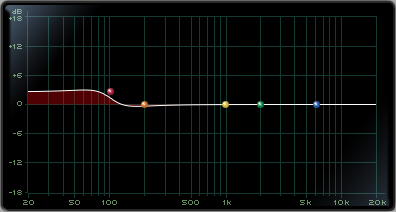
A Bass control is typically a shelving control.
Low-shelf-boost-shorter-q.png

This graph shows +3dB below about 70hz. So it' +3db at 70hz, 50hz, 40hz, etc. Some bass controls impact the sound up into the low mids.


High Pass Filters usually have a knee and then a constant slope.
upload_2023-5-8_2-33-19.png


The stated frequency is the point where response is down by 3dB. This is the knee or cutoff frequency. The slope is usually fixed at a certain rate per octave below the cutoff, 6dB/octave, 12dB/octave, 18dB/octave, 24dB/octave etc.

The HPF can be used many ways. With ported cabs, you typically tune the HPF to avoid sending excess power below the intended pass band of the cab.

The reason is because below the port tuning frequency (Fb) two things happen.
1. The cab's response falls off quickly. Typically I believe at something like 24dB per octave.
2. Cone excursion increases quickly.

Because of these two factors it does not make sense to send the cab power very much below Fb. The cab will be very inefficient and also mechanical power handling tends to drop of quickly because of the increase in excursion.

Take a look at this:
upload_2023-5-8_2-47-26.png


This 2512 is rated 250W RMS/500W Program, but notice this design is mechanically limited to 100hz with a steep HPF set to 40hz. Without the HPF, it would handle even less power.

Take a look at the frequency response plot and notice that it starts to roll off below about 80hz. Response is down -3dB by 58.7hz. By 20hz it's down about -29dB.

Not take a look at the excursion plot and notice it hits Xmax of 4.9mm a bit above 40hz.

The design is rated for 100W. If you are sending 100W and then apply a 40hz HPF, the power will be down to 50W at 40hz. Cutting the power in half = -3dB. If you use an HPF with a 24db/octave, I believe the 100W will be reduced to about 0.4W by 20hz.

Results of a properly aligned HPF: By reducing power below the cab's passband, you protect the woofer, increase power handling, increase headroom, and the sound will tend to be more focused and possibly even fuller.
 
Results of a properly aligned HPF: By reducing power below the cab's passband, you protect the woofer, increase power handling, increase headroom, and the sound will tend to be more focused and possibly even fuller.

Thanks for this detailed and thorough explanation of applications of the HPF filter - I think i now have a better understanding :)

What i'm still surprised/confused by is why do many (most?) on-board preamps (e.g. Aguilar) center/quote their 'bass boost' adjustments roughly around the same place where it seems like a good idea to 'hpf-them-away' to protect the cabinets and/or reduce the 'muddiness' of the tone.

Would it not be more effective/efficient to have the 'bass control' centered higher, with a narrower bandwidth? Or could it be that though the specs state that the boost is 'at 40Hz', it starts ramping up before that?

I know I can experiment with this using a parameteric bass eq (for example in my HX Stomp), but I guess I'm curious as to how the 'status quo' on oboard preamps came to settle at the 'bass adjustment' being that low.

(apologies if i'm not explaining my question very well).
 
With the sort of low-end roll-off that a lot of bass cabs have, boosting at 40 hz will have the effect of flattening out the mid-bass range, and offering a small bump in the upper-bass range, while leaving the sub-bass significantly reduced. A similar effect can be had when combining that 40 Hz bump with a high-passed signal.

Thanks for this explanation - this seems to make sense. Though - wouldn't it be more efficeint to have a mid-bass bump with a narrower bandwidth to begin with?
 
  • Like
Reactions: DJ Bebop
Thanks for this explanation - this seems to make sense. Though - wouldn't it be more efficeint to have a mid-bass bump with a narrower bandwidth to begin with?

Even with the eq flat, some power will be feeding very low freq information to the woofer....some of it will be unintelligible rumble to the ear and it'll make the woofer "work" harder.......I much prefer to trim that. Different rooms/spaces may suffer from very low freq rumble/mud at slightly different frequencies, so a variable HPF allows tailoring the low shelf to the room/ situation. I love being able to boost lows and low mids and then use my ear to adjust the low freq floor level. It lets me reliably dial a sound that's thick and full but clear. If you haven't experimented with a HPF, I suggest giving it a try. As compared to other pedals, they are not expensive; hearing is believing ;)
 
Sounds right, 40 hz isn’t the best.

Fender Rumble bass is 80 hz, as is Darkglass amps. GK has 60 hz. Ashdown is usually 100 hz; their ABM has 45 and 100, so you can set the low bass lower than high bass to be more defined, I did that with my Peavey mk4, 50 and 100 hz, also my car stereo at 63, 160. With the Fender I can set the low mid (at 280 hz) higher than bass to get similar effect. But… never used a HPF myself.

Fender Rumble tested:

upload_2023-5-8_9-19-5.jpeg
 
High Passing any instrument helps keep the mix clean and prevents your amplifier power from being taxed reproducing non-musical information.

In the case of a four string bass, the frequency of the low E is 40Hz. That is a reasonable play to high pass because transients containing info below that frequency are non-musical information. If you filter that part the non musical part of the frequency range, everything gets cleaner and amp is happier.

If you are playing a 5-string or are using drop tuning, you will adjust the filter point to the lowest frequency of the fundamental. In actuality, all cab's frequency response will fall off at the low end of the spectrum, but you want the fundamental frequency of the lowest note unfiltered. Below the fundamental, why drive your amp trying to reproduce what a cabinet and speaker will not?
 
Not sure if it's better to post this here, or on the Amps/Cabs section, but this is something that I'm not sure how to think about, so would appreciate your inputs.

The bass-EQ point on most on-board preamps tends to be around 40Hz, with quite a wide band bandwidth.

At the same time, it seems to be TB-accepted-wisodm that HPF'ing things around 35-40 Hz is a good idea, with some suggestions for HPF'ing higher than that, around 50s-60s. According to this view - EQ'ing around 40Hz should essentially be boosting 'low end mush' which is bordelrine inaudible, and just cab-torture.

I'm not really sure how to square these two pictures, and/or how to best approach low-end EQ conceptually. I mainly play basses with a low-B (5s or 6s) and occasionally down-tune to low-A, so there should of course be 'fundamental' info below 40Hz as well.

Is there a particular reason why we don't see many pre-amps with 'bass' EQ's centered around 60 or 80Hz?
A lot of people actually like their high pass more around 100hz.

Me, I just like rolling off the 20, and keeping everything else
 
Last edited:
Would it not be more effective/efficient to have the 'bass control' centered higher, with a narrower bandwidth? Or could it be that though the specs state that the boost is 'at 40Hz', it starts ramping up before that?

If it's a shelving control there is no center or peaking frequency. As I mentioned previously, a bass control could easily be tuned to reach well into the mids. So yes, it can start ramping up (or down) at a much higher frequency.

The best think to do, IMHO, is play around with the controls on your amp to learn how they change the sound. If you have two amps, they may both spec a 40hz bass control. But you may find that the shape and range of the filter is significantly different. This is pwrobably more likely than not.
 
With the sort of low-end roll-off that a lot of bass cabs have, boosting at 40 hz will have the effect of flattening out the mid-bass range, and offering a small bump in the upper-bass range, while leaving the sub-bass significantly reduced. A similar effect can be had when combining that 40 Hz bump with a high-passed signal.

This. And it's glorious :)

I 'discovered' it by accident a while ago and quickly started talking about it, only to find iy was a well known technique used by many: turn up the bass EQ and adjust the HPF upwards to remove the lowest of the low. It makes getting a fat bass with definition and mush-free quite easy with a little practice.
 
Ampeg V4B reissue OM lists +13dB and -12dB at 40hz for the bass control.

Here is the tested response from: Amp Lab – Ampeg V-4B | Bass Gear Magazine

My guess is 40hz is approximately where the shelving starts.
upload_2023-5-8_14-8-5.png


As you can see from the gray line, the amp has a built in HPF, so the response starts rolling off about 35hz. I believe the Bass control is a shelving filter, but the HPF shapes the response so this is not clear. The slope of the built-in HPF is pretty shallow.

The range of the Bass control appears to reach all the way up to about 800hz. At 200hz you get about +5dB and - 3dB.
 
Last edited:
  • Like
Reactions: kumimajava
As @Wasnex has said, the bass control is probably a shelving rather than peaking unit. It may be spec'ed at 40hz, but that doesn't mean that is a peak. That is just the frequency where the manufacturer made their calculations. And look at the graph just above this post to see that the shelving EQ affects frequencies as high as 200 Hz.

@Doug4321 posted measured responses from a Fender Rumble. That makes the low EQ look like it isn't a shelving EQ. Which I admit I think makes more sense but is not all that common?
 
Shelving eq’s are unique as the way the turnover frequency is defined is not at all standard. The frequency published is often where the maximum boost/cut occurs. Since these filters are typically first order, with 12 dB of boost at 40Hz would result in 6dB of boost at 80Hz and 3dB of boost at ~120Hz. This is why combining a shelving eq with a high order HPF can result in some particularly useful voicings.
 
Thanks for this explanation - this seems to make sense. Though - wouldn't it be more efficeint to have a mid-bass bump with a narrower bandwidth to begin with?
Not really. The interaction of the cut and boost produces a different curve than simply boosting at a higher frequency, and, as has been mentioned, provides girth without sacrificing definition.
 
  • Like
Reactions: kumimajava
There's the math and the graphs, and then there's the ears.
Setting your HPF and setting your bass knob may seem counter intuitive, but it is not. Just start with the HPF wide open, then pluck your lowest note and slowly raise the cutoff frequency. It should remove mud at first, and then at some point, start removing meat. Find the sweet spot where all it cuts is mud.
Season to taste with the bass knob(s).
The result is, to my ears, preferable to not having a HPF in place.
 
I was actually drawn to this thread because I just discovered that having a HPF (fdeck) with 12dbs /octave at 30hz and the second hpf at around 60-80hz while bumping the ampeg lows at 40hz give me a GREAT tone!

I think it creates an asymmetrical boost in the lows, bumping at 60-80hz wile cleaning the low end rumble!
 
  • Like
Reactions: kumimajava
There's the math and the graphs, and then there's the ears.
Setting your HPF and setting your bass knob may seem counter intuitive, but it is not. Just start with the HPF wide open, then pluck your lowest note and slowly raise the cutoff frequency. It should remove mud at first, and then at some point, start removing meat. Find the sweet spot where all it cuts is mud.
Season to taste with the bass knob(s).
The result is, to my ears, preferable to not having a HPF in place.

Yup, I have a Broughton always on HPF, it has no markings for frequency, you must use your ears. It really keeps me from overthinking it. There are basically 4 knobs on my pedalboard and amp that I touch every night: gain, master volume, bass and the HPF control. Bass and HPF really need to be tuned to the room.
 
  • Like
Reactions: kumimajava
Shelving eq’s are unique as the way the turnover frequency is defined is not at all standard. The frequency published is often where the maximum boost/cut occurs. Since these filters are typically first order, with 12 dB of boost at 40Hz would result in 6dB of boost at 80Hz and 3dB of boost at ~120Hz. This is why combining a shelving eq with a high order HPF can result in some particularly useful voicings.

Thanks for clarifying this. From the fact that many pre-amps state the 'bass frequency' i was thinking that it might be a typical 'bump' filter centered at that frequency. But as your comment and many other point out - if the bass is of shelving type, then thigs look different. So in fact pairing the bass 'shelving' filter with an HPF roll-off may in fact get closer to a (possibly asymmetric?) hi-bass bump of the kind i was thinking about.

Many thanks to everyone who's taken the time to respond, it's been very helpful.

I will, of course, keep experimenting 'with ears' also - I do have an HPF (Broughton & built-in into the BAmp), so will see where the journey takes me :)
 

Latest posts