• TalkBass has been independent since 1998. Add your voice.
    Create a free account to reply to discussions, view embedded media, and browse with fewer display ads.
    Join freeLog in
    Want zero display ads or expanded classifieds tools? Compare plans.

Bass set at 30hz?

I'm going to quote Charlie's post again here as it may help to understand using his graph with only one line on it, one control moving.

Along the bottom is the frequency in hertz. Frequency means just that...frequent....it's measuring how frequent the soundwave "cycles" in one second. 20 hertz is 20 times per second. 20 kilohertz, abbreviated khz, kilo meaning thousand, is cycling at 20,000 times per second. Some scientists who figured this out was named Mr. Hertz, so these "cycles" got labeled as "hertz", abbreviated Hz. The lower the frequency, the fewer cycles per second. The accepted range of normal hearing is from 20 to 20,000.


Up the left side of the chart is a "zero line". You can think of that as being "even", or "no effect". A flat line would mean no frequencies are being affected by the tone controls. Loudness is measured in decibels. On his chart, the bass control is turned up by 15 decibels, abbreviated as db. As you can see, the control is centered around 30hz, but "spills over" into much higher frequencies.

How much it spills over, or how wide a band of frequencies that surround the center of the control is the Q. Shown in the chart below is a parametric equalizer. This type of equalizer is fully adjustable in that you can adjust the frequency center being affected, how much you turn that frequency up or down, and how wide of Q is being used, meaning how far it spills over and affects frequencies around the center.


The lower the Q, the wider of a band of frequencies around the center get affected. All 3 lines are centered at the same frequency. The Q control adjust how wide the hump is.

Many bass amps have "semi-parametric" eq's, meaning you can adjust the amount of gain up or down, the frequency center being affected, but not the Q width. Many are fixed at 1 or 1-1/3 octave. An octave is a doubling or halving of frequency. From 30hz to 60hz is one octave, from 60 to 120 is another, etc. In that chart, the wide Q affects 3 octaves, the narrow Q affects 1/12th of one octave.

Hope this helps.

^ Very nice simple layman's explanation of the very basics of this. :)
 
and what type of filters does the Puma 500 have(old version)

At least quite likely a 6dB/oct slope like the Baxandall.
I have never seen something like 12dB/oct (or greater) for music instrument tone stack application.
IMO a 12dB/oct slope (or greater) would not sound pleasantly because the bass boost would focus only on a couple of lower notes whereas all upper notes remain nearly flat.
However any HPF/LPF application would be a different animal and needs at least 12dB/oct to provide practical appeal.

Funny story,
a couple of weeks before I bought a used Spector which came with an EMG BTS control. The BTS treble select-switches was set to factory setting and therefor the center for the bass set to very low like something around 30Hz.
I was not happy at all not either with Treble nor Bass reinforcement. So like many others did it before me I considered to swap the BTS. Fortunatelly I did rembember on the BTS feature which provides a Treble response pre selection.
I did it and, as well as the Treble response changed it's nervous attachment into a smooth brightness, so as well the Bass boost changed from a boomy overload of the lows into a very pleasant deep and full response.

EMG does not mention something about this behavior of their product anywhere but, any tweaking of the treble response impacts the bass response as well. So I saved lots of bugs and saved lots of time instead of figure out which electronic works best with that spector.
 
Thisbass, that is some cool info on your Spector.

Makes me wonder why the factory preset is the less "musical" one. Or why they didn't change the preset to the one more customers like after getting some feedback from sales.
 
Thisbass, that is some cool info on your Spector.

Makes me wonder why the factory preset is the less "musical" one. Or why they didn't change the preset to the one more customers like after getting some feedback from sales.

Tastes change---there is a thread going on over in the Amps forum about how to mod your SWR amp to remove the distinctive 80s/90s "SWR sound." That scoopy mid-cut tone just isn't as popular these days, I guess.
 
Tastes change---there is a thread going on over in the Amps forum about how to mod your SWR amp to remove the distinctive 80s/90s "SWR sound." That scoopy mid-cut tone just isn't as popular these days, I guess.

I did that mod to my SM400S and quite liked it. Didn't last very long as shortly after the preamp went bad. Don't think I hurt anything doing the mod, it was starting to have problems before I did it, but while it worked, it did make the amp a whole lot beefier, stronger sounding. Less like a SWR, more like an Eden or something along those lines.

I need to fix it and use it some more. There is some small signal shorting somewhere, like a small cap discharging to ground that isn't supposed to. Power section is good. I keep it now as a backup power for PA stuff.

That baked in scoop in the lowmids, in combination with no highpassing on the low end is what got them labeled as underpowered.
 
Tastes change---there is a thread going on over in the Amps forum about how to mod your SWR amp to remove the distinctive 80s/90s "SWR sound." That scoopy mid-cut tone just isn't as popular these days, I guess.

To add.....

Before I did the mod, I used to use the bass control and first two midsweeps to create a poorman's HPF of sorts, cutting the extreme lows all the way down, putting the bass back in up 60-80hz where I could make use of it, then adding a huge boost centered 200-300hz. Used up 3 knobs to "un-SWR" the sound. Luckily, there are 3 more to use for general tone adjustments. :)
 
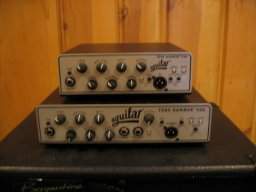
Can't wait to hear my Tecamp Puma 500 with the PowerSoft amp... I hope it pairs up well with my CN212... I know it has a slightly warmer and rounder tone than the newer version with the ICE power unit, but I'm a finger picker so I think it's going to work for me... and I have a bit more understanding about filters. Thanks to all... To the person who thought it was sneakers. lol This is what it looks like.
 

Attachments

  • Puma 500 front.JPG
    Puma 500 front.JPG
    56.5 KB · Views: 63
Thisbass, that is some cool info on your Spector.

Makes me wonder why the factory preset is the less "musical" one. Or why they didn't change the preset to the one more customers like after getting some feedback from sales.

I was wondering myself too just this moment.
We all know about the USA made Spectors, they come with the USA 9V circuit, and they provide a very unique growl.
IMO there are two essential parameters which fit perfect on these USA made instruments.The one parameter is the design of the bass and treble response coming out of the circuit, the other essential parameter is the tonal response of the Pau Ferro fretboard (in germany also called Rio Palisander).
Both parameter fit perfect in combination.

The CR made basses come with a rosewood fretboard which provides a distinct different tonal response then Pau Ferro.
IMO the USA 9V circuit is not a good choice for the CR made instruments. The CR basses provide more "natural" brightness due to the rosewood fretboard, and therfore demand a smoother tonality on treble boosts. To tell it in different words, the CR models provide already in flat EQ setting what my USA made bass does by boosting with the Treble knob.

I love them both the same way, that means both my USA made and my CR. The tone response of each instrument is different and as well the on board circuit on each one is different, but each parameter, instrument itself and circuit fit perfect as a whole.
I can't imagine to swap any circuit, cause I don't like to change a winning team!

The BTS in factory setting does a different response.
The treble response comes closer to the USA 9V, whereas then the bass response is a typical deep (boomy) one, I'd assume around 30Hz corner.
 
At least quite likely a 6dB/oct slope like the Baxandall.
I have never seen something like 12dB/oct (or greater) for music instrument tone stack application.
IMO a 12dB/oct slope (or greater) would not sound pleasantly because the bass boost would focus only on a couple of lower notes whereas all upper notes remain nearly flat.

In my experience it can sometimes sound pretty good: [Invalid or Expired Link Removed]. I didn't end up keeping the one I tried though.

I think the Alembic Series onboard preamps may be like that too. Same for the VCFs in many synthesizers, although calling that a tone stack may be a stretch.
 
Can't wait to hear my Tecamp Puma 500 with the PowerSoft amp... I hope it pairs up well with my CN212... I know it has a slightly warmer and rounder tone than the newer version with the ICE power unit, but I'm a finger picker so I think it's going to work for me... and I have a bit more understanding about filters. Thanks to all... To the person who thought it was sneakers. lol This is what it looks like.

Fabulous head. Yes, it is VERY big down low. You would again use that 30hz shelving to 'possible' slightly cut, but for the most part, when I had this head, I never touched it.

A little bit of the 'taste' filter goes a long way. I never touched it myself, but it is a nice, simple way to either roll off highs and boost mid mids turned one way (designed to bring out the woody mwaw of a fretless bass) or to roll off top end and eventually mids when turned the other way, going from muted Motown to pure dub. Sounds best set right in the middle to me (off).

The low mid control is the thing on this amp. It is the FAT control... burps the head up nicely if you want that. And the upper mid control is voiced perfectly (I believe centered at around 800hz) to take a bit of gank our of your top end when cut, or to add a bit of aggressive brightness when boosted.

Again, a VERY little bit goes a very long way with the EQ and filter.

Also, remember that both the input gain and the master are some form of audiotaper pots. This means they give a much more linear response to perceived output, resulting in lots of nice, even adjustment, but also requiring the knobs to be cranked more to reach full power than most other heads.

Enjoy, GREAT sounding amp.... deeper creamier and smoother than the current Puma (for better or worse depending what you want). Sounds great set flat with that Berg IMO and IME!
 
Found this..

-T1366202871T-1016-tecamp_puma_500.jpg


  • Preamp: solid state preamp with gain, taste, lo, lomid, himid, hi, master controls, switchable mute, DI pre/post, XLR balanced DI out, serial effects loop, tuner out, line out, line in
  • Output RMS: 500 w (4 ohms), 300 w (8 ohms)
  • Power Amp: Class D
  • Power Consumption: 600 w
  • Outputs: Speakon® combo connectors with ¼“ jack
  • DI Out: balanced, pre/post switchable
  • Dimensions: (W x H x D):
    27 cm x 4,4 cm x 21 cm / 10.7" x 1.6" x 8.3"
  • WEIGHT: 1,35 kg / 2.2 lbs
Link Removed

The EQ Low control is set at 30Hz +/- 15dB

The EQ Lowmid is set to 250Hz
To get the sound I like I would probably give some boost with the 30Hz knob and then adjust with the 250Hz for sufficient growl in tonal reinforcement.
Although I know that 2 knobs like that can't take place exactly into single 1 knob control which boosts around 50..60Hz corner. By the other hand, I'm pretty sure that the puma design engineers did the very best to provide a EQ section that fits as good as possible to most of all needs.

Again, a 80Hz shelf EQ (Low control knob) set to +10dB does at least the same amount of boost at 25Hz like a 30Hz shelf EQ (Low control knob) set to +10dB.

1) However a 80Hz EQ set to +10dB runs significant more power out of the system then a 30Hz EQ set to +10dB.
That means that a 80Hz shelf bass boost of +10dB is louder then a 30Hz shelf bass boost of +10dB.
2) Human ears are less sensitive to low frequencies which means that additional power will be needed at lower frequencies for same loudness.

IMO these 2 points are the main reason why shelf filters with extremely low centers/corners become dangerous to the gear sometimes.
 
The EQ Lowmid is set to 250Hz
To get the sound I like I would probably give some boost with the 30Hz knob and then adjust with the 250Hz for sufficient growl in tonal reinforcement.
Although I know that 2 knobs like that can't take place exactly into single 1 knob control which boosts around 50..60Hz corner. By the other hand, I'm pretty sure that the puma design engineers did the very best to provide a EQ section that fits as good as possible to most of all needs.

Again, a 80Hz shelf EQ (Low control knob) set to +10dB does at least the same amount of boost at 25Hz like a 30Hz shelf EQ (Low control knob) set to +10dB.

1) However a 80Hz EQ set to +10dB runs significant more power out of the system then a 30Hz EQ set to +10dB.
That means that a 80Hz shelf bass boost of +10dB is louder then a 30Hz shelf bass boost of +10dB.
2) Human ears are less sensitive to low frequencies which means that additional power will be needed at lower frequencies for same loudness.

IMO these 2 points are the main reason why shelf filters with extremely low centers/corners become dangerous to the gear sometimes.
Only dangerous if you don't use your ears and common sense.
 
In my experience it can sometimes sound pretty good: [Invalid or Expired Link Removed]. I didn't end up keeping the one I tried though.

I think the Alembic Series onboard preamps may be like that too. Same for the VCFs in many synthesizers, although calling that a tone stack may be a stretch.

If I read carefully enough it is 12dB/oct for HPF and/or LPF application, which I mentioned already as minimum (see post above).

edit:
by the way isn't it the steep slope beyond resonant peak that gives a pickup it's unique musical flavour?
 
Yes, but in this case that is used as the tone stack. ;)

see edit of post above ;)

But again HPF and LPF are different animals.
All of the spectrum below HPF corner and beyond LPF corner may be considered as obsolete (very very rough words).

Whereas a shelf low boost or treble boost coming with 12dB/oct that hits abrupt onto a given shelf-level?
No doubt about it that it could be someones best choice, however I have never seen a 12dB/oct shelf for instrumental application.
 

Latest posts