Find a way to tilt the cabs towards your head and not your back. You'll hear yourself then.

TalkBass has been independent since 1998. Add your voice.
Create a free account to reply to discussions, view embedded media, and browse with fewer display ads.
Join free Log in
Want zero display ads or expanded classifieds tools? Compare plans.

It is virtually inaudible from 20 feet away. No problem with the neighbors, or cranky soundmen either.
The transducer is a lead weight that creates a vibration of the platform giving the concussive feel of very loud speakers. When balanced with IEM it gives the sensation like you are in front of several SVTs. The wattage is needed to move the weight.
Having done a a little research on Bassboard multi-driver platform, they are rated a 600 watts. The Buttkicker was a larger platform and had a single driver.
But to your point, as it aged after15 years the platform got a little buzzy as the shock mounts showed signs of wear but nothing more annoying that a drum snare rattle.


In my experience the best way to solve that is to move around a bit to find a sweetspot and THEN resort to eq if it's still necessary. Especially if any of the eq'd signal goes to FOH (which it will unless you only send a clean, pre-eq DI signal to FOH). Sending a heavily eq'd "room corrected" signal to the mixing desk is rarely a good idea.



For these examples, both indoors. But I have experienced the same type of differences outdoors. When I'm on a wood stage, it sounds and feels great; when I'm on concrete, I can barely hear myself. In my examples, the concrete "stage" was just some floor space in the venue. The floor had some sort of faux or maybe real wood flooring, but the foundation was concrete.are both situations indoors or outdoors? I find most concrete stages tend to be outdoors and vice versa

It probably does have to do with your eq - I usually set mine fairly flat but when I’m on a resonant stage (ie hollow with usually wood on top) I tend to roll off the bottom similar to what you have going on. Each room is different so I start fairly neutral and roll off some bass if the room is too boomy or mushy sounding.For these examples, both indoors. But I have experienced the same type of differences outdoors. When I'm on a wood stage, it sounds and feels great; when I'm on concrete, I can barely hear myself. In my examples, the concrete "stage" was just some floor space in the venue. The floor had some sort of faux or maybe real wood flooring, but the foundation was concrete.
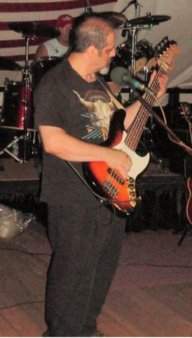
All 4 bands are cut in this picture I think. that's not good for cutting through.
Why are you cutting all your mids and lows? If those EQ settings are what you use, they might be the problem right there. You won’t need as much volume when your EQ is properly set up.

I also notice the "contour" switch is up... isn't that also a mid-scoop?
I guess I need to dig into it a bit more. I know while Buttkicker still makes the transducers, they no longer make the platforms. I wasn’t aware there were other manufacturers. Thanks for your response.
The Buttkicker brand isn't the only option... I've experimented with different transducers in making my own bassboard platform.

The Buttkicker brand isn't the only option... I've experimented with different transducers in making my own bassboard platform.
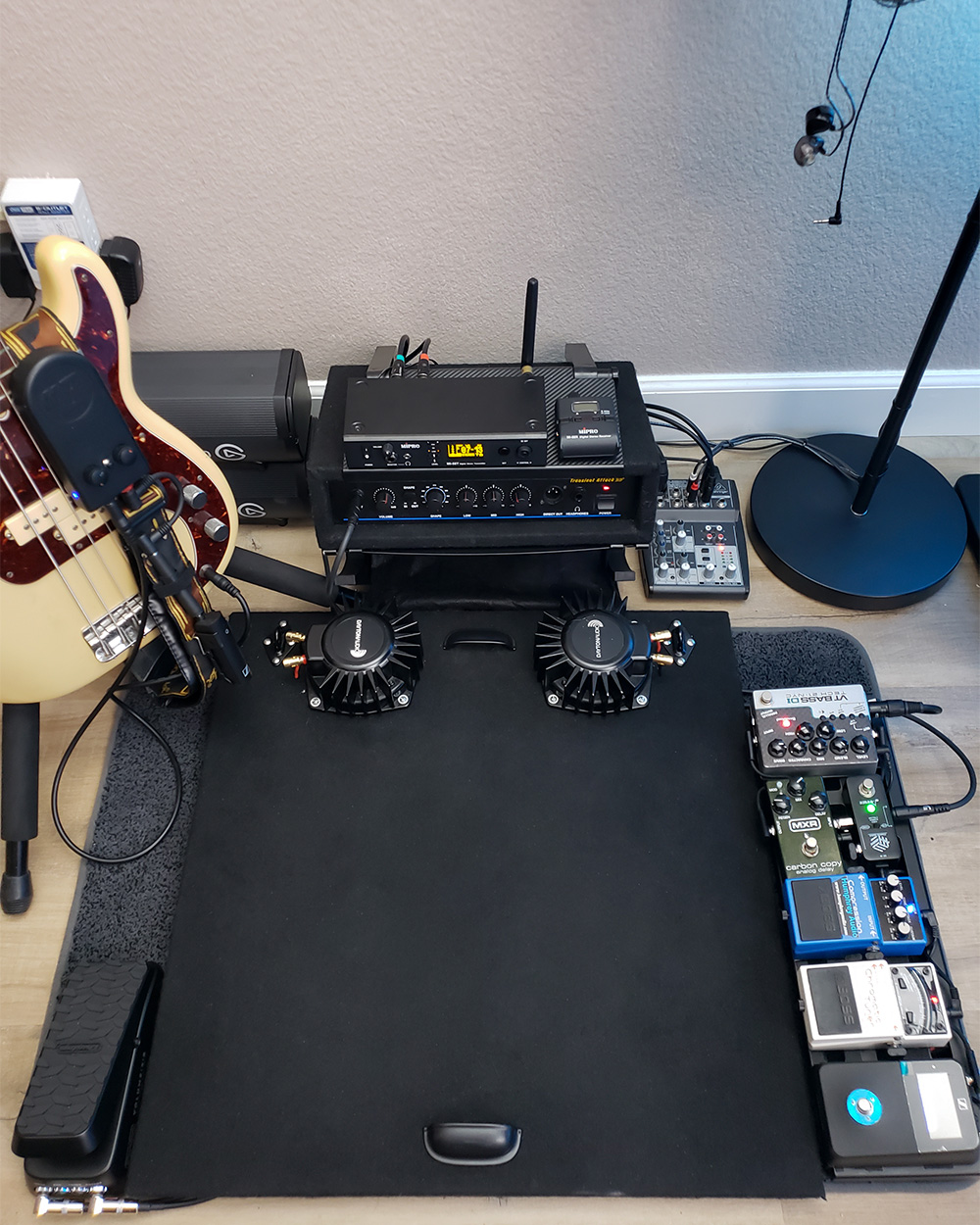
I've bought Buttkickers, AuraSound AST-2B-4, and Dayton Audio BST-1 transducers. Not sure if I got a bad buttkicker. It worked good, but it was noisy compared to cheaper options. I've tried different sized boards... using plywood and mdf because I can get larger size boards for less. I finally got the combo that worked best for me. 24"x24" ply with 2 Dayton BST-1 transducers (less than $100 at the time) in series with rubber feet. It worked great for me... but wasn't perfect... yet. Since the board doesn't always sit flat from moving around on the board, I use 24"x35" carpet... and it perfectly fit the board, and volume/pedalboard. This helped a lot no matter where I stood on the board.
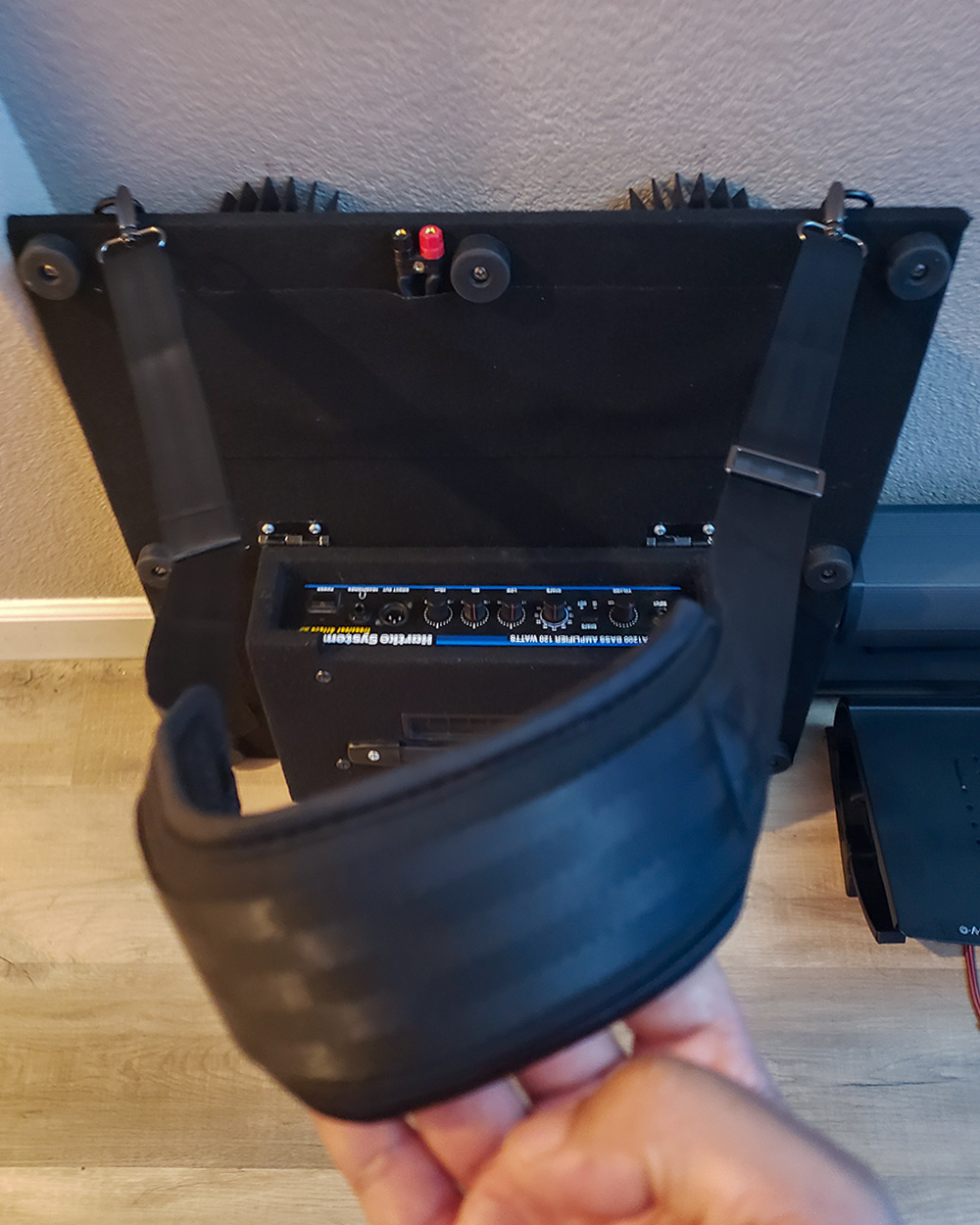
After I got feel I was satisfied with, I covered the board with speaker box carpet. Then I put a removable hinge on the bottom to attach my bass head for ease of transporting. The weight wasn't bad, but it was hard to carry, so I installed handles. That helped, but still hard on the fingers... so I put hooks next to the transducers so I can attach a heavy duty strap to carry it around my shoulders. Everything in the pic below (minus the 4 channel mixer that I use for home silent practice), can be carried in one trip... with a free hand for coffee.
Playing on a silent stage for the first time was different... but I love tech and experimenting... and this is how my silent stage setup evolved. I'm not sure what I'll experiment with next... but for now... this setup is near perfect for me... and the immersion makes playing on a silent stage so much fun. Ohhh... and I also use a BackBeat with my setup. Sometimes I'll input FOH on my BackBeat so I can feel the drum kick and snare. Here are some pics of my setup...

2) If you don't have to tweak your amp regularly, reverse your rig. Put the rack on the ground. Then stack your two cabs VERTICALLY on top of it. (If that makes you queasy just set the rack to one side and stack the cabs on the ground/stage.) But make sure you stack them vertically. In other words, do it like this. It will make all the difference in the world in how you hear your rig.
So I'm finding that at certain venues, I can't hear my cab very well on stage - even at volumes that I'm asked to turn down from. It's hard to determine why this happens when at some places, I get to enjoy a nice full sound that feels too loud on stage, but is fine in the mix.
I always use one or two 210 cabs that sit on a metal amp stand so my cabs are somewhat isolated from the "stage". Some variation of this:
View attachment 4812329
This weekend I played two gigs; first was in doors on a floor that had some synthetic "wood" on concrete. Could not hear a thing all night. Yesterday I played indoors on a wooden platform stage, and it was a great big enjoyable sound.
I got to thinking that perhaps the "stage" being hollow and wooden helps this (I can feel the bass in my feet). It seems the stand is transferring some energy to the floor, which I was not expecting.
So first is there any truth to this "theory", that a wooden stage helps boost the bass output?
If so, could I accomplish some of that benefit by building a little hollow box for under my stand - or would it need to be bigger than I'd want to manage for it work?
Thanks