• TalkBass has been independent since 1998. Add your voice.
    Create a free account to reply to discussions, view embedded media, and browse with fewer display ads.
    Join freeLog in
    Want zero display ads or expanded classifieds tools? Compare plans.

Bass String Frequencies

BaileyMan

Supporting Member
Jan 8, 2012
1,739
2,121
Oly Pen
I was looking for a chart that had the frequencies of each note on the bass. Wanting to know which range I want to dial in on the EQ. Of course, the ear is really the best tool for that, and of course there are all of the overtones that really make the notes come alive, but I wanted a general guide for the frequency ranges along different parts of the neck on different strings.

I created this chart for a 5-string bass (sorry 6-stringers) and only up to the 15th fret. I rarely play beyond the 15th fret and was more interested in frequencies up to the 12th fret or so.

Here's the link. I think you ought to be able to download it [Invalid or Expired Link Removed]:
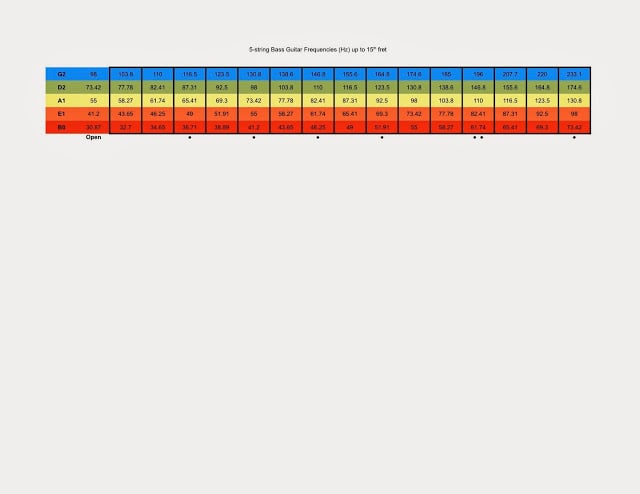

Bass%2520Frequencies.jpg
 
Fyi

Frequencies can be calculated as follows.

Remember A std is 440 hz and bass low E is around 40 hz. So bass low A is around there. Get lower A frequencies by dividing by 2: 440, 220, 110, 55. So the low A is 55 hz.

To get Ab divide 55 by 2 raised to the 1/12 power .

To get G, divide again by that ratio.
Etc.
To get A#, multiply by 2 to the 1/12 power.

Etc.

Do this in an Excel spreadsheet.

Enjoy
 
Fyi

Frequencies can be calculated as follows.

Remember A std is 440 hz and bass low E is around 40 hz. So bass low A is around there. Get lower A frequencies by dividing by 2: 440, 220, 110, 55. So the low A is 55 hz.

To get Ab divide 55 by 2 raised to the 1/12 power .

To get G, divide again by that ratio.
Etc.
To get A#, multiply by 2 to the 1/12 power.

Etc.

Do this in an Excel spreadsheet.

Enjoy
Thank G-d for Excel!
 
I was looking for a chart that had the frequencies of each note on the bass. Wanting to know which range I want to dial in on the EQ. Of course, the ear is really the best tool for that, and of course there are all of the overtones that really make the notes come alive.

In fact, the brain will fill in if provided with overtones. This gets hashed to death in amps and cabs, with folks using fdeck's HPF to remove problematic lows on the one hand and folks that are sure their system has to be pumping out full power at 30 Hz to let the low B be heard on the other.

My particular choice of amp has a built-in crossover that serves as an HPF (and/or LPF) and so I tried it for myself, having modeled the speaker and cab as much as I could and found that it would evidently be remarkably easy to blow at ~70 Hz, even with the limited power of the amp. Full frequency - smack E1 (I have a 4, not a 5) hear note, lots of things in the room vibrate. Crossover at 125 hz as HPF (taking out first and second harmonic) - hear note, sounds pretty similar, but things stay on the shelves, for the most part. As it happens, that's also the point where my modeling indicated that you could crank it all the way up without bothering the speaker. On that amp, if you had some serious sub amps and subs you could then patch the low out to those and vibrate the walls if you wanted, but I was convinced by the experiment that it makes more of a difference to the feel than the sound (and I had not expected that result until I tried it for myself.)

As such, the fundamental may not be what you really need to pay attention to in eq-ing, especially if a room or stage has nasty resonances you need to avoid that fall in that range. Likewise, taking too much out of the mids affects the perception of the lows.
 
In fact, the brain will fill in if provided with overtones. This gets hashed to death in amps and cabs, with folks using fdeck's HPF to remove problematic lows on the one hand and folks that are sure their system has to be pumping out full power at 30 Hz to let the low B be heard on the other.

My particular choice of amp has a built-in crossover that serves as an HPF (and/or LPF) and so I tried it for myself, having modeled the speaker and cab as much as I could and found that it would evidently be remarkably easy to blow at ~70 Hz, even with the limited power of the amp. Full frequency - smack E1 (I have a 4, not a 5) hear note, lots of things in the room vibrate. Crossover at 125 hz as HPF (taking out first and second harmonic) - hear note, sounds pretty similar, but things stay on the shelves, for the most part. As it happens, that's also the point where my modeling indicated that you could crank it all the way up without bothering the speaker. On that amp, if you had some serious sub amps and subs you could then patch the low out to those and vibrate the walls if you wanted, but I was convinced by the experiment that it makes more of a difference to the feel than the sound (and I had not expected that result until I tried it for myself.)

As such, the fundamental may not be what you really need to pay attention to in eq-ing, especially if a room or stage has nasty resonances you need to avoid that fall in that range. Likewise, taking too much out of the mids affects the perception of the lows.

Sure, the brain can fill in some of the missing pieces, and I agree that, in the end, it's all about what sounds good much more so than relying on numbers from a chart. However it's been helpful for me to know what the frequencies of the fundamentals are for honing in on which frequencies or frequency range to adjust when tweaking things, either live or recorded.