• TalkBass has been independent since 1998. Add your voice.
    Create a free account to reply to discussions, view embedded media, and browse with fewer display ads.
    Join freeLog in
    Want zero display ads or expanded classifieds tools? Compare plans.

Bass won't string

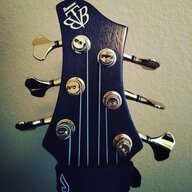
I have an older G&L L2000 currently strung up with Curt Mangan's. I like these strings a lot but they are rounds and have been on there for about 7 months. Whenever I try to put new strings on my G&L they all end up sliding out of the tuner.

It doesn't grasp on to the ends on any other strings except this particular set of 7 month of old nickel rounds. What do you think the problem is? What should I do? Should I just take it to a tech?

I understand if I haven't given enough info, I don't know much about these things. Please let me know. I also apologize if I have placed this in a wrong forum. Thank you guys
 
Are you sure you are attaching the strings correctly to the tuners?

First you should tread the end of the string onto the small hole in the center of the tuner, then bend it sideways out of the groove on top of the tuner post, then you wind it about 3 times around the tuner.

If you skip the first part the string may slip. especially the thinner strings.
 
^that and^^ that. I suggest bending before you cut just to be sure the outer winds don't unwind. And don't hand wrap the string around the post, use the key to wind it on. When almost done, push the ball free of the bridge to release any twisting that may have occurred and continue tuning. Bend the strings at the saddles and nut with your thumb so they run laser straight between the two points. Re-tune. Intonate.
 
If you did not cut the string to the proper length, (about 4" to 4 1/2" past the post), you may have a problem. If cut too short, you may need to buy another set of strings. If you did not trim off the ends, they still may be usable. Go to Fender's website on setups and read the instruction on installing strings.
Rocky
 
Well, you haven't answered whether you stick the string in the hole as standard practice. If you don't you aren't doing it right.
If you are and it still slips out, you cut them too short. You want at least three winds on the E and FOUR or FIVE on the A tuner. The D and G four or five.
 
I guess I forgot to answer that question. Yes, I do stick the string in the hole when I string this bass. I don't think there's another way to do it with these tuners, but there probably is. I should've mentioned this is mainly concerning the G and A strings. I'll check the windings on the A next time I string. And for the G I can't cut them or else they're too short. So I use them the length they are out of the box.
 
On rare occasions I have had g string slippage too :p. I found that getting the bend down low in the tuner slot and getting a really tight bend where it comes out of the slot fixed it. If the 90 degree bend sits too high out of the hole, the string flexes and doesn't get enough bite to stay put, if that makes sense.

You might want to try longer strings too if your G is just barely long enough: xl scale.
 
I can't recommend anything except practice at this point. The problem is technique. Sounds like you have it basically right.

And, quite obviously, don't cut off the string if that would make it too short.

One suggestion - get a string speed winder sized for bass tuners. Doing this by hand is more difficult and slower.

TgU7v8_5rS6DoekQibGD8aFD_wVSPAoiWUvCpi8eCs5QqznP6j4loufPOcRxpdV3xQNi8CnRNvA58Mq8PFIQ_MxaQg5zaT7ffQliwt5NezGIsUJjGjlpNaGK2cfTO5C0_BKdo-VahNr-AcaERCwK1Yt_CmQJMfhTngie0ukcuwrz9f_0lkrgvGr6BG2GsszZUx_zhSR9
 
I fixed it. I talked to my repair guy and he said that the screws on the tuner might have come a little loose. I tightened up the ones he said, I think he called them tension buttons..? I don't know..I can't hear.. And that fixed it right away. Thanks for your help everybody.
 
Bend end of string 90 degrees. Bring string out of slot and wind it OPPOSITE the direction you normally would wind it around the tuning peg for 1/2 turn then bring the string back through the slot and begin winding it in the normal direction. Instead of making a single sharp turn out of the slot and winding, you have made a sharp turn out, another sharp turn in, and another sharp turn out of the slot before winding around the peg. 3 times the sharp turns on the winding peg stops any slippage, unless you use teflon strings.