• TalkBass has been independent since 1998. Add your voice.
    Create a free account to reply to discussions, view embedded media, and browse with fewer display ads.
    Join freeLog in
    Want zero display ads or expanded classifieds tools? Compare plans.

basscyclist thread picture thread

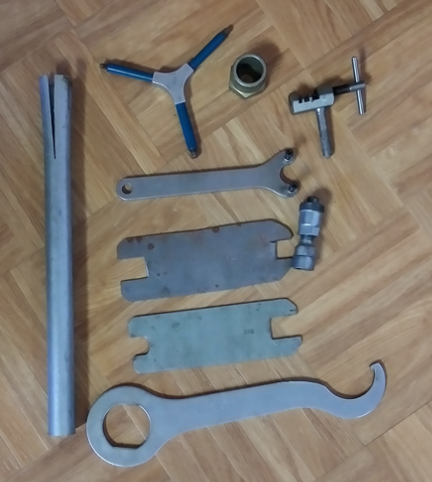
My oldest bike tools, all 30+ years old. This was occasioned by the chance discovery of my Park "Y" wrench, which had been missing for a couple years. As it turns out, it was in the kitchen drawer. Then I realized that some of my oldest tools are still in regular use. I've had the chain tool and freewheel tool since high school. Both of those were for my Schwinn Varsity. I made my own cone wrenches as needed from a piece of thick sheet metal and a hacksaw. Some of them are special -- you can't get a 3/4 inch cone wrench needed for a Bendix coaster hub. The piece of electrical conduit is a headset remover. Many of the books described making that kind of tool yourself. You can see that the bottom bracket tool has been banged on -- I've dealt with my share of stubborn BB's on old bikes that I rescue.

The remainder of the tools came along when I got a nice Trek in 1983, and there was a LBS a couple blocks from my college dorm. Most of them were purchased on the mechanic's advice of: "Here, you need one of these." A few more came along when I discovered the Bike Nashbar catalog. I still use a pair of sheet metal snips for cables -- by some dumb luck it actually works.
upload_2021-3-6_10-47-35.png
 
Still winter out here.

I rode my regular mountain bike with studded 2.6" Schwalbe Ice Spikers for a bunch of years without much issue but we get a lot of freeze/thaw which makes hardpacked conditions pretty common. I gotta say that since I got the fatbike, I don't feel the need to ride my MTB on snow at all. I'm sure that will change next week when it's likely to be really icy and I don't have studded tires on the fatbike yet (next season!). In all but icy conditions the fatbike is way more sure footed than my MTB. Better cornering, acceleration and braking on snow by a long shot. It's the right tool for the job.

k1nSKLc3mpDAfGJLLD_CTEDmK0GvEWKBcgblZCGqCSIDtvYNtcbZ-jBZydRmQxvLeKg424XA=w679-h904-no?authuser=0.jpg
 
Had a great ride on Sunday, ran into a bunch of friends on the trail, pics were taken. When I saw this one, I had a moment of "my dad's been dead for 21 years, how did they take a picture of him today?" And when the person who took it posted it on fb and tagged me, my entire family piled on to say how much I looked like my dad.

uM3Rn0tFZKHLn7L3G-ENqvBCgtdSco6asWFsSRrArzYlHcAt9uZzd6Xo0nvjbdTeORCXqTbA=w785-h904-no?authuser=0.jpg


This one was taken by me, standing in the exact spot I took the other one in. You can actually see the ocean in the far background in the shallow saddle in the hill on the other side of the pond.
h5HpYASeiwN_yCHcjkxfmQ8cDcf8VWK2VQpv0m3HFflvSN497N2vBHrNd8vXUtvy4QQbz3w=w1205-h904-no?authuser=0.jpg
 
I'm looking at a bike on CL that's in my budget but the seller says it needs crank bearings. How difficult is that to do?
It looks like I might need special tools. I'm not afraid to wrench, but don't want to beat my head against a rock about it.
The bike is an entry level Schwinn.
 
I'm looking at a bike on CL that's in my budget but the seller says it needs crank bearings. How difficult is that to do?
It looks like I might need special tools. I'm not afraid to wrench, but don't want to beat my head against a rock about it.
The bike is an entry level Schwinn.

An entry level bike will likely have a square taper bottom bracket. I've never worked on those but here's a video.

 
  • Like
Reactions: Inky13
Like @elgecko says, those bearings are not hard to replace. There's a more modern style that fits in the same threads and might be a preferable replacement, since it needs no adjustment, a so called "cartridge" bottom bracket.

If you have a link to the CL ad, it might be possible to see what the bottom bracket looks like in more detail. If it's not too far gone, it might only need adjustment. The only hitch is that it will require some tools to get in there, and for that reason, taking it to a shop might end up being cheaper.

I've worked on a bunch of old Schwinns, and they tend to be quite maintainable.
 
  • Like
Reactions: Inky13 and elgecko
In fact speaking of old Schwinns.

It belonged to a friend who had it as a kid, but now lives in a place where he needs multiple gears just to get up to the road from his house. It was made in 1963, my birth year. So far it is basically un-restored. I re-lubed all of the bearings and got a longer seatpost since it's a relatively small frame. I also tightened the spokes, which I was still able to turn after nearly 60 years of neglect. And new rubber. Kenda makes tires that fit this old Schwinn rim diameter.

It rides like a dream, just point it where you want it to go, and it rides itself.

upload_2021-3-20_19-37-52.png
 
E9D3F227-BB42-469C-A8AA-EAF106BB2A22.jpeg
Like @elgecko says, those bearings are not hard to replace. There's a more modern style that fits in the same threads and might be a preferable replacement, since it needs no adjustment, a so called "cartridge" bottom bracket.

If you have a link to the CL ad, it might be possible to see what the bottom bracket looks like in more detail. If it's not too far gone, it might only need adjustment. The only hitch is that it will require some tools to get in there, and for that reason, taking it to a shop might end up being cheaper.

I've worked on a bunch of old Schwinns, and they tend to be quite maintainable.
Not much of a pic. It's a MIC bike.
 
Yeah, like @elgecko says, it's probably square-taper, judging from the likely age of the bike. Park Tool website tends to have good tutorials:

Invalid Link Removed

You'll need a crank puller to remove the cranks. Then, the specific tool to remove the bottom bracket tends to vary over the years of manufacture. From my picture above, I've circled some things:

upload_2021-3-20_22-20-42.png


Red circle is the crank puller. One side of it threads into the crank arm (which is threaded to accept the crank remover), the other pushes against the spindle to separate the arm from the spindle.

Green circles are for the various holes and notches in the components that make up the bottom bracket bearing cups. You can see they've been banged on. Or if it's somewhat newer, it might have a whole bunch of teeth that a "spline" tool fits into.

The proliferation of tools is a negative of the entire bike industry. Sure, designs improve, but it's a pain to keep chasing the latest standards. I tend to work on a relatively narrow range of ages and styles of parts, so my tool box hasn't grown too huge. Rather than trying to own every possible tool, I buy as needed. The tools you see are my oldest, 30+ years. I have a roughly equal number of newer tools.

See if there's a bike co-op in your region. That's a way to get access to decent tools, and they usually take donations for helping people who need free / cheap bikes for transportation, plus offer things like basic repair classes.
 
I should add as a side note: If you're willing to destroy the original bottom bracket, you don't need proper tools. What I mean is, if you have the old fashioned multi-piece BB, and want to upgrade it to the "cartridge" type, then the old BB doesn't have to survive the operation. There's a fair possibility that if the BB is messed up, it's because it's already loose, in which case you might also be able to get away with fewer tools. And this is another reason to delay buying tools until you prove to yourself that you need them.

I treat delving into old bikes as a form of gambling. So long as you know the odds and can afford to lose, it's more fun and cheaper than Las Vegas. Well, at least, that part of Las Vegas. ;)
 
  • Like
Reactions: J_Bass and Inky13
Yeah, like @elgecko says, it's probably square-taper, judging from the likely age of the bike. Park Tool website tends to have good tutorials:

Invalid Link Removed

You'll need a crank puller to remove the cranks. Then, the specific tool to remove the bottom bracket tends to vary over the years of manufacture. From my picture above, I've circled some things:

View attachment 4210971

Red circle is the crank puller. One side of it threads into the crank arm (which is threaded to accept the crank remover), the other pushes against the spindle to separate the arm from the spindle.

Green circles are for the various holes and notches in the components that make up the bottom bracket bearing cups. You can see they've been banged on. Or if it's somewhat newer, it might have a whole bunch of teeth that a "spline" tool fits into.

The proliferation of tools is a negative of the entire bike industry. Sure, designs improve, but it's a pain to keep chasing the latest standards. I tend to work on a relatively narrow range of ages and styles of parts, so my tool box hasn't grown too huge. Rather than trying to own every possible tool, I buy as needed. The tools you see are my oldest, 30+ years. I have a roughly equal number of newer tools.

See if there's a bike co-op in your region. That's a way to get access to decent tools, and they usually take donations for helping people who need free / cheap bikes for transportation, plus offer things like basic repair classes.
Thank you so much for the detailed response! I've been running into this problem a lot the last few bikes. The Mrs. bike needs new cranks as did my last one. What's confusing is if a bike needs cranks or crank bearings. Wife bike spins freely but wobbles so I'm replacing the cranks. I will continue to search.
 
Thank you so much for the detailed response! I've been running into this problem a lot the last few bikes. The Mrs. bike needs new cranks as did my last one. What's confusing is if a bike needs cranks or crank bearings. Wife bike spins freely but wobbles so I'm replacing the cranks. I will continue to search.
Sometimes you can tell by looking real close at what's moving against what. For instance if you pull on one crank and the other one wobbles in synchrony with the first, then the bearing is loose. If one crank moves and the other stays put, the crank. Also the pedals. Murphy's Law says the problem will be in the last place you look, and furthermore, that you will replace the most expensive part before discovering the problem is in the cheapest part.

It's like finding cracks in an upright bass. What's moving? Sometimes you put your finger across the gap to see if you can feel it move.

If a crank is coming loose from a tapered spindle, it wasn't torqued down good enough in the first place, a cautionary note.
 
The proliferation of tools is a negative of the entire bike industry.

Amen! I just bought a new crankset for the bike in the above photo. After number of chainrings, crank length, and chain tooth count, the main criteria was "Will it work my existing bottom bracket tool?". I know they're not exhorbanant but didn't want to buy a tool I'd essentially use one time.
 
  • Like
Reactions: fdeck and MattZilla