I had some time on my hands today, so I thought I would post a question that I've been wondering about for years, relating to the operation of the DEEP switch on my Fender Bassman 135 amplifier.
I have researched this question several times over the past few years, with no good answer, so today I'm giving it another shot...
So:
The Bassman 135 has two channels, BASS INSTRUMENT and NORMAL.
The BASS channel has a DEEP switch, and the NORMAL channel has a BRIGHT switch.
The BRIGHT switch works as I would expect, obviously increasing the treble when in the "up" position, which is what I would think should be "on" (towards the word BRIGHT above the switch).
The DEEP switch, however DECREASES the low-end fullness quite noticeably when in the "up" position, no matter what settings of the tone controls I choose. I have always preferred the "down" (off?) position, because the amp sounds really wimpy with the switch on/up.
It is as if the DEEP switch is wired into the circuit backwards!
So today I've indulged my inner nerd/geek and played around with the schematic, online resources, and the Seymour Duncan Tone Stack Calculator program, to see if I can figure out what's up (or down ).
).
So, DOWN the rabbit hole we go!
Here is the relevant part of the Bassman 135 schematic, showing the DEEP and BRIGHT switches:
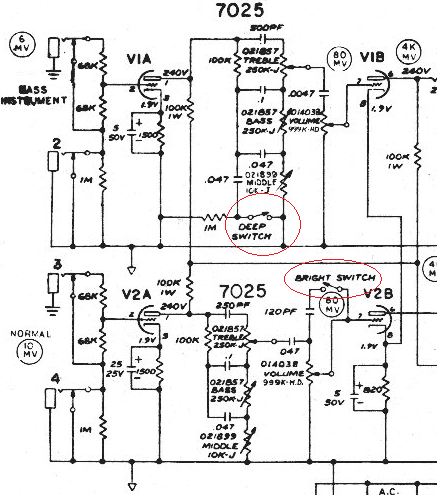
I am assuming that the Fender schematic follows the usual convention that the switches are shown in the normal (off) position ("Open" on the schematic = "off").
Here is a photo of the switch in the amp chassis:

It APPEARS that, when compared to the schematic, the wiring & resistor on the switch is NOT as I would expect for "down" is "off".
According to the schematic, closing the switch (DEEP on?) should short the 1M resistor to ground.
The switch in the picture shorts the resistor in the DOWN position.
Hmmmmmmm...
So I decided to fool around with some online schematics and the Seymour Duncan Tone Stack Calculator program to verify my suspicions.
The DEEP switch interacts with the MIDDLE control in the Fender tone stack circuit.
Here is an analysis of what happens to the circuit components with the switch on and off, and the MIDDLE control at 0 and 10:

Basically, with the DEEP switch off the lower 47nf cap is out of the circuit, like the DEEP switch doesn't exist. And with the switch on (shorting the 1M resistor) and the MID control at 0, C3 is increased to 100nf.
This Seymour Duncan Tone Stack Calculator circuit can approximate what happens with the DEEP switch on and off, and the MIDDLE control at 0 and 10 (it's not a perfect simulation, but it's close enough to give an idea of what's going on):

The Tone Stack Calculator shows that when the DEEP switch is in the ON position (according to the schematic), there is a 5dB CUT to all frequencies below 500Hz, regardless of the position of the MIDDLE control.
This is EXACTLY what I've been hearing from my amp, and what I would expect when examining how the actual switch is wired into the chassis.
The darn thing is wired BACKWARDS!
Up is off (low cut), and down is on (DEEP), which explains everything.
Why the heck would the engineers do such a thing?
And why couldn't I find any info about it in my searches? SOMEBODY must have been wondering about this!
And, do the DEEP switches in other Bassman models work opposite as well?
Thanks for listening...
I have researched this question several times over the past few years, with no good answer, so today I'm giving it another shot...
So:
The Bassman 135 has two channels, BASS INSTRUMENT and NORMAL.
The BASS channel has a DEEP switch, and the NORMAL channel has a BRIGHT switch.
The BRIGHT switch works as I would expect, obviously increasing the treble when in the "up" position, which is what I would think should be "on" (towards the word BRIGHT above the switch).
The DEEP switch, however DECREASES the low-end fullness quite noticeably when in the "up" position, no matter what settings of the tone controls I choose. I have always preferred the "down" (off?) position, because the amp sounds really wimpy with the switch on/up.
It is as if the DEEP switch is wired into the circuit backwards!
So today I've indulged my inner nerd/geek and played around with the schematic, online resources, and the Seymour Duncan Tone Stack Calculator program, to see if I can figure out what's up (or down
).So, DOWN the rabbit hole we go!
Here is the relevant part of the Bassman 135 schematic, showing the DEEP and BRIGHT switches:
I am assuming that the Fender schematic follows the usual convention that the switches are shown in the normal (off) position ("Open" on the schematic = "off").
Here is a photo of the switch in the amp chassis:
It APPEARS that, when compared to the schematic, the wiring & resistor on the switch is NOT as I would expect for "down" is "off".
According to the schematic, closing the switch (DEEP on?) should short the 1M resistor to ground.
The switch in the picture shorts the resistor in the DOWN position.
Hmmmmmmm...
So I decided to fool around with some online schematics and the Seymour Duncan Tone Stack Calculator program to verify my suspicions.
The DEEP switch interacts with the MIDDLE control in the Fender tone stack circuit.
Here is an analysis of what happens to the circuit components with the switch on and off, and the MIDDLE control at 0 and 10:
Basically, with the DEEP switch off the lower 47nf cap is out of the circuit, like the DEEP switch doesn't exist. And with the switch on (shorting the 1M resistor) and the MID control at 0, C3 is increased to 100nf.
This Seymour Duncan Tone Stack Calculator circuit can approximate what happens with the DEEP switch on and off, and the MIDDLE control at 0 and 10 (it's not a perfect simulation, but it's close enough to give an idea of what's going on):
The Tone Stack Calculator shows that when the DEEP switch is in the ON position (according to the schematic), there is a 5dB CUT to all frequencies below 500Hz, regardless of the position of the MIDDLE control.
This is EXACTLY what I've been hearing from my amp, and what I would expect when examining how the actual switch is wired into the chassis.
The darn thing is wired BACKWARDS!
Up is off (low cut), and down is on (DEEP), which explains everything.
Why the heck would the engineers do such a thing?
And why couldn't I find any info about it in my searches? SOMEBODY must have been wondering about this!
And, do the DEEP switches in other Bassman models work opposite as well?
Thanks for listening...
Last edited: