• TalkBass has been independent since 1998. Add your voice.
    Create a free account to reply to discussions, view embedded media, and browse with fewer display ads.
    Join freeLog in
    Want zero display ads or expanded classifieds tools? Compare plans.

BEAD strings on a 4-String

I restrung a 4-string electric bass with the BEAD strings out of a five-pack of flatwounds, and tuned it to ADad.

The lowest open note is the bottom key on a piano, and the highest note is middle C. So it's like having the bottom half of a piano.

In order to make it work, I had to move the bridge about half an inch down from where it was, so that the scale adjusters would actually work! It took a couple months of dinking around with it here and there to get it exactly right. I also had to widen the slots on the nut, but that was easy.

All told, it's been a great success. Anybody else do this?

 
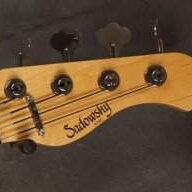
the jazz in my thumbnail is now BEAD. I dig it. I did have a little issue getting the B saddle back far enough to intonate. I am looking forward to doing a few gigs with it to really see if it worth it. But it is my only ax with a low B
 
  • Like
Reactions: Xanderzb
I thought about doing this with my Epiphone EBM, but went the other way, and made it a tenor bass. The bass seems to play much better than with standard tuning.

I thought the BEAD tuning would be a good option for gospel music, since that low B is used a lot.

Anyway, I'd love to see pics, or hear it being played!
 
  • Like
Reactions: Xanderzb
I restrung a 4-string electric bass with the BEAD strings out of a five-pack of flatwounds, and tuned it to ADad.

The lowest open note is the bottom key on a piano, and the highest note is middle C. So it's like having the bottom half of a piano.

In order to make it work, I had to move the bridge about half an inch down from where it was, so that the scale adjusters would actually work! It took a couple months of dinking around with it here and there to get it exactly right. I also had to widen the slots on the nut, but that was easy.

All told, it's been a great success. Anybody else do this?

Most of the local players in my area that play metal do this. Many of them played a 5 string at one point but never used the g string. I had a 5 tuned low f#bead once. It was cool but man those low f# strings are expensive literally like that 1 string cost as much as a 5 string set does and they die super fast
 
  • Like
Reactions: Xanderzb
I have a primary bass and one backup tuned to BEAD using 65,85,105,130 string gauge and it works great. That means I have filed the nut and set up the neck and intonation for BEAD. The bass plays in tune all the way up the neck. I rarely miss the higher notes and find that I'm using much more of the fingerboard to create dynamics by jumping octaves. I do NOT play in heavy, drop tuning bands, but find that I get more use of the lower register notes than the high ones. Playing blues with a guitarist that uses drop D frequently, and a top 40 band where newer tunes include keys that make the lower range notes extremely useful. I have 5-ers, but prefer a 4 string. A huge bonus was the fact that songs in the key of E through A make the fret 5 to fret 12 area of the neck much more useful and that middle area of the neck has a great low/mid tonal spectrum.
 
  • Like
Reactions: 99Z3 and Xanderzb
I've been tossing this idea around, and I'm confused when I read the various threads on this concept:

There are lots of 34" scale 5 strings, right?

Why is it that every other 34" 5 string has no problem with a B string, but it seems like so many people talk about how it's some great feat to configure their 4 string 34" bass with a B string?

Same with intonation? I read often that they've had to really work to get proper intonation, yet again, every other 34" 5 string doesn't seem to struggle with this.

I'm not trying to be nasty, but is this simply a byproduct of people making things needlessly complicated, or is there really some deeper aspect to this that I'm ignorant of?
 
No such deeper aspect. At all. I usually use 5 stringers, but many times have strung 4-string basses BEAD. Latest was my Epiphone Viola bass (30.5" scale length). Not ideal of course yet with proper overdrive/SansAmping it's perfectly suitable for some fast-HC I mostly play. I even played acoustic sets with it sounding clean no problem. As a side note, but related, having played Stingray 5ers for some 15 years I don't buy into the "longer than 34 for low B" myth. The quality of a B string sound is WAY more succeptible to the instrument's construction than to a mere 3% variation in length. As an example, the low B in every Ibanez BTB I tried (35") is significantly weaker than that of any of my StingRay 5ers (34"). So don't take scale as an instant "WILL/WON'T work" spec when speaking low B.
 
I've been tossing this idea around, and I'm confused when I read the various threads on this concept:

There are lots of 34" scale 5 strings, right?

Why is it that every other 34" 5 string has no problem with a B string, but it seems like so many people talk about how it's some great feat to configure their 4 string 34" bass with a B string?

Same with intonation? I read often that they've had to really work to get proper intonation, yet again, every other 34" 5 string doesn't seem to struggle with this.

I'm not trying to be nasty, but is this simply a byproduct of people making things needlessly complicated, or is there really some deeper aspect to this that I'm ignorant of?
I can only speak for myself here, the reasons that I converted one of my 4 stringers to BEAD were :-

I had about 6 x 4 stringers sitting round not being played because I played 5 stringers most of the time.
I had a half used 5 string set lying about.
I rarely use the G string on a 5er.
I am an incurable tinkerer and I had everything to hand to try it at zero cost.
I was interested to see the results.
It is easily reversible.
I could.

I have never suffered from a weak B on either 4 or 5. I believe that a lot of weak B sufferers have inadequate low end reproduction from their amp and/or speaker (but that is just my opinion and as always YMMV).

I have never had any trouble intonating a B string as long as the witness points are established. 4 or 5 string makes not a scrap of difference, it is a well established physical process not some black art.
 
  • Like
Reactions: Xanderzb
Yeah, stringing BEAD on a four string isn't a huge feat; all I had to do was move the bridge down about half an inch lower on the body, so the adjusters had a bit more room to move. I also had to round out the nut a bit for each string.
That must be the intonation trouble people are talking about. Before I moved the bridge, there was a noticeable problem as I played higher up the neck. But when I realized what was going on, it was a real easy fix.

The weak B's are almost certainly due to the limits of the amp, not the string. The acoustic physics involved in these very low frequencies pose some serious challenges for cabinet design. I play in drop-A, which is 27 Hz (A=432). That's a wavelength of almost 42 feet. Needless to say, my open A string is awful quiet compared to the higher notes.