• TalkBass has been independent since 1998. Add your voice.
    Create a free account to reply to discussions, view embedded media, and browse with fewer display ads.
    Join freeLog in
    Want zero display ads or expanded classifieds tools? Compare plans.

Beh'r DEQ2496 for EQ and Comp/Limiter for IEM setup?

Anyone use 1 of these or something similar for EQ/Comp/Limiter in their IEM setup?

My IEM is racked with a stereo Comp, but I would like to add a stereo EQ without upsizing my rack.

I know IEM is not there intended purpose and it has features that won't be used, but would one of the these work well in this application?
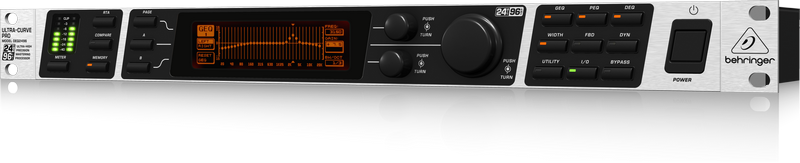
DEQ2496_P0146_Right_L.png


Link Removed
 
compression in monitors is a very bad idea!

unless it's set to only kick in as a safety hard limiter for out of control volume events you do not want that.

EQ in IEMs is a little more of a grey area, but i've never once found the need. if i have good earbuds then the signal should sound right left flat.
 
  • Like
Reactions: s0c9
I am running 1964ears Qis - 4 driver customs.

When I have had the luxury of a stereo or even mono aux send the need for eq is not really there. I agree.

Usually I don't have the luxury of an aux send (or 2), I am normally set up like this:

I use a Yamaha MG06 4channel mixer which is fed with:
ch1 My vocals from a splitter box I put at the base of my mic stand. Phase switch is 180 so I don't get cancelation when I add my vocals in with the FOH feed in my IEM
ch2 Rode M3 I have over the drums for drums and ambient
ch3 Bass signal from pedalboard/DI
ch4 FOH send from the mono out on the desk or parallel out from the active sub on my side of stage

The above is obviously mono, so I suppose I am trying to set my IEM rack up for multiple scenarios.

I run light compression on my IEM - about 2.5:1. I find it keeps the kick and my bass in check. I am taking a FOH feed, I actually think compression in this situation is wise. As far as a standard wedge set up goes I completely agree with no compression. it's a great way to have a singer blow their voice out trying to push. I suppose I don't see that being as likely with IEM.
 
As has been stated above.. I recommend that you use compression on monitors feeds ONLY if it's the brickwall limiter kind.
As far as EQ etc.. YMMV - it's a taste thing.

In my current band, we use an X32 Rack for our IEM mixes. The channel settings mirrored (were copied from) FOH at some point, but have remained pretty static since.
We do NOT put compression on ANY of the vocal channels. I check for that at each gig, as we've seen that setting reset occasionally.
The IEM mix output buss settings are also flat.. NO EQ, compression, gate, effects, etc.
I also have EQ capability on my G3 receiver.. it's flat, but i do have the adjustable limiter set to -18dB instead of the default -6dB. Gotta protect that hearing!!
Other than that.. I'm listening to the channel settings.. EQ, compression, insert effects, gates, etc. with no mods.
 
As has been stated above.. I recommend that you use compression on monitors feeds ONLY if it's the brickwall limiter kind.
As far as EQ etc.. YMMV - it's a taste thing.

In my current band, we use an X32 Rack for our IEM mixes. The channel settings mirrored (were copied from) FOH at some point, but have remained pretty static since.

Other than that.. I'm listening to the channel settings.. EQ, compression, insert effects, gates, etc. with no mods.

Do you do this for your standard monitor (wedge) sends also? I'm curious to know if you have reverb/delays etc on the vox in wedges or you only do this for IEM? so the send point to your aux sends is pre fader when you look at the settings on your X32?
 
A limiter is very useful on IEMs to prevent unwanted spikes.

We use a Presonus 32.4.2 and can control the output of our mixer. Generally, we place no gate or compression on the AUX output.

What is certainly useful is putting a high pass on the output when using IEMs. Anything below at least 55 hertz is unwanted in your mix, maybe even 65 hertz. The only thing producing that sound in a live context is typically sub woofer boom which you do not want. By putting a high pass filter on the aux outputs you would be getting rid of a lot of the mud spilling into the mics from the subs, even if the individual channels themselves already have a high pass filter on them. You can experiment with the high pass filter by cranking it upwards until you hear a difference to the sound when playing a low B and then backing a little bit back.

Also, in some venues, it might be useful to EQ the lows a bit down.
 
Do you do this for your standard monitor (wedge) sends also? I'm curious to know if you have reverb/delays etc on the vox in wedges or you only do this for IEM? so the send point to your aux sends is pre fader when you look at the settings on your X32?
We only have one Wedge (active) in use.. for the guitard who needs the "amp in the room" feel.. but yes.. same approach. He controls mix levels from his iPad mini, mounted on his mic stand. Each output [buss] mix can control the level of effects sent to it... independent of the main FOH mix. So singer can have more effects than I .. if he wants. What we CAN'T do (without more effect/output buss'es) is have DIFFERENT effects on each mix. We get the same effects that FOH uses, but can individually control the level of those effects in our IEM/wedge mixes.

On the X32 series, you can tap the output buss signals at various points. For our IEM's we are set to pre-fader, yes.
 
A limiter is very useful on IEMs to prevent unwanted spikes.
It's not just useful.. it's a MUST HAVE !! Any IEM mix needs a limiter in-line to protect your ears. Most wireless systems have those built into the receivers.. the more expensive systems having adjustable limiters. For wired systems where you have compression available on output busses, set it to be a brick-wall limiter. If you don't have that capability, you need to put a limiter between your ears and the source signal.

Generally, we place no gate or compression on the AUX output.
We do the same.. because we are all IEM, except for one wedge.

What is certainly useful is putting a high pass on the output when using IEMs. Anything below at least 55 hertz is unwanted in your mix, maybe even 65 hertz. The only thing producing that sound in a live context is typically sub woofer boom which you do not want. By putting a high pass filter on the aux outputs you would be getting rid of a lot of the mud spilling into the mics from the subs, even if the individual channels themselves already have a high pass filter on them. You can experiment with the high pass filter by cranking it upwards until you hear a difference to the sound when playing a low B and then backing a little bit back.

Also, in some venues, it might be useful to EQ the lows a bit down.
I think this is personal taste. I have a high-pass/low-cut filter on my overall mix, but it's set at like 40Hz.. I LIKE to hear ALL my bass in my IEM mix.. FOH is different.. YMMV
 
hi pass on the output when using IEMs. Anything below at least 55 hertz is unwanted in your mix, maybe even 65 hertz.
oh hell no.

as a bass player i find that intolerable, and wouldn't like it as a guitar player either.

would you want your home stereo speakers or your studio monitoring hi-passed like that?

hi-passing is a must for wedges but not for IEMs.
 
The 55 hertz figure is just an indication. Different mixers have a different slope on the high pass. On the presonus, the slop is only 6db/Octave. That means that the high pass filter is not making an abrupt cut at that frequency but there is a gentle roll off of frequencies so that there is only real noticeable attenuation at further down the hertz range. Consider this:

a) all the wanted relevant information contained in all vocal mikes, guitars, toms, and overhead mikes is all way above that range.
b) only the bass drum, bass and keyboards are producing worthwhile information in the lower ranges. The bass guitar's fundamental tones and most interesting overtones include frequencies from about 60 Hz up to about 1 KHz.

Depending on the venue, the stuff in the lower frequency spectrum is often bleed from the subs and general rumble. This can really clutter up a mix.

Of course, this is not a hard and fast rule. If you are playing a big open air stage with little to no spill/rumble on stage you may well not engage the high pass filter. If on the other hand you are playing in a bad room with all sorts of boominess, engaging the high pass filter to eliminate those really low rumbling frequencies can help achieve a better mix.

As always, you should use your ears - if the lower notes on the bass start to sound anaemic or if the bass drum has lost its bottom end, then the high pass filter is set too high. If you prefer it off, leave it off.
 
all the above is correct for speakers out in the room, but for IEMs if you want a pleasing, natural sound leave the high pass off.