• TalkBass has been independent since 1998. Add your voice.
    Create a free account to reply to discussions, view embedded media, and browse with fewer display ads.
    Join freeLog in
    Want zero display ads or expanded classifieds tools? Compare plans.

Bent fingers or straighter fingers?

Much of this depends on the position of the bass in relation to your hand. If you play the bass right up under your chin you need to somehow shorten your arm's length in order to facilitate plucking. If the bass is swinging down by your knees, the opposite is true. You have to stretch as far as possible just to reach the strings. Of course, this is extreme for the sake of the contrast, but how you choose to make an arm consisting two long segments separated by an elbow, a wrist that's capable of a wide range of motion and fingers which you use to operate the instrument is a personal decision.
 
  • Like
Reactions: Wasnex
Doesn't matter, as long as they're clean.
shopping.jpeg
 
I had been exploring floating thumb, slap, and using index, middle, ring finger for plucking by this time, so bending my fingers no longer felt so awkward.

I have transitioned primarily to using bent fingers now. I think my tone is punchier and I have more control and the ability to produce a wider range of sounds. With straight fingers I thought my tone was smoother.IMHO there are things you can do better with straight fingers, and there are things you can do better with curved fingers.
That's the thing- floating thumb. To use straight fingers to move my arm and hand away from the bass seemingly taking away my ability to mute strings with my thumb.

I've never really given it much thought, but I just checked, and I play with my fingers bent.

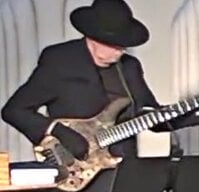
One thing I've noticed about Andrew Gouche is, as great as he is, his ergonomics leave a lot to be desired. Look at the bend in that wrist. If that's what allows him to play with straighter fingers, I'd say it's not worth it.

View attachment 3622399

That's the thing. I'd love to play like him, but that wrist bend is so uncomfortable for me. So I guess the my bent finger technique is pretty usual. As I think about it, my technique sort of comes out of my folk/finger picking from guitar which doesn't use a lot of straight fingers as some classical two finger-pluckers sometimes do.
 
OP asks a good question. I think the difference is where the movement comes from. “Straight fingers” means the finger mostly pivots from the first joint, and “bent” implies the pivot is mostly from the second joint.

My old school heroes (Jaco, Stanley, etc.) all seem to use the first “straight” joint. I believe this is also the traditional recommended rest stroke technique for classical guitar. It delivers more power and for me personally is faster than the second “bent” joint.

These days I mostly use second joint for normal playing, mostly because it’s the best way to do floating thumb muting, and it’s more relaxed. It’s also a good way to do a free stroke pluck (where the plucking finger does not come to rest on on the next string after the pluck).

When I have to play something blazingly fast, I resort to first joint playing. I think of first joint as “vintage” technique and second joint as “modern”.
 
OP asks a good question. I think the difference is where the movement comes from. “Straight fingers” means the finger mostly pivots from the first joint, and “bent” implies the pivot is mostly from the second joint.

My old school heroes (Jaco, Stanley, etc.) all seem to use the first “straight” joint. I believe this is also the traditional recommended rest stroke technique for classical guitar. It delivers more power and for me personally is faster than the second “bent” joint.

These days I mostly use second joint for normal playing, mostly because it’s the best way to do floating thumb muting, and it’s more relaxed. It’s also a good way to do a free stroke pluck (where the plucking finger does not come to rest on on the next string after the pluck).

When I have to play something blazingly fast, I resort to first joint playing. I think of first joint as “vintage” technique and second joint as “modern”.

Great answer. I've never been a "first joint" player, but perhaps it's something I should develop for my bag o tricks. I can see employing it momentarily, but can't see using it for most stuff as it adds stress to areas that have the beginnings of arthritis, right in that first and second joint and into the back of my hand. I suppose, like anything else, the more versatile the technique adaptations the more expansive the sonic palette.
 
Straight wrist police are on the scene. I think the key is really to just have a relaxed hand in whatever position.

Muscles that move our fingers are in the palm and forearms. The muscles in the palm move a bit more independently than the forearm ones, but you can get by either way. When you bend your first knuckle (mcp) you are using your lumbricals in your palm. When you bend the other joints (pip and dip) you use your flexors in the forearm. The reverse is true for extending the fingers. The mcp is extended by muscles in the forearm and the pip and dip joints are extended by your interosseous muscles in the palm...allegedly.

The shared muscles in the forearm is the biggest reason you need to relax all your fingers when playing. If day you hold your ring and small finger maximally extended because you only play index and middle fingers, you can't fully flex your index and middle fingers...no or little flexion at the dip joint in particular.
I’m a surgical technologist and I’ve scrubbed plenty of tendon repairs where The patient attempted suicide by cutting their wrists. When these patients cut through the flexor tendons in their wrist they can NOT flex their fingers. On top of that in order to verify that we’re are suturing the correct tendons together we actually pull on the flexor tendons and watch to see which fingers flex’s. So again the bulk of the strength in our index and middle fingers is in our forearm not the palm of our hand. I’m just talking about what I’ve seen with my own eyes.
 
That's the thing- floating thumb. To use straight fingers to move my arm and hand away from the bass seemingly taking away my ability to mute strings with my thumb.

Part of the evolution of my technique is due to transitioning to 5- and then 6-string bass in the early 90s. The 6-string, especially, forced me to modify and expand my muting technique. But I still find patterns that jump quickly back and forth across non-adjacent strings to be easier with anchored thumb.
 
  • Like
Reactions: smeet
I've never really given it much thought, but I just checked, and I play with my fingers bent.

One thing I've noticed about Andrew Gouche is, as great as he is, his ergonomics leave a lot to be desired. Look at the bend in that wrist. If that's what allows him to play with straighter fingers, I'd say it's not worth it.

View attachment 3622399

If you play like that with your wrist bent that much it will eventually cause problems

keep your wrist straight

like this guy here

richbrown-1280x640.jpg
 
  • Like
Reactions: jamro217
I’m a surgical technologist and I’ve scrubbed plenty of tendon repairs where The patient attempted suicide by cutting their wrists. When these patients cut through the flexor tendons in their wrist they can NOT flex their fingers. On top of that in order to verify that we’re are suturing the correct tendons together we actually pull on the flexor tendons and watch to see which fingers flex’s. So again the bulk of the strength in our index and middle fingers is in our forearm not the palm of our hand. I’m just talking about what I’ve seen with my own eyes.

I think James Collins is specifically talking about flexion of the MP joint while keeping the IP joints extended. This requires the lumbricals and not the power of the long flexors. Now in the case of someone cutting the long flexor tendons, then the origin of the lumbricals on the flexor digitorum profundus is unstable, so they don't work very well to flex the MP joint.
 
When I pluck with straight fingers it's usually old-school anchored thumb playing. More on harder rocking tunes. I too switched to a 5er in the early 90s IIRC. I needed to come up with better muting.

I mostly play like a fingerstyle blues/folk/country/jazz guitarist. The bass is high, and both wrists are straight. I use my nails to pluck most of the time. The nails are just long enough to pluck and not any more, otherwise I couldn't take the nails out of the equation for a rounder tone. I mute the G (or C) string with my pinky and the next string with my ring. My goal is to be seamless between thumping, double thumping, playing a fat tone with my thumb like Sting, using my thumbnail as a pick, using my index as a pick like Bernard Edward's "chuck" technique, anchored thumb on pickup and fingerstyle like a guitarist. I'm doing ok. My pick playing is bad though. Bad.

No rules except take care of your health. Oh yes, and have fun.
 
  • Like
Reactions: Wasnex
I’m a surgical technologist and I’ve scrubbed plenty of tendon repairs where The patient attempted suicide by cutting their wrists. When these patients cut through the flexor tendons in their wrist they can NOT flex their fingers. On top of that in order to verify that we’re are suturing the correct tendons together we actually pull on the flexor tendons and watch to see which fingers flex’s. So again the bulk of the strength in our index and middle fingers is in our forearm not the palm of our hand. I’m just talking about what I’ve seen with my own eyes.
Your correct partially, but if you paralyze somebody's lumbricals and interosseous muscled by cutting the median and ulnar nerves and follow up with the patient, they develop a claw deformity where they cannot extend the pip and dip joints or flex the mcp joints. So you you actually need more than just your flexor digitorum profundus and flexor digitorum superficialis muscles.

There are muscles in both places.
 
Last edited:
I think James Collins is specifically talking about flexion of the MP joint while keeping the IP joints extended. This requires the lumbricals and not the power of the long flexors. Now in the case of someone cutting the long flexor tendons, then the origin of the lumbricals on the flexor digitorum profundus is unstable, so they don't work very well to flex the MP joint.

... if you paralyze somebody's lumbricals and interosseous muscled by cutting the median and ulnar nerves and follow up with the patient, they develop a claw deformity where they cannot extend the pip and dip joints or flex the mcp joints. So you you actually need more than just your flexor digitorum profundus and flexor digitorum superficialis muscles.

There are muscles in both places.
Yep.

Here’s some nice detailed explanations...


Watch from 2:40 onwards...
 
If you play like that with your wrist bent that much it will eventually cause problems

keep your wrist straight

like this guy here

View attachment 3622600
But you have to ask,what is he doing in the picture at the time.

I doubt that he plucks everything that way.
It looks like he's hooking his finger under to "pop" the C string.
Or he may have just thumb stroked the chord form.

You have to do different things,to do different things.
Example Of Straight Wrists.
 
  • Like
Reactions: SteveCS
If you play like that with your wrist bent that much it will eventually cause problems

keep your wrist straight

like this guy here

View attachment 3622600
I did a bit of digging around.
Rich Brown.
He doesn't play that way all the time.

This is likely what he's in the midst of doing in your pic.
A hybrid thumb and finger style.
Or palm muting.
 
Last edited:
  • Like
Reactions: Groove Doctor
I did a bit of digging around.
Rich Brown.
He doesn't play that way all the time.

This is likely what he's in the midst of doing in your pic.
A hybrid thumb and finger style.
Or palm muting.


some of us bass players get wrist problems ae we age … most notable was John Wetton >>> 'I changed the emphasis of what I do': How John Wetton's health crisis impacted his art | Something Else!

One of the benefits of palm muting on bass is that it demands that you employ a good right hand technique … I almost never bend my wrist badly and I don't have wrist problems.

jb10.jpg
jeff-ric-01.jpg
 
Part of the evolution of my technique is due to transitioning to 5- and then 6-string bass in the early 90s. The 6-string, especially, forced me to modify and expand my muting technique. But I still find patterns that jump quickly back and forth across non-adjacent strings to be easier with anchored thumb.

I hear ya. I've been practicing bass seriously for less than 2 years (having "played" it forever). I'm at the point where I have moderate speed, but now also have to develop at tonal nuance, particularly playing cleanly all the time. I play mostly 5ers, have a 6er (Ibby Gio) that I'm beginning to practice with more. My goal is to become very hirable... but have some serious work to do yet.
 
  • Like
Reactions: Wasnex

Latest posts