• TalkBass has been independent since 1998. Add your voice.
    Create a free account to reply to discussions, view embedded media, and browse with fewer display ads.
    Join freeLog in
    Want zero display ads or expanded classifieds tools? Compare plans.

Bernard Edwards in Guitar World, Jan 1985

This is nothing earth-shattering, but just something I thought was an interesting look at how even one of the greatest R&B bassists was viewed by some in his heyday.

I was recently flipping through my January 1985 Guitar World (Jeff Beck on cover) when I realized that my profile pic of Bernard Edwards was actually from the interview he did with them in that issue. I probably read it back then, but had forgotten about the disillusionment he was feeling regarding the music biz at the time. Nile Rodgers went all in on the new technology and Bernard was going in a different direction.

He talked about how he and Nile's musicianship was not only dismissed, but "belittled" (his word) because they played in a "quote unquote disco band." Ironically, in the same interview he said how upsetting it was to see James Jamerson, who'd died in 1983, be so overlooked at the time. To me back then, Chic's music was so obviously head and shoulders above so much of the drivel that dominated the dance charts in the late 70s/early 80s. I guess the hatred of anything labeled "disco" affected people's objectivity.
 
This is nothing earth-shattering, but just something I thought was an interesting look at how even one of the greatest R&B bassists was viewed by some in his heyday.

I was recently flipping through my January 1985 Guitar World (Jeff Beck on cover) when I realized that my profile pic of Bernard Edwards was actually from the interview he did with them in that issue. I probably read it back then, but had forgotten about the disillusionment he was feeling regarding the music biz at the time. Nile Rodgers went all in on the new technology and Bernard was going in a different direction.

He talked about how he and Nile's musicianship was not only dismissed, but "belittled" (his word) because they played in a "quote unquote disco band." Ironically, in the same interview he said how upsetting it was to see James Jamerson, who'd died in 1983, be so overlooked at the time. To me back then, Chic's music was so obviously head and shoulders above so much of the drivel that dominated the dance charts in the late 70s/early 80s. I guess the hatred of anything labeled "disco" affected people's objectivity.

What gear did he list?
 
What gear did he list?
Here's the excerpt where they cover that:

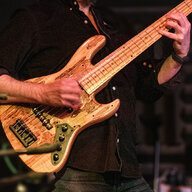
Bernard has twenty-two basses to choose from. "My pride and joy is my Spector," he says. "I use it all the time. It sounds good, it's one piece of wood, it's got EMG pickups on it—it knocks me out." His guitar arsenal includes two by Music Man, which he used for all Chic's records, and two vintage Fender Jazz basses, from 1962 and 1964. All his basses are strung with Dean Markleys ("I'm one of those guys that changes his strings once a year," he laughs). He almost never uses effects ("I'm in love with the natural sound of the bass"), and feeds his signal into his stalwart Sunn Colisseum. "I got it in 1977, " he recalls, "and I've used it ever since. Before that I had the Sunn Orion. The Colisseum has four 15-inch Gans speakers in it."​
 
At that time, Bernard Edwards' bass playing was new and it used to bother "some" old-fashioned musicians.
Bernard Edwards was my true influencer.
In the words of Ringo, peace and love!, but I think the bigger factor really was the backlash against disco, as Bernard said.

By the late 70s, it's not like Edwards' style was radical or anything, it was following in the tradition of his own heroes, such as Jamerson and Rainey. The fact that he applied his talent to music that was being marketed as disco had to be the overarching reason, as disco had become such an anathema by 1979/80 (if not earlier). And regardless of the fact that Chic's rhythm section was in fact a filthy funk outfit, not really disco. Just my take!
 
In the words of Ringo, peace and love!, but I think the bigger factor really was the backlash against disco, as Bernard said.

By the late 70s, it's not like Edwards' style was radical or anything, it was following in the tradition of his own heroes, such as Jamerson and Rainey. The fact that he applied his talent to music that was being marketed as disco had to be the overarching reason, as disco had become such an anathema by 1979/80 (if not earlier). And regardless of the fact that Chic's rhythm section was in fact a filthy funk outfit, not really disco. Just my take!

Yes said what I was going to say. Disco and Rock, especially Punk Rock or Metal, took a sociological significance that went beyond music. Fortunately for Bernard Edwards, he lived long enough to see British artists openly pay their respects to Nile Rodgers and Bernard Edwards. As it was with the Blues, a generation earlier, once hip British "cats" approved, mainstream American suddenly realized these guys were good too.
 
By the late 70s, it's not like Edwards' style was radical or anything, it was following in the tradition of his own heroes, such as Jamerson and Rainey.
For my musical education/upbringing, Bernard Edwards was different from Jamerson and/or Rainey.
Bernard Edwards' phrasing was different, his pattern/groove was more dynamically articulated, his use of short embellishments (especially, ghost notes) without breaking the groove was different. Bernard Edwards bass playing (formally and informally) even developed (kind of changed) my technique.
Bernard Edwards knew how to play a "busy" and have enough space to "breath."
 
For my musical education/upbringing, Bernard Edwards was different from Jamerson and/or Rainey.
Bernard Edwards' phrasing was different, his pattern/groove was more dynamically articulated, his use of short embellishments (especially, ghost notes) without breaking the groove was different. Bernard Edwards bass playing (formally and informally) even developed (kind of changed) my technique.
Bernard Edwards knew how to play a "busy" and have enough space to "breath."

I am sure Edwards was influenced by Jamerson and Rainey. He was probably influenced by Jemmott, Cogbill, Paul Jackson, and Rocco Prestia too. The main thing is that he came up with his own style.
 
The main thing is that he came up with his own style.

Bernard Edwards had his own phrasing. His short fill-ins, embellishments were different from other famous bass players. I remember many years ago listening to "Le Freak" song first time, I was mesmerized by that bass fill right before Verse 1, "WOW!"
Yes, It was different!

Bernard Edwards was as ONE entity with his bass guitar, its tone.
(Without his bass tone/sound, it was impossible to created that kind of lines.)

Even his death was (almost) on stage - dying while playing the bass.
A true bass player!
 
This is nothing earth-shattering, but just something I thought was an interesting look at how even one of the greatest R&B bassists was viewed by some in his heyday.

I was recently flipping through my January 1985 Guitar World (Jeff Beck on cover) when I realized that my profile pic of Bernard Edwards was actually from the interview he did with them in that issue. I probably read it back then, but had forgotten about the disillusionment he was feeling regarding the music biz at the time. Nile Rodgers went all in on the new technology and Bernard was going in a different direction.

He talked about how he and Nile's musicianship was not only dismissed, but "belittled" (his word) because they played in a "quote unquote disco band." Ironically, in the same interview he said how upsetting it was to see James Jamerson, who'd died in 1983, be so overlooked at the time. To me back then, Chic's music was so obviously head and shoulders above so much of the drivel that dominated the dance charts in the late 70s/early 80s. I guess the hatred of anything labeled "disco" affected people's objectivity.

If you could some how post that entire article, I would be very appreciative .
There isn't a lot of print or interview s of his around .
 
  • Like
Reactions: Dr. Cheese
For a second there I thought @Dr. Cheese had gone back to using his old avatar.

Bernard Edwards - man, what a player. I'll never forget first listening to the C'est Chic and Risqué albums. It was as if a huge switch was flipped and a giant light came on.

Bernard Edwards had touch that was elite. There were times when he very nearly sounded fretless. I love fretless, but I honestly think my favorite tone is when a fretted bass gets the sound Bernard Edwards got on songs like My Forbidden Lover.
 
For a second there I thought @Dr. Cheese had gone back to using his old avatar.

Bernard Edwards - man, what a player. I'll never forget first listening to the C'est Chic and Risqué albums. It was as if a huge switch was flipped and a giant light came on.
My Pavlovian response has been they were Cheese threads too.
Back on topic, I recently listen to Debbie Harry's Koo Koo album after a very long time and Bernard's playing on there kills.
 
The fallacy of quickly dismissing an entire style of music or trend:

Disco re-made the production style of most records in that the kick and bass guitar were suddenly much further forward in the mix, and have been far more present ever since.

I was playing in those days, and the advent of synths, sequencing, and keyboard bass and drum machines made us wonder if we were about to be replaced. Fortunately, no.

Those records revived bass and drums, and a lot of guys stayed working or came to a career because of those sides in NYC, Philly, the West Coast, even South Florida.

And try and convince me in the middle of your 'disco sucks' rant that 'Freak Out' or 'He's the Greatest Dancer' or 'I'm Coming Out' are even on the same planet as 'Disco Duck'.

The section of Bernard Edwards, Tony Thompson, and Nile Rodgers was deadly, precision funk that's rarely been matched, and I always think that in any genre of music, you have the dreck, the big average middle, and the divine. Bernard, Tony, and Nile were/are masters and the head of the divine list.
 
Bernard Edwards had touch that was elite. There were times when he very nearly sounded fretless. I love fretless, but I honestly think my favorite tone is when a fretted bass gets the sound Bernard Edwards got on songs like My Forbidden Lover.
Bernard had that slidy, slippery swing in his feel - in both hands.

I highly recommend Nile Rodgers' autobiography to anyone here who has yet to read it.