• TalkBass has been independent since 1998. Add your voice.
    Create a free account to reply to discussions, view embedded media, and browse with fewer display ads.
    Join freeLog in
    Want zero display ads or expanded classifieds tools? Compare plans.

Best bass + string + amp combo that got you the most clear/punchy E string sounds?

I feel like I'm in a rut where across 3 different basses (P-Bass, Rickenbacker, Stingray) with 4 different sets of strings, and across the two bass amps I own, I can never quite get an E string tone that maintains clarity and volume while getting thump. It's as the ADG strings all have a punch that noticeably goes away or is lessened the minute I got that lowest string.

The ONLY exception seems to be the E-string on my 5 string Ibanez ATK bass. For some reason there's no issues at all with that.

So what bass+string+amp combos have people used to get that clear, punchy E sound that balances well with the other 3 strings?
 
  • Like
Reactions: Zooberwerx
Yes! What’s the combo here?
First sound clip
YAP_1371.jpg


Second sound clip
YAP_1386.jpg


both use same aliexpress knock off pedal combo > bass amp
IMG_20250722_215440.jpg


and my favorite flatwound bass string
1778314485900.png
 
An idea... it may be possible to work on this with gear you already have. You might have more low-end than you really need in your mix. You can try to reduce low end for a while and give yourself time to get used to it that way (less bass, more balance)--tweak your signal chain (EQ, compression, everything else) with that reduced bass over a good period of time. After you feel that you have a good balance between the strings, bring some low end back a bit at a time. See where that takes you.

I haven't played an ATK but reviews seemed to indicate that it has a Stingray-like sound. If it is more trebly and less bassy than your other gear, it could make your 5-string seem more balanced string to string.

I was looking at this in the past and was trying thicker string gauges. I ended back at regular string gauges and looked more closely at how each string steps down in timbre (a little more bass and a little less clarity) and sure, it can be more noticeable on the E string. I found that EQ (including HPF as part of EQ) and instrument setup (pickup heights) to be what I really needed. Compression can help, but I think other things need to be balanced out before a compressor can do its best work.
 
Last edited:
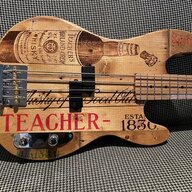
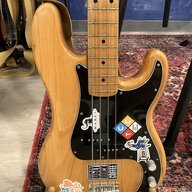
My best open E sound that’s heavy, deep and very articulate comes from my p bass as per my picture below.

Sycamore body, roasted maple neck, quarter pounder pickups and SIT nickel medium light strings.

Sounds great on all of my amps and combos but at its top with my Traynor SB 500H and my two GK Neo IV 112 cabs. Definitely not a smooth jazz bass sound though.


1778325578590.jpeg
 
I use Stingray Special 4H with Slinky Cobalt Flats 45-100 with Mesa WD 800 and 1x15 Subway Cab:

Get Excellent E string tone/sound according to my personal taste and perception in my 50 years of playing

Through Cab, DI and Headphone output

Not that other combinations over years weren't acceptable

I have also heard great E tones on recordings/videos using multiple Basses and strings obviously skill of production Engineering
 
Last edited:
I can never quite get an E string tone that maintains clarity and volume while getting thump
If you're turning up the bass knob on your amp to try to get more thump, try doing the opposite. The thump is not in the fundamental, it's how the low harmonics mix with the fundamental.

The fact your most thumpy bass is the ATK can be related to that -- of your three basses it's the one with the pickup closest to the bridge.

Also experiment with technique. Try different positions for your picking hand.
 
  • Like
Reactions: andymac and tonym
You want a taught E string, 35 scale necks will have more tension, more clarity and overtones.

But I've owned 34’s with good B and E strings- namely headless and angled headstocks.

But first try new strings, something with a hex core, try pulling down bass EQ a little- bass often adds fluff/junk to the signal.
Personally I think 212 cabs sound the most punchy.

Lastly I am a modeler convert, I got a GT1000 and you can do things like run two signal chains together to get both thump and sizzle.
 
My current rig is an MIJ P Bass with an EMG GZR and Fender Hi-Mass bridge, Rotosound Swing Bass strings, and an Ampeg Rocket 215. Punch for days! I do a lot of chords high up the neck as well, and it's clear and punchy across the whole range of the instrument. When I had a StingRay, it wore Rotosounds as well.

I wouldn't underestimate the value of playing with different pickup heights. I currently have the E and A side of the pickup a little lower which really evens things out. You'll have to find which strings you naturally hit harder or softer and account for that.
 
I feel like I'm in a rut where across 3 different basses (P-Bass, Rickenbacker, Stingray) with 4 different sets of strings, and across the two bass amps I own, I can never quite get an E string tone that maintains clarity and volume while getting thump. It's as the ADG strings all have a punch that noticeably goes away or is lessened the minute I got that lowest string.

The ONLY exception seems to be the E-string on my 5 string Ibanez ATK bass. For some reason there's no issues at all with that.

So what bass+string+amp combos have people used to get that clear, punchy E sound that balances well with the other 3 strings?
I play a 1982 Jazz with an all-maple neck and 70's Pickup spacing of 4" center to center. I bought it in mint condition in 1985. Prior to that I played a 1965 Jazz that I bought in 1966, but it was stolen along with all my touring gear in 1976. I played flatwounds on my 65 until late 1971 when I switched to Fender black nylon tape wound. The tapes were darker sounding than the flats back then. That worked well for the era.

When I bought my '82 Jazz in 1985, it had Dean Markely Blue Steel round wound strings on it. It was a much punchier and more percussive sound that the flats or tapes I'd used before. I replaced them a couple of times with the same strings. The balance between strings was not that good and you really wanted to avoid playing the lower 4-frets on the D and G strings. So I'd play those notes up higher on the previous string. Then. I replaced them with some DR Black Beauty strings (round wounds). The balance was a little better from string to string but I still avoided the lower 4-frets on the D and G strings. Granted, I was gigging a lot, but my Black Beauty Strings tuned into my Speckled Gray Ugly strings long before the strings wore out. After looking around a bit and watching various video comparisons, I decided to try a set of the LaBella White Tape Wound Strings. Bought those here on the TB market and absolutely love those strings.

LaBella makes 4 different sounding tape wounds now. The black tape wounds are the darkest/warmest sounding; the white tapes are the brightest sounding; and the white with gold core and white with copper core somewhere in between the two. The white tapes are semi-opaque and you can pretty easily discern the color of the core. The whites sound closer to the round wounds in that they have a lot of the higher harmonics that round wound have. Additionally, and a really big feature of them, they are really nicely balanced from string to string. If I'm playing and octave E or and octave A, I no longer have to move up to the 7th fret of the A and D strings. I can easily play them down on the second fret of the D and G strings. So I no longer avoid those lower 4-frets on the D and G strings and just play those notes wherever it is most convenient to fret them from my current hand position. I count this as a big plus and I love the sound I get out of them.

I'll play my current Jazz through three different amps as well as a DI with preamp and get the same sound out of all of them. It helps that all three were designed by David Nordschow (founder of Eden and DNA). For small venues, I'll use my Eden TN226 amp which is class D (4.7-lbs.) with 225-watts rms into 4Ω. That's my small venue amp and I match that with an Eden EX-112 cab. It gives me great, full sound for small venues. For most of my gigs, I'll used my DNA-800 amp (400 watts into 8Ω, 800-watts into 4Ω or 2Ω) into my DNS-210 by DNA. That 8Ω 210 cab handles 700-watts rms and putting a max or 400-watts into it will fill almost all indoor venues medium and large. If it's a long room, I may bring in my 8Ω DNS-410 cab (handles 1400-watts) for the extra decibels.

I'll also run that DNA-800 amp into my DNS-410 cab for outdoor venues where there are reflective surfaces in the area. For wide open music festivals though, I will break out my Eden WT500/800 and bridge it at 800-watts into my DNS-410. I get told at music festivals to turn down if I run my master up to 10:30, so I'll run it at 10:15 and everyone is happy. Evidently it is putting out too much sound for them to balance well through their FOH systems with my master set at10:30. I don't mind that at all because that means I never have to lug around a 200-lb. 810 cab for those wide open spaces.

On other thing I will use is my WTDI, which is a DI box with built-in Eden WT preamp. If I'm playing an indoors stage that has good monitors and mains, I will leave my amps and cabs at home and plug my WTDI into the snake to the board. Still get that same great sound. If I'm playing a place that has a back line, I'll plug that beauty into the effects in of the back line amp, which bypasses the amp's preamp and uses Eden preamp feeding the back line's power section. It's amazing the different amps that will sound like my Eden gear with that little rascal. I also use that WTDI for recording sessions. With most of my Eden gear I run a flat signal with the exception of a little boost up to 1:30 in the low mids at 250Hz. My WTDI can't address 250Hz because its low mids control is centered at 500Hz. My Jazz sounded so good through that that at a recording session in 2019 after our 3-hour session the sound engineer and the owner of the studio both came out to see what the heck I was using that sounded so good. So I use that for all my recording session now both amateur and pro.

I get great, punchy E-strings sounds out of all those combinations of gear. My '82 Jazz just sounds exceptionally good through all of them.

Here's my '82 Jazz:
WhiteLady.jpg


This is my small venue rig that fits so nicely in a chair and can be loaded in or out in one trip:
TN226PlusEX112_600x846.jpg


this is my DNA-800 amp that I use for most gigs:
DNA800_front_650x160.jpg


here's my Eden WT500/800 on top of my DNS-210 and DNS-410 cabs:
BigRig_600x888a.jpg


And lastly my WTDI:
WTDI_600x469.jpg
 
Last edited:
ou might have more low-end than you really need in your mix. You can try to reduce low end for a while and give yourself time to get used to it that way (less bass, more balance)--tweak your signal chain (EQ, compression, everything else) with that reduced bass over a good period of time. After you feel that you have a good balance between the strings, bring some low end back a bit at a time. See where that takes you.

If you're turning up the bass knob on your amp to try to get more thump, try doing the opposite. The thump is not in the fundamental, it's how the low harmonics mix with the fundamental.
Yeah, that would also be my first guess, based on what you said. It's counterintuitive, but turning your bass down on your amp could be just what you need.
 
  • Like
Reactions: Nebadon2000
Yeah, that would also be my first guess, based on what you said. It's counterintuitive, but turning your bass down on your amp could be just what you need.
Knobs are on Amps for reasons🙂

You are not necessarily turning down Bass when setting knob below 12 O'clock for multiple reasons

I used Bass control to set for my personal taste depending on enviroment that decided we're knob was set: then made small adjustments for certain songs
better now since I have variable HPF

As Andy from Mesa has said 12 O'clock is just one position on knob

Yes equipment you are using can influence settings
 
Precision = Dunlop Flats 40-100
Rickenbacker = stock Rick round wound strings. I think they’re 45-55-75-105?
Stingray= Dadarrio Roundwounds Nickel Plated steel. 45-100
I have no experiences with either Rick or Ray. I do own two P basses, one with GHS Boomers 40-55-75-95 and one with Ernie Ball Group 4 (40-95) flats and E strings on them do reasonably well.

That being said, I always get the best E's on my Jazz basses. "Best" as in best-balanced with the rest.
 
I can get it to be punchy with most if nto all open E strings. Yes the open E feels like it has been stripped pf any "meat"

It's mostly technique and setup IMO

Technique, lightly fret to mute the E just a little ahead on the nut or you could palm mute on the bridge. Try thumbed down stokes. Avoid pushing the strings into the frets, Use two fingers for more meat on the string.
Devices: A scrunchy or nut mute speciall if you are on the top frets and hitting the B
EQ - HPF -- around 70 - 85 Hz, Bass flat to subtle cut, low mids -- boost some
Strings -- flats can help but sometimes can be not as focused -- Rounds can be better. About 100 on E can actually excite over tones and not necessarily more fundamental
Setup --- low action is not that beneficial, raise it some, play with pickups heights on low, put some clearance on the first 2 frets, cut the nut properly. Make sure neck plate screw and bridge are taut
Pedal -- Something with tilt EQ or even a cocked wah, compressor preferably with attaxk, release and ratio. A buffer may help with long cable runs
 
  • Like
Reactions: tris66
The only way to really know what a given bass truly sounds like take the amp and any effects out of the equation (and by removing the amp and cab you're also eliminating all the variables of the room you happen to be in). Record those basses DI through the cleanest front end you have available, no tone shaping. Track the bass alone and also against something like a drum loop or whatever for a little context if you want, play it back both ways. Listen back on good headphones, studio monitors, etc. How do they sound? Then go from there.
A P, a 'Ray, a Ric--all with weak E strings? Assuming they're set up properly, doesn't add up. Problem might not be the bass....
 
Last edited: