• TalkBass has been independent since 1998. Add your voice.
    Create a free account to reply to discussions, view embedded media, and browse with fewer display ads.
    Join freeLog in
    Want zero display ads or expanded classifieds tools? Compare plans.

Beyma 8G40 anyone

bassinflorida

turn that dang thing down
Jan 27, 2014
862
969
73
Tampa, FL
Anyone use or find a specific niche for the beyma used in combination with kappalite2012LF in a ported enclosure? Both are 8 ohms and wired in parallel.
With or without crossover(s). I did it but not entury happy as it.
Your muses are appreciated.
 
Hard to say. Was this just some arbitrary box you stuffed them in? What was the crossover design? How were you keeping the Beyma out of the Kappalite's domain?
Are the drivers separate with their own porting?
It would also help if you describe what doesn't work.
 
Busy here. Sorry for the delay. Built box out of 3/4" birch dedicated for these speakers I sort of arbitrarily chose. One big box, separate isolated chambers with separate porting. Decided to try it without a crossover first, well, just because.
SPL is 95 for each of these speakers and is a decent starting point. The 12" is in about about 4 cu ft with a 22"x1.125" port and the 8 is in about 1 cu ft with a 9"x1.5" port with lots of polyfill around the 8". The cabinet had to be sized to fit into my ride. h=36" d=18" w=20".
As it sounds now, I may need a crossover. The 8" definitely projects some frequencies I had rather hear from the 12. A work in progress.
 
The Kappalite 3012LF has over four times the displacement capability as the 8G40, which implies that the 8G40 will reach its linear excursion limit (approximate fartout threshold) at about 12 dB lower SPL than the Kappalite. That discrepancy can be somewhat mitigated by putting the 8G40 in a small enough airspace to restrict its excursion, but still its thermal power handling is barely more than half that of the Kappalite (250 watts vs 450 watts). So if the two are run in parallel, the 8G40 will be the limiting factor, so much so that imo the Kappalite will probably go louder all by itself before the cab exhibits signs of distress.

So consider this to be another vote for using a crossover, preferably no lower than 400 Hz.
 
. Built box out of 3/4" birch...I sort of arbitrarily chose. Decided to try it without a crossover first, well, just because.
You may not appreciate it, but this is textbook 'How Not To Build A Speaker'. Using a midrange with a 3012LF is a good plan. But the midrange is a real midrange, either in a sealed sub-enclosure or a sealed back driver, and there's a crossover, otherwise it just doesn't work. When there are free plans out there that show you how to do it the right way I just don't get it.
 
  • Like
Reactions: bassinflorida
The Kappalite 3012LF has over four times the displacement capability as the 8G40, which implies that the 8G40 will reach its linear excursion limit (approximate fartout threshold) at about 12 dB lower SPL than the Kappalite. That discrepancy can be somewhat mitigated by putting the 8G40 in a small enough airspace to restrict its excursion, but still its thermal power handling is barely more than half that of the Kappalite (250 watts vs 450 watts). So if the two are run in parallel, the 8G40 will be the limiting factor, so much so that imo the Kappalite will probably go louder all by itself before the cab exhibits signs of distress.

So consider this to be another vote for using a crossover, preferably no lower than 400 Hz.

Details. Appreciated!
 
The Kappalite 3012LF has over four times the displacement capability as the 8G40, which implies that the 8G40 will reach its linear excursion limit (approximate fartout threshold) at about 12 dB lower SPL than the Kappalite. That discrepancy can be somewhat mitigated by putting the 8G40 in a small enough airspace to restrict its excursion, but still its thermal power handling is barely more than half that of the Kappalite (250 watts vs 450 watts). So if the two are run in parallel, the 8G40 will be the limiting factor, so much so that imo the Kappalite will probably go louder all by itself before the cab exhibits signs of distress.

So consider this to be another vote for using a crossover, preferably no lower than 400 Hz.

Greetings sir. I did get a 2-way crossover for the 8G40. I left the 3012LF full range. Considering I built my cabinet using unorthodox dimensions, I was sure I could make an off the shelf crossover work by tweaking the cabinet if I had to. I got (the newer) Eminence PXB2500 500HZ @ 400W. This particular crossover actually tames the 8G40 very well in my configuration. I am using only the TH500 through this cab but it turned out very well. Lucky? Sure. But I will take luck any day.
 
The Kappalite 3012LF has over four times the displacement capability as the 8G40,

You can't compare klippeled xmax (9.1mm) vs voice-coil overhang (4.5mm), the latter is less optimistic.
Using a different calculation method for xmax (used by Oberton) brings the xmax of the 8G40 to 6.25mm instead of 4.5mm. This is a real-world number that can be (sort of) "compared" with the klippeled method.

which implies that the 8G40 will reach its linear excursion limit (approximate fartout threshold) at about 12 dB lower SPL than the Kappalite. That discrepancy can be somewhat mitigated by putting the 8G40 in a small enough airspace to restrict its excursion, but still its thermal power handling is barely more than half that of the Kappalite (250 watts vs 450 watts). So if the two are run in parallel, the 8G40 will be the limiting factor, so much so that imo the Kappalite will probably go louder all by itself before the cab exhibits signs of distress.

So consider this to be another vote for using a crossover, preferably no lower than 400 Hz.

12dB? Slight calc. error here (I'll forgive you ;))

New calculation for displacement difference between these two drivers would be a factor of 3.6, which is approx 5dB :) This is purely based on displacement, the cabinet volume / tuning and thermal power handling will of course alter this number.

Edit: max spl simulation below
black curve = 3012LF 60ltr tuned to 42hz
red curve = 8G40 12 ltrz tuned to 62hz

3012LF vs 8G40.png


As you can see the 3012LF has a big advantage below 60hz. A 112 based on the 3012LF vs a 4x8 based on the 8G40 will give the 112 still much more output below 60hz then the 4x8 (which will have more max spl above 60hz when you feed it enough power)
 
Last edited:
You can't compare klippeled xmax (9.1mm) vs voice-coil overhang (4.5mm), the latter is less optimistic.
Using a different calculation method for xmax (used by Oberton) brings the xmax of the 8G40 to 6.25mm instead of 4.5mm. This is a real-world number that can be (sort of) "compared" with the klippeled method.

Voice coil overhang + 15% is the calculation I used, that's the real-world approximation suggested to me by an engineer who designs woofers for a living and uses Klippel routinely. He told me that usually comes out close to the Klippel figures. This gives a calculated volume displacement of about 114 cc for the Beyma, vs 496 cc Klippel for the Kappalite.

Based on these figures, the Kappalite has 4.35 times the displacement of the Beyma, so my claim that the Kappalite has "over 4 times the displacement" of the Beyma was reasonable.

I don't know how Oberton measures xmax, but apparently they use a different yardstick, and in my experience some of the European formulas for calculating x-max are overly optimistic.

12dB? Slight calc. error here (I'll forgive you ;))

New calculation for displacement difference between these two drivers would be a factor of 3.6, which is approx 5dB :) This is purely based on displacement, the cabinet volume / tuning and thermal power handling will of course alter this number.

Not sure how you come up with that, nor am I convinced that I need forgiveness here... but hey a little extra forgiveness is not a bad thing to have, so thank you!

But the way I see it, we get a 6 dB increase for each doubling of displacement. By way of example, imagine we start with one woofer and add a second identical woofer, wired in-phase of course, and drive both to the same excursion... this will give us +6 dB. (This is true at low frequencies... as we get higher up the distance between the acoustic centers becomes large compared to the wavelengths, so at most angles the output is no longer coherent.) In practice it doesn't matter whether that doubling of displacement comes from adding a second woofer, or from using a woofer with twice the displacement of the first one.

Or to put it another way, two coherent sources of equal SPL (which would be analogous to one doubling of displacement) sum to 6 dB louder than a single such source.

And since the internet never lies, here's a Invalid Link Removedwith more on the subject, including an online calculator.

Therefore two doublings of displacement = 12 dB. Even using the more optimistic Oberton-based excursion calculations, the difference in displacement-limited SPL between the Beyma and Kappalite would still be between 9 and 10 dB.
 
Last edited:
  • Like
Reactions: Arjank
Voice coil overhang + 15% is the calculation I used, that's the real-world approximation suggested to me by an engineer who designs woofers for a living and uses Klippel routinely. He told me that usually comes out close to the Klippel figures. This gives a calculated volume displacement of about 114 cc for the Beyma, vs 496 cc Klippel for the Kappalite.

Based on these figures, the Kappalite has 4.35 times the displacement of the Beyma, so my claim that the Kappalite has "over 4 times the displacement" of the Beyma was reasonable.

I don't know how Oberton measures xmax, but apparently they use a different yardstick, and in my experience some of the European formulas for calculating x-max are overly optimistic.


Not sure how you come up with that, nor am I convinced that I need forgiveness here... but hey a little extra forgiveness is not a bad thing to have, so thank you!

But the way I see it, we get a 6 dB increase for each doubling of displacement. By way of example, imagine we start with one woofer and add a second identical woofer, wired in-phase of course, and drive both to the same excursion... this will give us +6 dB. (This is true at low frequencies... as we get higher up the distance between the acoustic centers becomes large compared to the wavelengths, so at most angles the output is no longer coherent.) In practice it doesn't matter whether that doubling of displacement comes from adding a second woofer, or from using a woofer with twice the displacement of the first one.

Or to put it another way, two coherent sources of equal SPL (which would be analogous to one doubling of displacement) sum to 6 dB louder than a single such source.

And since the internet never lies, here's a Invalid Link Removedwith more on the subject, including an online calculator.

Therefore two doublings of displacement = 12 dB. Even using the more optimistic Oberton-based excursion calculations, the difference in displacement-limited SPL between the Beyma and Kappalite would still be between 9 and 10 dB.

Crap, you're totally right, how could I have made this mistake and tell you it's +3dB! (probably to much going on in my head because of private matters lately and have been on a speakerbuild hiatus for quiet some time)!!! :thumbsup: :)
I did a simple check with AJhorn sim and doubling the displacement gives a +6dB increase.

Below a max spl sim of both drivers in a sealed enclosure, this shows the difference much better then that of a ported enclosure.

8G40 vs 3012LF closed.png


Btw. the Oberton calculation is less optimistic then e.g. the one that Faital uses. I've used several Oberton drivers and Eminence to know that they can sort of be compared.
 
Last edited:
Thanks Arjank, I get mixed up too. I can and will make mistakes, so go ahead and let me know when it looks like I'm making one.

As I think back on what I've read about Oberton woofers, probably mostly from you, I get the impression that Oberton uses a superior motor geometry of some kind whose performance justifies what would otherwise look like an optimistic x-max figure.
 
Bit of outdated trivia but here goes anway...

Plan A:
I tried the 3012LF and the Beyma 8G40 in combinations that might work.
My initial goals were the most bang for the buck WHILE fitting two separate cabinets into the backseat of my Nissan Frontier without blocking any viewing area.
I sourced my wood at a local big box using 1/2" x 24" x 24" oak boards cut to size. Built the cabinet and loaded it with just the 3012. It was braced adequately and dampening material placed in notorious places. Box size was 24x18x22 with a vertical slot 15" x 1.5" and with a 8" baffle. It actually sounded good, but at the volume I intended to drive it it just walked across the floor.

Plan B: Build a larger box using heavier wood and add the Beyma 8G40 with a crossover hoping to maybe double the volume and keep it onthe floor. Yeah I know, I should have used the popular 6" mid speaker insteaf of the Beyma. Realizing more mass was defeating my purpose for a lighter cab I went ahead anyway to see what it would sound like. The Beyma sensitivity rating might be higher than listed specs .Even with the crossover, it drastically overpowered the mids. I tried a higher crossover, 800HZ and a pad, and it still puished the mid too much. (yes, everything was wired correctly). The Beyma was in a separate sealed chamber < 1ft cu. and had its own separate slotted baffle design. Did not make any satisfactory difference.

Plan C:
So, thought I would build completely sealed smaller cabinets as a last resort. Research did not verify these speakers were designed for this configuration but what the heck. Curiosity killed the cat, or built the telephone or some silliness like that. Sealed cabs were a flop also.

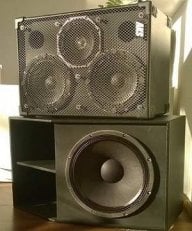
Plan D: (DONE) I have on hand (4) 4-ohm 10" Delta Lite speakers I took from an old Avatar Cab. Pretty good speakers actually. One of my first trial cab builds included using two of these wiered in series mounted near vertical, and building another lightweight cab with a larger 12" or 15" high power light weight 8-ohm speaker. I settled on the 12" because of vehicle transportation contraints. By this time I was done trying to stay in 'known guidelines' probably because I did not have suitable access to the quality woods needed, So I went back to Big Box and sourced the 1/2" oak boards necessary for the sides, back and front and baffle. This time I used untreated cheap 2" x 4" for braces. Made a solid asembly much easier. The cabinet outside dimensions fir my criteria,the cab is not very heavy probably because of the 3012, and it is braced, screwed and glued like the best of them. Sounds pretty good too. Separate it is a decent stand alone cab and paired with the other 2x10 I still have to go find the dog. Wife built a loft bed and had some paint left over.
GumBall.jpg
 
  • Like
Reactions: Hoyt