On a positive note, both Abrasive Response and Credential Flinging are playing Lollapalooza this year!

TalkBass has been independent since 1998. Add your voice.
Create a free account to reply to discussions, view embedded media, and browse with fewer display ads.
Join free Log in
Want zero display ads or expanded classifieds tools? Compare plans.
In the home audio world, I use four small subwoofers distributed around the room to de-correlate the in-room bass energy, and this works quite well. Credit to Earl Geddes; I'm using his idea with his permission.
Full-range dipole speakers also introduce decorrelation relative to a monopole speaker, as the backwave is shifted in phase 180 degrees relative to the frontwave (which tends towards cancellation at long wavelengths, but is otherwise smoother in-room).
I think that a good transmission line introduces decorrelation due to the internal path-length-induced time delay on the backwave energy, such that we have the phase relationship between the two bass sources - woofer and line terminus - rotating relative to one another (to my ears a good transmission line sounds better than it measures, and this is one possible explanation)

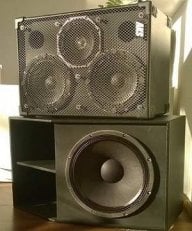
The MVW cabinet theoretically does more scrambling-up of the backwave energy than either a transmission line or dipole, and therefore should be less room-sensitive than either.
(De-correlation also has benefits further up the spectrum, but that's sort of a different topic).
Anyway that's my best guess at this point. This is all imo, ime, and ymmv.

That's [distributed multiple subs] indeed one of the best solutions, but it takes some experimenting to get the positions of the subwoofers right. A DSP with parametric EQ will also come in handy to give each subwoofer a dip in a certain frequency range.
Why does it [the manipulated vortex waveguide] theoretically scramble more then a dipole?
In my experience it's not nearly so complicated. Since the location of any one sub only has a fractional impact on the whole, no one sub's location is critical, which is not the case when you're trying to position a single sub.
......... The amplifier included has a single band of parametric EQ, but to the best of my knowledge none of my Swarm customers have felt the need to use it.
Geddes has achieved +/- 1.5 dB by measuring and DSP-correcting each individual sub using a proprietary algorithm that he wrote, so there is room for improvement over my less rigorous approach, but not a whole lot.

Okay I'm not one of the two people who really understands this stuff, so this is just my take:
Turbulence is manipulated into smearing the effective path length.

So, if I visualize it, I see little "tornados"(vortex) inside the MVW grabbing the sound-waves(with different frequencies) and then after some time spewing them out of the flares. So, what creates these little tornado's? panels distributed throughout the cabinet with different lenghts/angles etc?
And how does one know that the "panels" are dimensioned / positioned correctly to avoid the randomness of the little "tornados" and the affecting frequencies? To many variables, but that's just my opinion.....I wanna know how it works
My security clearance allows me to talk about what the cabinet does, but I'm not cleared to talk about how it does it.


I know.......
One of the things that impresses me the most about the genesis of the MVW cabinet is that Steve and Tom were attentive enough to notice an unexpected result in an experimental cabinet they built, and instead of dismissing it as impossible or an anomaly or a mistake, they relentlessly it pursued into uncharted territory. Their backgrounds had uniquely prepared them for this mission. They are both way out on the tail end of the bell curve, and they are not afraid to spend a weekend building test boxes just to learn one little thing. They work harder than kids play. They tell me over the phone about the approaches they take to this or that situation, and most of the time they are things that I literally never would have thought of. It's like I think in addition and subtraction (and have gotten fairly good at it), but these guys think in calculus and differential equations without even trying.



Seamonkey
I've tried to be civil. I've tried to take the high road. You are following back and forth to create a negative atmosphere. Since you have nothing positive to say and are casting an enjoyable discussion in a negative light. Everyone says to ignore the trolls. That's difficult for me to do as I feel it's not fair that every time you show up on a thread---it no longer makes me angry---it just saddens me.
I respectfully ask for you to not post on any of the threads involving my speakers. I know that there is no one on these threads that wants to hear from you. Your presence offers nothing positive.
I am going to strongly voice my opinions to the mods and have you unable to post in these threads.
Talkbass is nearly always a positive experience---even when opinions differ. I don't think it's fair that every time I open one of these threads I feel saddened by your presence.
Actually your petty rants have no influence on anyone's interest in my cabinets. I feel that when someone's presence only causes negativity (as the obvious goal)that it's not out of line to ask the mods to step in.
Arjank,
I believe some of the info you request may soon be available third party even.
Also don't think just tornados events just non-laminar.
BigE

Mike - I'm in with a question that occurred over the weekend. Have you had a chance to compare the modular version of the 210 flex to the 'all-in-one'? I am wondering if there is an audible difference having the 10" drivers in separate chambers versus one chamber.



Mike - I'm in with a question that occurred over the weekend. Have you had a chance to compare the modular version of the 210 flex to the 'all-in-one'? I am wondering if there is an audible difference having the 10" drivers in separate chambers versus one chamber.