• TalkBass has been independent since 1998. Add your voice.
    Create a free account to reply to discussions, view embedded media, and browse with fewer display ads.
    Join freeLog in
    Want zero display ads or expanded classifieds tools? Compare plans.

Blues substitutions

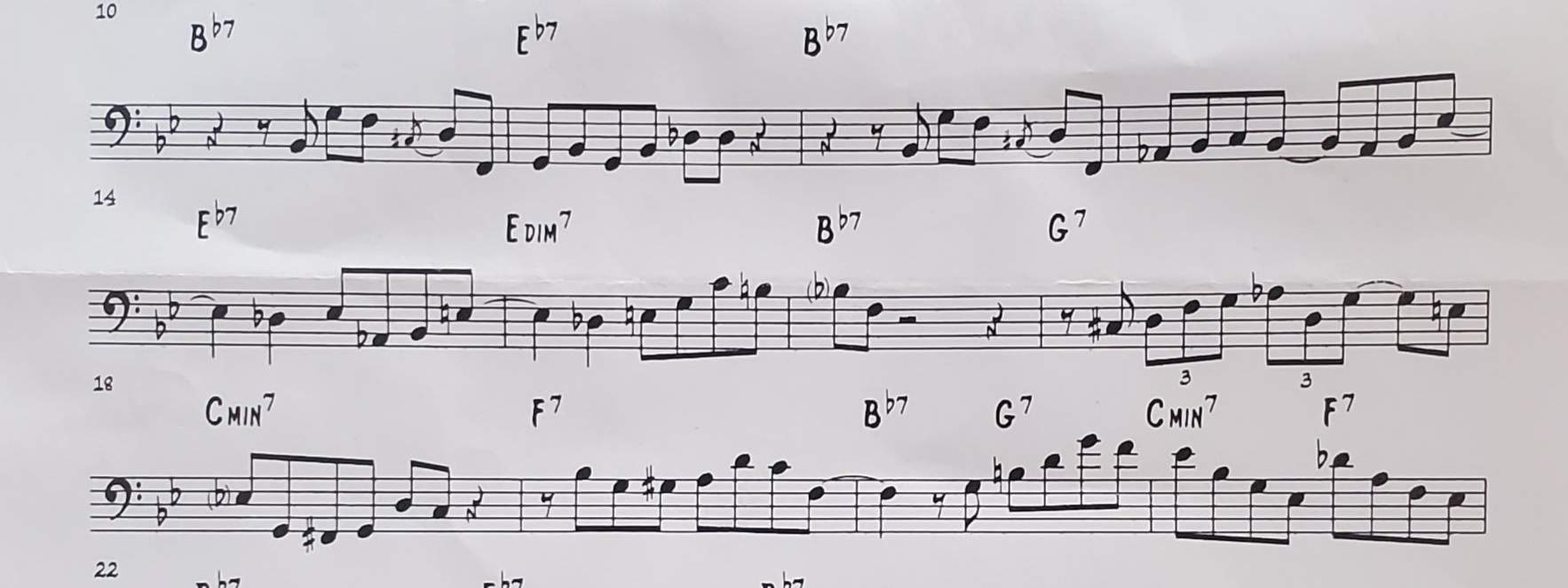
Can someone help me to understand the substitutions in this chord progression.

Bar 6 is a diminished substitution, correct? Is this just a common thing in blues? Or what is its point?

But then also in the 1-6-2-5 bits why is the G dominant and not a minor? That I really don't get.

Thanks!
20210606_074027.jpg
 
Can someone help me to understand the substitutions in this chord progression.

Bar 6 is a diminished substitution, correct? Is this just a common thing in blues? Or what is its point?

But then also in the 1-6-2-5 bits why is the G dominant and not a minor? That I really don't get.

Thanks!

View attachment 4293228
What you’re seeing is the result of jazz players embellishing on (spicing up) a standard 12 bar blues progression. The E dim. 7 in the sixth bar is a passing chord. This #IV diminished chord is often used to go from the IV to the V chord but it’s also commonly used in jazz blues progressions to lead from the IV to the I. It’s adding motion and flavour to the progression.

Regarding the G in the eleventh bar being a dominant 7th chord rather than a minor 7th chord: this is very common with jazz blues. The turnaround is still functioning as a I-vi-ii-V but playing the vi as a dominant 7th changes the flavour and opens some doors. To quote Mark Levine (from The Jazz Theory Book): “Playing (G7) instead of (Gm7) gives the progression a stronger sense of resolution going to (Cm7), and there are far more opportunities to alter dominant 7th chords than there are to alter minor 7th chords”.
 
What you’re seeing is the result of jazz players embellishing on (spicing up) a standard 12 bar blues progression. The E dim. 7 in the sixth bar is a passing chord. This #IV diminished chord is often used to go from the IV to the V chord but it’s also commonly used in jazz blues progressions to lead from the IV to the I. It’s adding motion and flavour to the progression.

Regarding the G in the eleventh bar being a dominant 7th chord rather than a minor 7th chord: this is very common with jazz blues. The turnaround is still functioning as a I-vi-ii-V but playing the vi as a dominant 7th changes the flavour and opens some doors. To quote Mark Levine (from The Jazz Theory Book): “Playing (G7) instead of (Gm7) gives the progression a stronger sense of resolution going to (Cm7), and there are far more opportunities to alter dominant 7th chords than there are to alter minor 7th chords”.

Brilliant, thanks!
 
  • Like
Reactions: bass12