• TalkBass has been independent since 1998. Add your voice.
    Create a free account to reply to discussions, view embedded media, and browse with fewer display ads.
    Join freeLog in
    Want zero display ads or expanded classifieds tools? Compare plans.

Double Bass Bowing posture

I recently started bowing my bass. . I started lessons, and I am working from the Simandl book with my teacher. I got a basic question about posture. I think I understand a comfortable position for me to play pizzicato. But I find that I need to bend forward to bow. Otherwise, my bow is over the fingerboard. Should my bow be between the end of the fingerboard and the bridge?
 
I second extending the end pin.

There is not necessarily and ideal position. Rather, you are seeking the best compromise between what is best for your left and right hands.

When standing you should expect to do somewhat of a dance with the bass...meaning the relationship between the bass and your body changes as you play up and down the neck. However (IMHO) in the lower positions you should not have to bend over to get the bow into proper position.


I will try this. It's so much getting the basics down. A lot to address.

I found learning to bow to be very difficult and frustrating at the beginning. It did eventually get better, but I thought about quitting all the time for the first 6 months. Good luck and hang in there. If you're like me, after 18 months of lessons and practice you'll be nearly mediocre! :)
 
I recently started bowing my bass. . I started lessons, and I am working from the Simandl book with my teacher. I got a basic question about posture. I think I understand a comfortable position for me to play pizzicato. But I find that I need to bend forward to bow. Otherwise, my bow is over the fingerboard. Should my bow be between the end of the fingerboard and the bridge?

As many suggests here, try rising the endpin. I did this after a couple of lessons and years of approaching the stance from a left hand comfort standpoint. I ended up with similar approach for both arco and pizz vs the right hand. Now I`m able to somewhat comfortably play pizz higher or lower on the fingerboard ( the default is loose and angled right arm ), and arco anywhere between the end of the board and next to the bridge. The distance relation between my arms remain mostly the same when I move higher on the board with my left hand. And when I need the percussive and sustaining pizz tone from the end of the board, or need to go even below the bridge, or on top of the tailpiece arco ( I play free improvisation stuff on top of everything else ), it`s much easier and comfortable now than with low endpin. All I have to do is bend forwards / backwards, and take a step back if I need my right hand really low. It took me some time to sort of relearn the left hand, but overall everything about my playing is better now after the change, sound, intonation, what have you.

FWIW I really learned to stand straight while bowing with even shoulders only recently when I started learning the french bow, now along with the german bow.
 
Last edited:
You want your bowing hand to be as comfortable (loosely straight, without unneccesary tensions) as possible. Set your bass height according this. The left hand can always move a bit up, that's not such a problem.
Unless you've got a shoulder impingement and can't raise your left arm up that much.

It has to be a compromise. I end up with a bit of bending forward to bow, just because I cannot lift my left arm high above my head for long periods, and because most of my playing is pizzicato in lower fingered positions. I suspect that if I were to try to turn myself into an orchestral bassist (I'm not going to) I'd have to use a stool, which changes the whole way one addresses the instrument, from what I've seen.
 
  • Like
Reactions: jj.833 and Wasnex
I find that I need to bend forward to bow

A teacher told me that the more I bend my knees, the better. I heeded his advice, & my technique immediately improved.

I find that I use different postures when playing in different neck positions, and different postures when playing in the same neck position on different songs.

My first inclination was to try to muscle the bass and the bow into producing the sound that I wanted. I now find that I do much better if I think about moving my body into a posture that better helps coax the sound you want out of the instrument. It's literally like I am dancing with the instrument. (Please don't tell my wife, 'cause I'm not really much of a dancer.)

And don't forget about the rule of 10,000 hours.

IMHO
YVMV
etc.
 
Very timely topic for me as I have started to have some muscle and tendon issues in my right leg. At my lesson yesterday I asked my teacher for some ideas and he suggested some things similar to material in posts in this thread. I will be looking into the Alexander Technique over the next few days and will see what my teacher has to say about it next week. I suppose the fact that I am 77 may have something to do with it too.:)
 
I've been using my phone video myself and I think I made progress although in the oppisite direction. I must also be must shorter then I thought because I put the pin all the way in so the bass is almost on the ground and I think I found my spot.
First. I raised the pin up to where the body and neck joint, (Heel?), were at my armpit. It was high. I couldn't jive with that height but the bow certainly ended up where I wanted. But I couldn't get comfortable. I also had a hard time standing with the bass if I attempted Thumb position. I felt and looked like I was leaning forward and the bass was leaning backwards and we leaned on each other. Like a teepee. Really not ideal for me. I ended up lowering it to the ground, referenced 'The Evolving Bass Player' Rufus Reid and came to the conclusion that I could do this better with the bass lowered. I guess for me a little bending over to bow is best.
 
I've been using my phone video myself and I think I made progress although in the oppisite direction. I must also be must shorter then I thought because I put the pin all the way in so the bass is almost on the ground and I think I found my spot.
First. I raised the pin up to where the body and neck joint, (Heel?), were at my armpit. It was high. I couldn't jive with that height but the bow certainly ended up where I wanted. But I couldn't get comfortable. I also had a hard time standing with the bass if I attempted Thumb position. I felt and looked like I was leaning forward and the bass was leaning backwards and we leaned on each other. Like a teepee. Really not ideal for me. I ended up lowering it to the ground, referenced 'The Evolving Bass Player' Rufus Reid and came to the conclusion that I could do this better with the bass lowered. I guess for me a little bending over to bow is best.

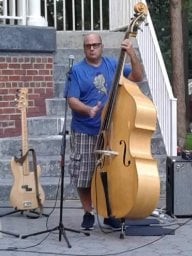
Having the end pin all the way while standing sounds really low to me. You mentioned before you and the bass were both at angle and met in the middle, but you were still bending. To me that means you actually want to raise up the bass even higher, so that your body can remain straight.

A rule of thumb i had learned from is that a good starting point to measure is when the bass is standing straight up, you want the nut of the bass to be around eye level or even higher toward the top of your head. With the end pin in, where does the nut of the bass line up to on your body?
 
  • Like
Reactions: Wasnex