• TalkBass has been independent since 1998. Add your voice.
    Create a free account to reply to discussions, view embedded media, and browse with fewer display ads.
    Join freeLog in
    Want zero display ads or expanded classifieds tools? Compare plans.

Brand New PV63s Defective

Disclosure: I do not have an amp so only way for my to know that pickups are working are tuner signals. I do have a multimeter but symbols confuse me on it. See below:

Got my new set of PV63s in and tried installing them on my primary Precision. No signal. Thought I installed the wires poorly so I tried them again, making sure solder joints are nice and shiny and the lead wire tip is touching the volume pot lug. Made sure everything else was secure. No signal.

Looked at the pickups themselves and they looked fine. Solder joints weren't loose or fraying.

Tried to install them on my 2nd Precision and same result. Made sure everything was done right. No signal.

I'm at a loss. I contacted the seller on eBay about a possible defective pickup but I don't know what's wrong.

I know there's a way to see if the pickups work via multimeter but I don't know what the symbols on mine mean:
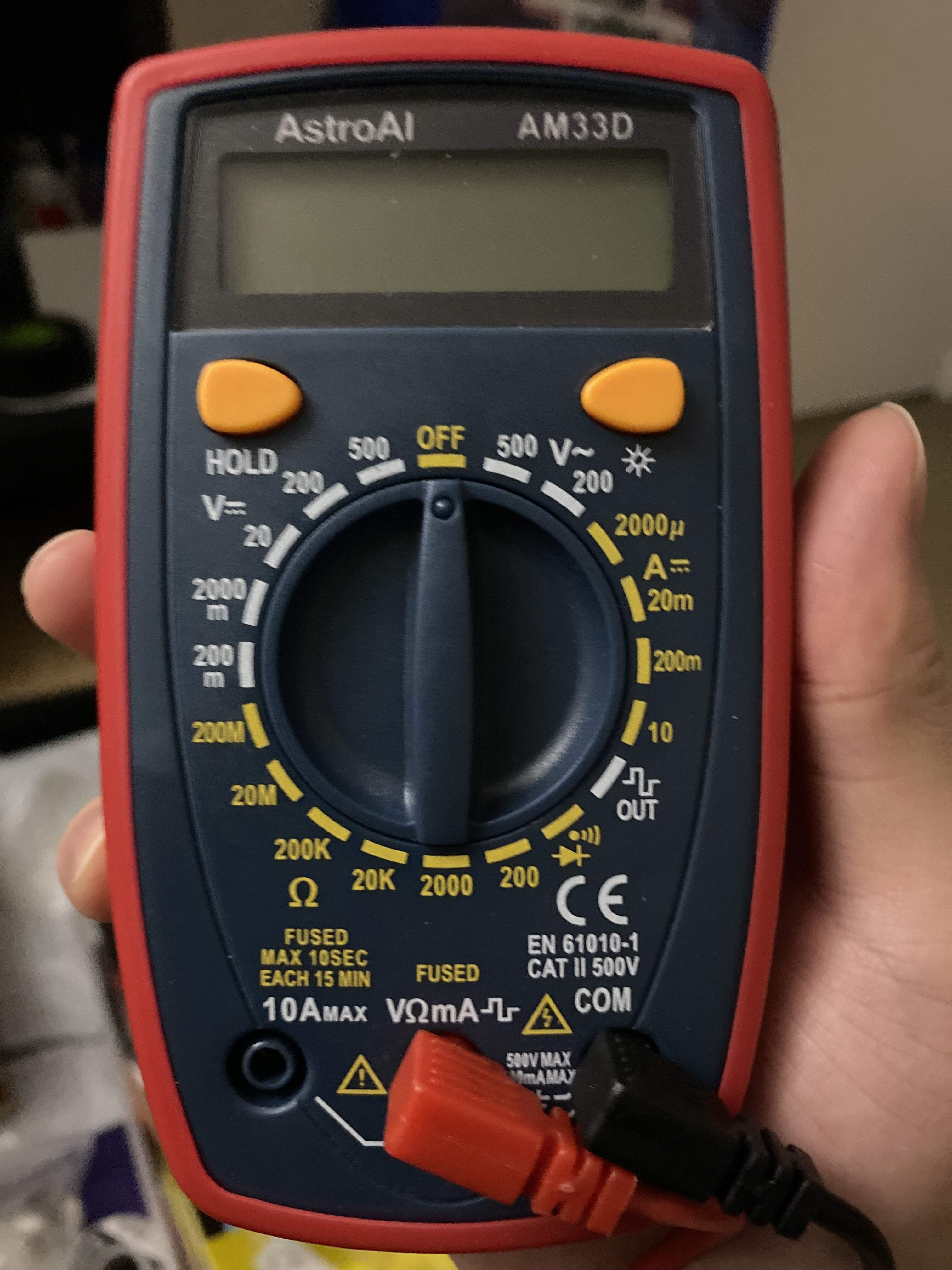

image.jpeg
 
You will use an ohm setting, probably the 20k setting in yellow at 7 o'clock on your dial.

Measure the lead wires on your pickup with the probes on your meter, make sure the pickup is not connected to anything. It should read somewhere around 12k ohms. If you dont see 12k you can move the dial around and try some different ranges, but it will definitely be one of the yellow ohm settings.
 
Your meter can really do a lot of things. I suggest you track down an instruction manual and learn more about it.
If you can't find the specific manual, you'll probably be able to find some generic info about using this class of test equipment. Except for a few specific features, most of these are pretty much the same when it comes to operating them.

Quickly... There is the Ohmmeter as already mentioned. Those scales are Yellow from 200M (200 megohm aka million ohms) through 20k (kilohm or thousand ohms) to 200 (ohms). The next on after 200 is a diode and or continuity tester. It will give you a beep on continuity. (Just touch the leads together as an example.)

The section with a V followed by a straight line over a dotted line is for measuring D.C. voltage.
The V with a wavy line is for A.C. voltage measurements.

For measuring DC current you use the A strait/dotted line ranges. This is a bit more complicated as you have to place the meter leads in line with the current flow. Definitely read up more on this before trying it.

Press the HOLD button so your reading stays displayed. The other button on the right is a back light for the display.

I think the white "square wave" symbol that also says OUT, will produce an audio tone that be used to trace signals through and audio circuit.

The primary difference between these meters often called called DMM (Digital Multi-Meter) or DVM (Digital Volt-Meter) is that some have Autoranging Functions where you don't need to select Voltage/Current/Resistance ranges. The meter automatically selects the range as needed. Your's is not auto-ranging, but thats OK. You might just need to change the range to get a proper read on whatever you measure.