• TalkBass has been independent since 1998. Add your voice.
    Create a free account to reply to discussions, view embedded media, and browse with fewer display ads.
    Join freeLog in
    Want zero display ads or expanded classifieds tools? Compare plans.

Double Bass Bridge adjuster at lowest point - need more

It sounds like given all of the above, cutting down the bridge top to the point where there is a little room to move the adjusters either way would be the best option, no?

I'd think so. You'll need to have the top reshaped/reslotted anyway, to match the fingerboard, so why not just take the material out there. I would ask them to make sure the feet fit to the top of the student's bass, and then set the string heights to whatever he likes, with the adjusters raised a turn or 2...
 
I think this is way easier to do well than deepening the string slots and the reshaping of the bridge that will be needed as well.

Not in my experience. Filing the string slots down to where you want them and recrowning the bridge on a belt sander is so much easier than making two precision cuts that have to be exactly right across three dimensions using a saw that may or may not be true.
 
Not in my experience. Filing the string slots down to where you want them and recrowning the bridge on a belt sander is so much easier than making two precision cuts that have to be exactly right across three dimensions using a saw that may or may not be true.

Of course, I take your point. If the OP doesn't have the right tools or know how to use them, it won't work. But he did say he's built guitars and is comfortable working with wood. I guess all I'd say is that I feel that shaping and slotting a bridge is one of the real skills of setup, and it can really affect the tone and playability of the instrument, and I've seen lots of very badly crowned bridges by people who thought they could just deepen the slots and reshape.
 
OK, well now I see both points of view!!

I do have a clamping sliding jig for my table saw (cabinet panel sliding miter setup) and feel like I could easily replicate a parallel straight cut across both legs. I just checked with a straight-edge and the cut across both legs is inline - meaning I could cut them in one pass. I had thought they were angled. That's actually great. Also have a drill press and end mill for deepening a hole if necessary.
 
B38.JPG


As a guitar builder, he should understand how strong binding tape is and has likely used it similar with a tablesaw.....

Chris: If your $$$ challenged student wants to give any one of these methods a try at the school woodshop, hit me up and I'll send a box of old bridges for them to work on.....
 
Hi all,

Got a Thompson RM100 (ply) Lefty and trying to get my D and G strings a little lower but when I got the bass the adjusters were already at their bottom setting. My strings at the 12th are 8, 7, 7 and 6. The E and A sound good but I think the D and G could improve with lowering I think (Spirocores).

How much work is it to rework the bridge so the adjusters have some adjusting in both directions? I've worked and built some guitars and am comfortable working with wood - I just would like to know where to remove some height.

Also, my relief measures 3mm in the center - which seems like a lot no?

Cheers!
I would lower the D an G
 
Hi all,

Got a Thompson RM100 (ply) Lefty and trying to get my D and G strings a little lower but when I got the bass the adjusters were already at their bottom setting. My strings at the 12th are 8, 7, 7 and 6. The E and A sound good but I think the D and G could improve with lowering I think (Spirocores).

How much work is it to rework the bridge so the adjusters have some adjusting in both directions? I've worked and built some guitars and am comfortable working with wood - I just would like to know where to remove some height.

Also, my relief measures 3mm in the center - which seems like a lot no?

Cheers!
I would lower the D and G slots to 6 and 5 millimeters with a small, round metal file.
OR move the whole bridge 1 mm to the E string side...
 
  • Like
Reactions: Don Hergert
View attachment 3588707

As a guitar builder, he should understand how strong binding tape is and has likely used it similar with a tablesaw.....

.....

James,

I don't care how strong you tape is. You should use Rotunda 4906 from RHC tapes. It is double sided adhesive, so you just stick the bridge onto the sliding jig. Way less movement during cutting than taping from the top. Comes off cleanly if you remove it quickly. Residue needs solvents if you wait too long. I use the stuff every freaking day. I don't know what I'd do without it actually...
 
Yes. That's what you should do if you need to fit a bridge that already has adjusters. If you are adding adjusters or need to remove some height from the top, and have access to a good table saw (not a contractor's saw from Home Depot) then that's a good way to go. I simply tape the bridge to a thin piece of HDF, using parallel bars against the fence to make it straight (Sliding jig not even necessary), and then adjust the fence to cut off the required amount.
 
  • Like
Reactions: james condino
Cool info here!! Thanks!

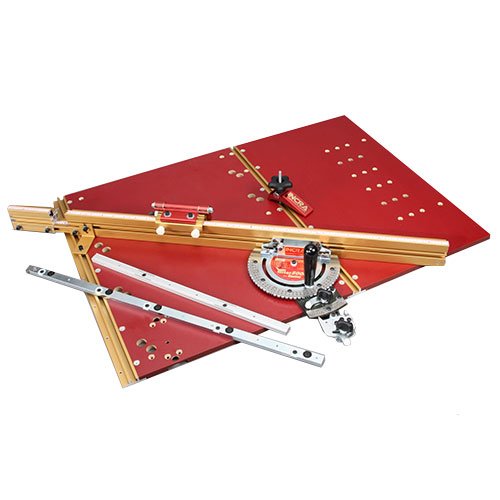
Here's what I use for cabinetry (below). It has lots of clamp options on the sled. But, as you say, affixed properly to a sacrificial squared piece run against the fence is all it takes.
41tAdJqrhwL.jpg

Damn man, I wouldn't even know what to do with all of that stuff:D
 
... It's easy to mess this up IME.
^^This (and IME too)^^

In addition to my DB, my mandos and banjos also have floating bridges and my mandos and my Dobro also have what could accidentally become a reversible saddle. It's always nice to know in advance how to put them back together correctly, and approximately where they were on the instrument before the project started.
 
  • Like
Reactions: warx
View attachment 3588707

As a guitar builder, he should understand how strong binding tape is and has likely used it similar with a tablesaw.....

Chris: If your $$$ challenged student wants to give any one of these methods a try at the school woodshop, hit me up and I'll send a box of old bridges for them to work on.....


Why do I find this image disturbingly suggestive of Edgar Allan Poe's "The Pit and the Pendulum"?
 
.....access to a good table saw (not a contractor's saw from Home Depot) ...
No tool shaming here. :) I have such a saw and can make very accurate cuts with it. But, the only time I trimmed adjustable feet, I had access to a really good disc sander with a rock-solid and accurate table. It took a few seconds per foot, and everything lined up square. Marking accurately is the key, and knowing how to follow your line.

 
  • Like
Reactions: Brent Nussey
While this may be obvious, it might be wise to check that the bridge is also in the right spot as it stands right now. Is it centered and is it the right distance from the end of the fingerboard or nut? I recently had a bridge trimmed down only to realize after the fact that the bridge was not centered, and also too close to the end of the fingerboard. I am pretty sure the person that did the work did not check those aspects of the bridge positioning and ended up putting the bridge right back where it was which was incorrect. On the plus side i am now comfortable positioning my own bridge, doing the measurements, etc.
 
While this may be obvious, it might be wise to check that the bridge is also in the right spot as it stands right now. Is it centered and is it the right distance from the end of the fingerboard or nut? I recently had a bridge trimmed down only to realize after the fact that the bridge was not centered, and also too close to the end of the fingerboard. I am pretty sure the person that did the work did not check those aspects of the bridge positioning and ended up putting the bridge right back where it was which was incorrect. On the plus side i am now comfortable positioning my own bridge, doing the measurements, etc.
Yes, move it one mm to the bass side, and the inbalance could be solved
 
Do you normally cut the feet before you fit them?

Neil, thanks for asking this! IMHO, it makes the job harder, unless someone has invented a jig to hold the disembodied feet back onto the bridge while fitting the feet.

This whole thread has got me thinking about bridge fitting. In the past 12 years I have probably fitted close to 100 bass bridges, mostly with adjusters, and almost entirely without complaints. There are a lot of variables involved in the full process! Recently I compared notes with another bass luthier on how we each do this job. Just between the two of us, there was a lot of "Really!? Huh, I guess that could work, but that's not how I do it..."

Don't even get me started on the threads up / threads down issue. No peace in Lilliputia!

To the OP, adjusters that are bottomed out make no sense. Either solution (removing wood from the crown or removing from the middle of the legs) will work. In your case there seems to be plenty of room at the crown, but that's not always the case.
 
  • Like
Reactions: warx