• TalkBass has been independent since 1998. Add your voice.
    Create a free account to reply to discussions, view embedded media, and browse with fewer display ads.
    Join freeLog in
    Want zero display ads or expanded classifieds tools? Compare plans.

Double Bass Bridge Adjusters Question

I've probably installed 40 or 50 adjuster sets. The composites were my favorite. We would usually run the wheel through a buffer to smooth out the sharp edges. I'd tap the feet twice over and add plenty of paraffin and/or graphite.

So, do you install them with the point on the end? How does that mesh with the hole you've drilled in the leg?

I wouldn't install adjusters that way because of the danger of breaking the leg with only a very slight height differential between the two sides.
 
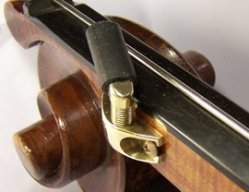
Here's a recent example of one of Hachez's bridges. As you can see, he's using a thick composite adjuster threaded into the feet, with a tiny amount of clearance at the legs to make adjusting under tension a little easier.

attachment.jpg

Paul, the New Harmony adjusters are slightly rounded. This gives them a slightly gapped look when sitting flush which is what this picture looks like to me. I am not aware of any bass luthiers purposefully leaving a gap between the leg and dial on the unthreaded side of the adjuster.
 
I am not aware of any bass luthiers purposefully leaving a gap between the leg and dial on the unthreaded side of the adjuster.
Actually, the bridges I have seen from Robertson's have a small gap between the wheel and the leg. They ride exclusively on the shaft's angled tip, which corresponds to the angle at the end of the hole. It's pretty slick, and they are easy to adjust, but I have modified a few of these to ride on the wheel and I thought they sounded fuller.
 
Two things:

1. Most of the luthiers I respect put the adjuster threads into the bridge feet. That includes Dan Hachez, Don Robertson, and Elisabeth Steves. It's easier to install everything on center this way. It also makes the adjusters easier to use when every turn isn't also turning the feet around.

2. Those luthiers are also using a composite adjuster with a conical stud. They look like this:
A1342.jpg

I didn't mean that I had a problem with the threads being face down - only that they look a bit skewed. I suppose that the conical stud is OK, but I'd be sure to match it to the point angle of the drill bit.
 
Hmm I'm interested in trying some Teflon tape on the end of the bridge leg that rests on the adjuster wheel now. I don't think I can feel comfortable having the bridge rest on just the posts.

IMO, teflon tape is Quatsch in all circumstances. "Quatsch" is a German word which I need not translate. It doesn't work well on pipe threads, for which it is marketed, so it especially doesn't work for anything else.
 
IMO, teflon tape is Quatsch in all circumstances. "Quatsch" is a German word which I need not translate. It doesn't work well on pipe threads, for which it is marketed, so it especially doesn't work for anything else.

Maybe this belongs in "TalkPlumbing," but Teflon tape works quite well for its marketed purpose, which is on pipe threads. That is, so long as you know how to use it. :)
 
Hi all

i've just taken my full circle off with the intention of putting my realist pickup back on. after removing the full circle, i've reinstalled my wooden adjusters. the adjusters aren't flush with the legs of the bridge.

is this wrong somehow? are the supposed to be flush?

any advice is welcome! thanks!

jeff reed

Jeff,
Regardless of the issue of whether the adjusters should be flush or not. Your front of your bridge is bending upward, and warping, which isn't something you want to happen. I'm not a luthier, but to me it looks like your adjusters are extended out to far. The whole setup looks out of alignment. Just my take.

Ric
 
Kolstein does it too, and puts a wad of teflon tape up at the tip, for ease of turning.
I added tape to my own bass to stop the bridge from rattling. After years of heavy use, the holes in the legs had widened slightly. The tape kept the pin from rattling, and made turning the adjusters way easier.
 
Jeff,
Regardless of the issue of whether the adjusters should be flush or not. Your front of your bridge is bending upward, and warping, which isn't something you want to happen. I'm not a luthier, but to me it looks like your adjusters are extended out to far. The whole setup looks out of alignment. Just my take.

Ric

Ric-- I agree that something seems amiss with the adjusters being out that far and angled. Note that the pic is upside down. The tailpiece end is at the top. What looks like warping may just be the curved/tapered upper side (lower in the pic) of the bridge.
 
Hmm I'm interested in trying some Teflon tape on the end of the bridge leg that rests on the adjuster wheel now. I don't think I can feel comfortable having the bridge rest on just the posts.

Maybe this belongs in "TalkPlumbing," but Teflon tape works quite well for its marketed purpose, which is on pipe threads. That is, so long as you know how to use it. :)

Joey,
I think that teflon tape would just bunch up and make a mess. I'd try some thin sheet instead.

Drurb, I know that teflon tape is standard for plumbing in North America, but have you ever tried hemp? It's popular in Germany. After using it once I've never used the tape again. Dupont conspiracy anyone?

As to sticking a ball of bunched up tape in the adjuster hole, I would recommend a thin disc of teflon instead. This would be more durable and also give you more control over the standoff distance. If you are using delrin adjusters, however, I see no benefit. Delrin against maple should be frictionless enough.

With wood adjusters, I think a healthy dose of graphite powder would be more effective, and have less impact on sound.
 
Joey,
I think that teflon tape would just bunch up and make a mess. I'd try some thin sheet instead.

I wasn't sure how durable the stuff was. There are plenty of easy things to make aluminum adjusters turn nicely however.

Back to the OP, I edited the photo to a better orientation. The bridge does not look warped, but at least the bass side adjuster seems to be sticking out at a weird angle. It's possible they are extended too far, introducing too much flexibility. I would consider having shims added to the legs so you have more of the threads in the wood.
 

Attachments

  • ImageUploadedByTalkBass1393879605.935874.jpg
    ImageUploadedByTalkBass1393879605.935874.jpg
    83.4 KB · Views: 157
I wasn't sure how durable the stuff was. There are plenty of easy things to make aluminum adjusters turn nicely however...

Sorry to keep nit picking, but IME, if the adjusters don't turn easily, it's more likely to be that the bridge isn't sitting straight, causing the stud to bind against the hole, rather than friction between the leg bottom and the wheel.
 

Latest posts