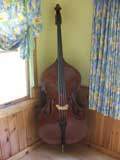
When you do take it to a luthier, have them check out the adjusters. It looks like they are kind off loose allowing the bridge to lean even more.

Enjoy the benefits of a premium membership!
Upgrade Account
-
TalkBass has been independent since 1998. Add your voice.
Create a free account to reply to discussions, view embedded media, and browse with fewer display ads.
Join free Log in
Want zero display ads or expanded classifieds tools? Compare plans.
You are using an out of date browser. It may not display this or other websites correctly.
You should upgrade or use an alternative browser.
You should upgrade or use an alternative browser.
Double Bass Bridge at a Worrying Angle
- Thread starter Claire1931
- Start date
More options
Who Replied?
Whole thing looks hinky to me. Adjusters too far out, top of bridge not parallel to feet, etc.
OP, you may just need to bite the bullet and have someone competent fit you a new bridge.
OP, you may just need to bite the bullet and have someone competent fit you a new bridge.

It appears that most of the comments here have given advice on how to persuade the bridge slant towards the tailpiece, which is what most of us need to do from time to time. OP's very first photo shows the opposite, that the bridge was already slanted (too much) toward the tailpiece... so most of the advice is wrong.
The bridge will not fall over in either direction. It won't fall toward the neck, because it's slanted the other way, and it won't fall toward the tailpiece, because the afterlengths won't let it. However, it might just break!
As @KUNGfuSHERIFF points out, it appears from the "after" photos that correcting the bridge's slant results in poor contact of bridge feet to the bass's top. To me, that indicates that the adjusters are poorly installed or that the entire bridge needs to be replaced.
The bridge will not fall over in either direction. It won't fall toward the neck, because it's slanted the other way, and it won't fall toward the tailpiece, because the afterlengths won't let it. However, it might just break!
As @KUNGfuSHERIFF points out, it appears from the "after" photos that correcting the bridge's slant results in poor contact of bridge feet to the bass's top. To me, that indicates that the adjusters are poorly installed or that the entire bridge needs to be replaced.
It might be possible to fill the holes and redrill the adjuster holes, but that is something the luthier decides if it is possible or not.
If possible it will be much cheaper than a new bridge.
Don’t try that yourself. Usually the adjuster holes are drilled when the bridge is one piece and the legs are cut afterwards to be sure that the hole is at the right place and angle.
If you try it, be prepared to pay for a new bridge with luthier fitting. That is a lot of work to do it right.
My luthier put some (drilled) wood on the bridge feet because I needed the bridge a bit higher. I probably would have done it myself, but the bass already was at the luthier for other things and I didn’t had the right type of wood and tools.
If you need the adjusters that high, that might also be a solution for your bridge.
Someone before did a bad job with the adjusters of your bridge.
If possible it will be much cheaper than a new bridge.
Don’t try that yourself. Usually the adjuster holes are drilled when the bridge is one piece and the legs are cut afterwards to be sure that the hole is at the right place and angle.
If you try it, be prepared to pay for a new bridge with luthier fitting. That is a lot of work to do it right.
My luthier put some (drilled) wood on the bridge feet because I needed the bridge a bit higher. I probably would have done it myself, but the bass already was at the luthier for other things and I didn’t had the right type of wood and tools.
If you need the adjusters that high, that might also be a solution for your bridge.
Someone before did a bad job with the adjusters of your bridge.
Sure looks like it was slanted towards the neck to me.OP's very first photo shows the opposite, that the bridge was already slanted (too much) toward the tailpiece

Could the feet be backwards?
Last edited:

Earl
Supporting Member
If you look at the first picture you can see it is slanted toward the fingerboard (you can see the end of the fingerboard.)It appears that most of the comments here have given advice on how to persuade the bridge slant towards the tailpiece, which is what most of us need to do from time to time. OP's very first photo shows the opposite, that the bridge was already slanted (too much) toward the tailpiece... so most of the advice is wrong.
The bridge will not fall over in either direction. It won't fall toward the neck, because it's slanted the other way, and it won't fall toward the tailpiece, because the afterlengths won't let it. However, it might just break!
As @KUNGfuSHERIFF points out, it appears from the "after" photos that correcting the bridge's slant results in poor contact of bridge feet to the bass's top. To me, that indicates that the adjusters are poorly installed or that the entire bridge needs to be replaced.

If you look at the first picture you can see it is slanted toward the fingerboard (you can see the end of the fingerboard.)
I think some confusion is arising because the first and third photos are upside-down, or at least they're showing upside-down in my browser.
I think some confusion is arising because the first and third photos are upside-down, or at least they're showing upside-down in my browser.
Yes, you're right. I'm wrong. Never mind!
I had posted “could the feet be backwards?” Could the whole bridge be backwards? I’m not seeing anything in the provided pics that tell me either way. The string slot widths leave it ambiguous to me. Anyone else look at that?

I had posted “could the feet be backwards?” Could the whole bridge be backwards? I’m not seeing anything in the provided pics that tell me either way. The string slot widths leave it ambiguous to me. Anyone else look at that?
It is possible that the feet could be backward or could have been reinstalled on the wrong sides of the bridge. We had a school bass that had the bridge knocked over and completely off(!) and the feet separated from the bridge. Whoever put it back together reversed the feet (E foot on G leg and G foot on E leg). Took us a while to figure it all out, but boy the bass sounded like cr*p until we did.


Please don't install discarded British Saxophone parts on American Double Basses.
As I recall, we fought a war over these issues a long time ago...and we won.
Thx.


