• TalkBass has been independent since 1998. Add your voice.
    Create a free account to reply to discussions, view embedded media, and browse with fewer display ads.
    Join freeLog in
    Want zero display ads or expanded classifieds tools? Compare plans.

Bridge cover, pickup cover. What are they for?

holllowbody

Guest
Mar 25, 2009
148
0
So I have been noticing that some basses have metal covers / shields over the bridge and pickup(s). Many basses don't have them though.

Anyhow, I can't seem to figure out what purpose they serve.

Anyone here know what these covers are for and why some basses have them and others dont?

Thanks
 
The original P bass had one single coil pickup with a cover that was grounded to reduce noise. The bridge cover had a foam strip on the inside that dampened the strings to reduce sustain and emulate the sound of upright basses. Both covers started with functional purposes but now with noiseless pickups and sustain being a good thing, I suspect they are strictly design elements.
 
The pickup cover makes a good palm rest for those of us with lazy hands.

The bridge cover helps to increase sustain by preventing palm muting ...again for those of us with lazy hands who pick near the bridge.
 
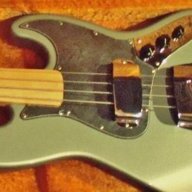
I just like the vintage vibe - these are original and there is foam residue under the bridge cover:
 

Attachments

  • '76 P FL.jpg
    '76 P FL.jpg
    183.2 KB · Views: 334
The original P bass had one single coil pickup with a cover that was grounded to reduce noise. The bridge cover had a foam strip on the inside that dampened the strings to reduce sustain and emulate the sound of upright basses. Both covers started with functional purposes but now with noiseless pickups and sustain being a good thing, I suspect they are strictly design elements.

There is an alternative to that history lesson. I have read in several places that Leo Fender put on the bridge cover/foam to protect the bass in transit. It was meant to be removed when played. Among Motown aficionados and insiders, it is claimed James Jamerson did not know this and kept it on his bass, thus giving, in combo with his aged flatwound strings, that upright "thud" sound. Since then, those who want emulate his sound have kept the cover on their P bass and have added foam under the strings to deaden the sound.
 
There is an alternative to that history lesson. I have read in several places that Leo Fender put on the bridge cover/foam to protect the bass in transit. It was meant to be removed when played. Among Motown aficionados and insiders, it is claimed James Jamerson did not know this and kept it on his bass, thus giving, in combo with his aged flatwound strings, that upright "thud" sound. Since then, those who want emulate his sound have kept the cover on their P bass and have added foam under the strings to deaden the sound.

As the rumors of Leo's parsimonious nature happen to exist even to the extreme of using floor tiles for dots and fret markers - I dunnow if I'd give this story much credence.

Bending metal, drilling it and chrome plating it - not to mention another two screws just for a shipping protector is kinda off the radar for me, personally.
 
As the rumors of Leo's parsimonious nature happen to exist even to the extreme of using floor tiles for dots and fret markers - I dunnow if I'd give this story much credence.

Bending metal, drilling it and chrome plating it - not to mention another two screws just for a shipping protector is kinda off the radar for me, personally.

he only said the foam was meant to be removed
 
There is an alternative to that history lesson. I have read in several places that Leo Fender put on the bridge cover/foam to protect the bass in transit. It was meant to be removed when played. Among Motown aficionados and insiders, it is claimed James Jamerson did not know this and kept it on his bass, thus giving, in combo with his aged flatwound strings, that upright "thud" sound. Since then, those who want emulate his sound have kept the cover on their P bass and have added foam under the strings to deaden the sound.

I doubt that to be the case. As said above, the original P basses were grounded through the pickup cover and had foam in the bridge cover. P basses continued to be sold with foam mounted in the cover, and in 1960 the jazz bass was also introduced with a muting system mounted on the bass under the cover which changed over to a strip of foam in 1963. They continued to ship with foam into the late 70s - my 78 fretless P came to me with the original covers has the glue strip from the foam. The covers would be a big cost to manufacture and install just to protect an instrument in shipping, especially when they could just ship them in the hard cases or add some foam into the shipping box.
 
There is an alternative to that history lesson. I have read in several places that Leo Fender put on the bridge cover/foam to protect the bass in transit. It was meant to be removed when played. Among Motown aficionados and insiders, it is claimed James Jamerson did not know this and kept it on his bass, thus giving, in combo with his aged flatwound strings, that upright "thud" sound. Since then, those who want emulate his sound have kept the cover on their P bass and have added foam under the strings to deaden the sound.

I doubt that. I have seen pics of '51 P-basses with the pickup covers removed, and you can clearly see the grounding wire from under the pickup located at the mounting hole for the cover. The original intention wass indeed for shielding (even tho it didn't really work) and, as Leo originally had the idea that the bass was to be played with the thumb,the cover would also serve as a palm rest. Leo never intended for the cover to be removed.
 
As the rumors of Leo's parsimonious nature happen to exist even to the extreme of using floor tiles for dots and fret markers - I dunnow if I'd give this story much credence.

Bending metal, drilling it and chrome plating it - not to mention another two screws just for a shipping protector is kinda off the radar for me, personally.

Exactly right. Same reason he originally wanted to use Alder as a body wood. Not because of tone issues, but because it was cheaper and more readily available. Basically, Leo was a cheapskate. He wouldn't have went to all the trouble and expense just for a shipping protector as Joe says when a piece of shaped cardboard would have sufficed for such a use.
 
BluesWalker said:
I have read in several places that Leo Fender put on the bridge cover/foam to protect the bass in transit. It was meant to be removed when played.

Well that is totally false because Leo himself drove in his car to many States far away, to display, and hand deliver those early Precision Basses. He would show players how he intended the instrument was meant to be played; resting your palm on the pickup cover and either plucking with your thumb or picking. Remember, the focus was to mimmick the sound of an upright.

The Precision was out for 8 years before Jamerson ever picked one up.