• TalkBass has been independent since 1998. Add your voice.
    Create a free account to reply to discussions, view embedded media, and browse with fewer display ads.
    Join freeLog in
    Want zero display ads or expanded classifieds tools? Compare plans.

Double Bass Bridge work video!

If these could be built for a reasonable cost, they may be good for schools, especially grammar and high school. Also where there are humidity issues. I have a carbon fiber guitar and it's great.

But I'd certainly rather have a wooden bass. Can't wait for the new Upton I ordered!
 
Invalid Link Removed

Behold!

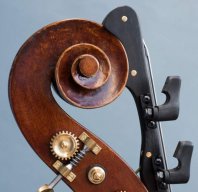
I may be young and an inexperienced player, but I am apprenticing at a shop, and I know what I like, especially in basses, and to quote forester, "me no like". The scroll, the shape, and color, and the tone just seems "superficial" and for $12,000, lacks the depth you would find in a quality carved instrument for that price. That's just my opinion, you may hear it differently, and may like it.

But if you think logically, the thicker the sound board (in this case, the top of the bass), the less it's going to vibrate. That's the general rule. The pressure exerted on the top of a bass by the strings on the bridge is roughly 3,000lbs. Now, I don't know how strong carbon fiber is compared to wood, but to support that, I would imagine it would have to be near as thick as a good double bass top anyway. I may be wrong. But wood is resonant, and something like a thick piece carbon fiber just doesn't seem to me like it would vibrate like a good thick piece of tone wood carved to perfection. The resonant properties of wood are superior in my opinion to carbon fiber, so all things the same, wood wins in my opinion. I would imagine this would sound and resonate something like a laminate bass, but probably not quite as good considering again, wood vs carbon fiber.

Just my two pennies!
 
If you pick up a carbon fibre rod, it is light and stiff and rings every bit as well as spruce.

The advantages I can see are from a production and durability point of view. IF the sound is what you like to hear, then the prospect of no visits to your luthier, ever, might be appealing and very cost-effective.

On the down side, there is something about wood that is unpredictable and it is, in part, what the wood takes away from the sound that gives an instrument its character. it's not just the thickness of the top, its the shape and the arching.

You might want to check your maths about the 3000lbs, too. Seems a bit on the high side.
 
Matthew

The 3000lbs figure is just what the luthier I'm training under told me. Today actually we were fitting cello bridges, and he said 2000lbs for a cello, and I asked about bass and he said 3000.
I can definitely see it being an advantage about the humidity thing in schools mentioned. They won't crack like a carved bass, and my guess is they won't warp like some cheaper ply's will.

Has anyone here ever carved carbon fiber? Can it be done like wood can?
 
You could test the theory: take the bridge/string-jack you use when working on cellos, and see if you can lift the back of a small car with it--just twisting with your fingers, mind you. You can certainly lift those strings with it...

I think somebody may be off by a decimal point, anyway...just a guess. But I am pretty sure that a ton pressing down on the < 1 square inch that the bridge feet cover would not only crush the cello, but mash right through it, crushing the bridge, and everything else in its way. I'd be surprised if it were even 200 lbs, but maybe... Same sort of deal on the bass.

I have carved carbon fiber, and either my wood tools are not good enough (I admit I don't go in for the top-dollar stuff) or this stuff is REALLY hard on steel tools. I did manage to trim the CF bars I installed in the neck, but it dulled my tools almost instantly. Not fun--in future I will figure out another way to trim the things.

Chet
 
Chet
2000 and 3000lbs does seem a lot. I'll recheck with him, but I am sure that is what he said. I'm not saying he's right, just that I'm sure he said thousand, not hundred or anything like that.
And considering if you set a car down on a bridge it would probably break...I mean it's easy enough for them to warp...
 
I'm just curious as to what you don't like here?

lifeless;inanimate..irrespective of its attributes.(everything about it gave me the creeps)

opening the case on a hot afternoon will the salute be fragrance or an odor?

it is WOW worthy...but falls short of the GAWD when confronted with a traditional wooden aristocrat.

normal disclaimer: should the above apply to,or in anyway resemble person or persons etc,etc...
 
He may have said foot/pounds (ft/lbs) which would translate to a support weight of about 20-30 lbs in total for the bridge. This seems very reasonable, in fact rather little. Try lifting one foot of a bass bridge off the belly and you'll get an idea of how much pressure is there! I can just about get one foot in the air with a Clark Kent style groan! That has to be more than 60 lbs. So 3000 ft/lbs does seem conservative! Of course this will vary from bass to bass with bridge height and string tension being major factors. I have a 5er with a highish bridge with Tomastik reds on so....
After all he asked for pressure and not total weight and pressure is measured in 'weight per area'. I'm off to hunt the net for some details on this....
 
IIRC your average bass string pulls 60-70lbs longways, but the downwards moment of this is about 15%-20% so you're looking at around 50lbs downwards tension. But it'll depend on lot of things. Maybe yr luthier was talking foot-lbs, I've never heard it expressed like that. if that's the case, and say your bridge foot is 1" square, that brings 3000 down to 21 lbs x 2 is 40lbs ... we're in the ballpark already. But I don't guarantee your maths. I always say the belly has to support a weight like a child standing there...

There's no POINT carving carbon fibre. You build it up to the thickness you want, then that's IT. if you did carve it, you;d weaken it cos you'd be cutting into the carbon fibres.
 
I have carved carbon fiber, and either my wood tools are not good enough (I admit I don't go in for the top-dollar stuff) or this stuff is REALLY hard on steel tools. I did manage to trim the CF bars I installed in the neck, but it dulled my tools almost instantly. Not fun--in future I will figure out another way to trim the things.

Chet

I had the same experience. Now I make sure the CF reinforcement is buried deeper in the neck with lots of wooden ripping over top. If I do need to work the stuff, I use sandpaper. It grinds off pretty smoothly. :)
 
Yup-- I did manage to think that far ahead. The CF bar was OK as far as the level at the surface of the neck-- but I installed it so that it protruded into the pegbox, thinking i could just trim it flush. (Yow!!..Bad idea!) A dremel with a grinder might have been a better approach, but I had burned my dremel up, at the time, trying to cut a purfling slot for a bass-back, and had not yet replaced it. :-)

Chet
 
I doubt there is much of a market at $12K. If they were reasonable, say $1500 -$2000 then they may be good for schools if you think they will last 20 years with little to no work needed on them. Carbon Fiber is incredibly strong. The necks are super stable and do not move.

A lot of folks just will not be able to get over the CF material compared to traditional wood. But if humans are around in 1000 years, these may be what is used 99.99% of the time, or a material like it.
 
lifeless;inanimate..irrespective of its attributes.(everything about it gave me the creeps)...
Thanks for the clarification. Since the OP and the thread title was focused on the setup portion of the site...I thought you were finding objection in the setup.

Personally I have never cut any instruments bridge foot with a chisel and it seems odd but I would give it a go. I use a knife myself...and so do all the guys here at the shop as well as almost all the makers I have studied with and/or been around.
 

Latest posts