What's wrong with keeping the bridge that your bass comes with? What is the difference between bridges? Why would you buy a different bridge? All they do is hold strings and set up intonation right? So once intonation is set, who cares?

Enjoy the benefits of a premium membership!
Upgrade Account
-
TalkBass has been independent since 1998. Add your voice.
Create a free account to reply to discussions, view embedded media, and browse with fewer display ads.
Join free Log in
Want zero display ads or expanded classifieds tools? Compare plans.
You are using an out of date browser. It may not display this or other websites correctly.
You should upgrade or use an alternative browser.
You should upgrade or use an alternative browser.
Bridges
- Thread starter WilliamSandoval
- Start date
More options
Who Replied?

For me, there are a couple reasons why I might change the bridge:
1) Aesthetics. If all the hardware is chrome and the bridge is black, it might bother me just a touch. Similarly, if the bass has really nice, cast hardware and looks really elegant and then has an old style fender "bent-plate" style bridge, I might want to change it to individual lock-down saddles or something.
2) Weight. There is a belief out there that a heavier bridge sustains more and has a more fundamentally strong tone.
3) Quality. The bridge on my MIM Pbass had one of the saddles keep slowly riding down the height-adjustment screw until the action and intonation was off by a noticeable amount. I eventually replaced it with an aftermarket version of the same bridge and haven't had the same issue.
If the bridge that comes with/on the bass is solid, it generally doesn't matter (IMHO)
1) Aesthetics. If all the hardware is chrome and the bridge is black, it might bother me just a touch. Similarly, if the bass has really nice, cast hardware and looks really elegant and then has an old style fender "bent-plate" style bridge, I might want to change it to individual lock-down saddles or something.
2) Weight. There is a belief out there that a heavier bridge sustains more and has a more fundamentally strong tone.
3) Quality. The bridge on my MIM Pbass had one of the saddles keep slowly riding down the height-adjustment screw until the action and intonation was off by a noticeable amount. I eventually replaced it with an aftermarket version of the same bridge and haven't had the same issue.
If the bridge that comes with/on the bass is solid, it generally doesn't matter (IMHO)

The material and density of the bridge are all factors in tone, clarity and sustain. If you installed a badass II or III bridge on your jazz I bet that the difference in sound will be worth the money and for the better, I put one on my P bass and it just opened up the sound of the instrument. Some models or makes come with pretty hefty bridges stock, like stingrays for example. Some people may say if it ain't broke dont fix it. But for a small price you can improve your bass in a fairly large way with minimal work.

I have a MIM Jazz and after a few years of playing the standard bridge did the same thing as BananaKing's P, the saddle on the A string just kept riding down and it was unplayable. Ended up putting a Gotoh bridge on it which is great, though I don't know if I really noticed much change in tone or sustain.

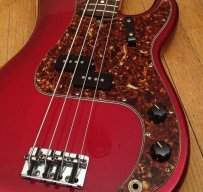
On my Squier P Bass Special (dinosaur) the bent-metal Fender called a bridge was inadequate. The string saddles did slide around a bit affecting playability when finger playing anchored on the back pickup.
So I did not spend a lot of moola but replaced it with a Classic Vibe '60 J bass bridge in chrome. It is similar to a Gotoh 201 but the string plate is solid metal and the string spacing is a tad wider, which is cool. (see Angela Instruments)
It did get me sustain in places I did have it before. And the intonation can now be set to the 19th fret and even harmonics are dead on.
I am weird like that-liking to verify the intonation by 7th fret harmonics.
So mine was broke and I fixed it. This will be my backup bass so it needs to get a little bit upgrading.
LLater 'player
So I did not spend a lot of moola but replaced it with a Classic Vibe '60 J bass bridge in chrome. It is similar to a Gotoh 201 but the string plate is solid metal and the string spacing is a tad wider, which is cool.
(see Angela Instruments)It did get me sustain in places I did have it before. And the intonation can now be set to the 19th fret and even harmonics are dead on.
I am weird like that-liking to verify the intonation by 7th fret harmonics.
So mine was broke and I fixed it. This will be my backup bass so it needs to get a little bit upgrading.
L
Later 'player
Most current Gibson/Epiphone basses have one of the worst bridge designs ever. The strings themselves actually hold the bridge and saddles in place. This means that whenever you have to take the strings off, the bridge falls off and the saddles fall out of the bridge, thus screwing up any sort of intonation(I am currently considering replacing it). That seems like a pretty good reason to replace a bridge to me.
right, mechanical deficiencies are the main reason to upgrade.
as for intonation, as long as the saddles can be moved far enough either way, there's absolutely no difference between one bridge and another.
as for intonation, as long as the saddles can be moved far enough either way, there's absolutely no difference between one bridge and another.
right, mechanical deficiencies are the main reason to upgrade.
as for intonation, as long as the saddles can be moved far enough either way, there's absolutely no difference between one bridge and another.
+1
Personally I am of that school. IF you play with a great deal of harmonics & there is some serious deficiency in that area, replacement would be an option but if all is well I would leave things be. Most problems with an instrument occur from addressing a issue that does not exist. Additionally, if you re-sell that Bass, original equipment is a plus, it's very rarely a detraction.

What's wrong with keeping the bridge that your bass comes with? What is the difference between bridges? Why would you buy a different bridge? All they do is hold strings and set up intonation right? So once intonation is set, who cares?
Nothing's wrong with it. I have only replaced one bridge, and that was because I changed the hardware from chrome to black.
Some bridges have more / less adjustment than others, some bridges set strings higher, some are heavier than others.
Yup, they secure the strings, set intonation and convey vibrations from strings to body. They also affect the balance of the instrument due to weight.
My approach to bridges is that unless there is a mechanical problem with the bridge that cannot be corrected, use the original bridge that the manufacturer installed on the instrument.
People obsess, fuss and worry WAY too much about bridges when they should spend their time practicing instead.

I literally had one of the barrels fall out of a MIM P-bass once - mid gig. I switched to a Gotoh and loved it. Sold the bass, loved the bridge. I think unless you are 100% sure you know (a) what you want and (b) what you expect from a new bridge, don't do it. Chances are, if you bought the bass with that bridge, you'll be happy for the rest of it's life with what you have. Unless is drops a barrel ... 
Poor design and aesthetics. I'm of the opinion that bridge mass/material don't make any significant difference, as long as it's well-designed and well-built.
However, I'm a real stickler for aesthetics - majorly anal-retentive in that regard - and so I swap bridges a LOT. My all-time favourite is the Hipshot A-style - I must have bought at least ten of those to date - and I'm also very fond of the Hipshot Vintage.
However, I'm a real stickler for aesthetics - majorly anal-retentive in that regard - and so I swap bridges a LOT. My all-time favourite is the Hipshot A-style - I must have bought at least ten of those to date - and I'm also very fond of the Hipshot Vintage.


