...but the main reason, is the sound I've experienced from Pöllmann; have had two, one from the -70s, one from the -80. The -70 was the best sounding bass I've ever come across, the other really great, both with that special Pöllmann sound, dense and a little dry, projective, sounding at it's best from a distance. Those were build by the late father of the brothers. I have never heard builds by them, so it's a bit nervous...expect it will sound pöllmannish though!The Pollman is beautiful! Why did you decide to go Pollman as opposed to Ham, Radelet, or Upton? I wonder if the right upper bout of the Schnitzer Ergobass is similar.

Enjoy the benefits of a premium membership!
Upgrade Account
-
TalkBass has been independent since 1998. Add your voice.
Create a free account to reply to discussions, view embedded media, and browse with fewer display ads.
Join free Log in
Want zero display ads or expanded classifieds tools? Compare plans.
You are using an out of date browser. It may not display this or other websites correctly.
You should upgrade or use an alternative browser.
You should upgrade or use an alternative browser.
Double Bass Brock Radelet basses
- Thread starter Mike Goodbar
- Start date
More options
Who Replied?
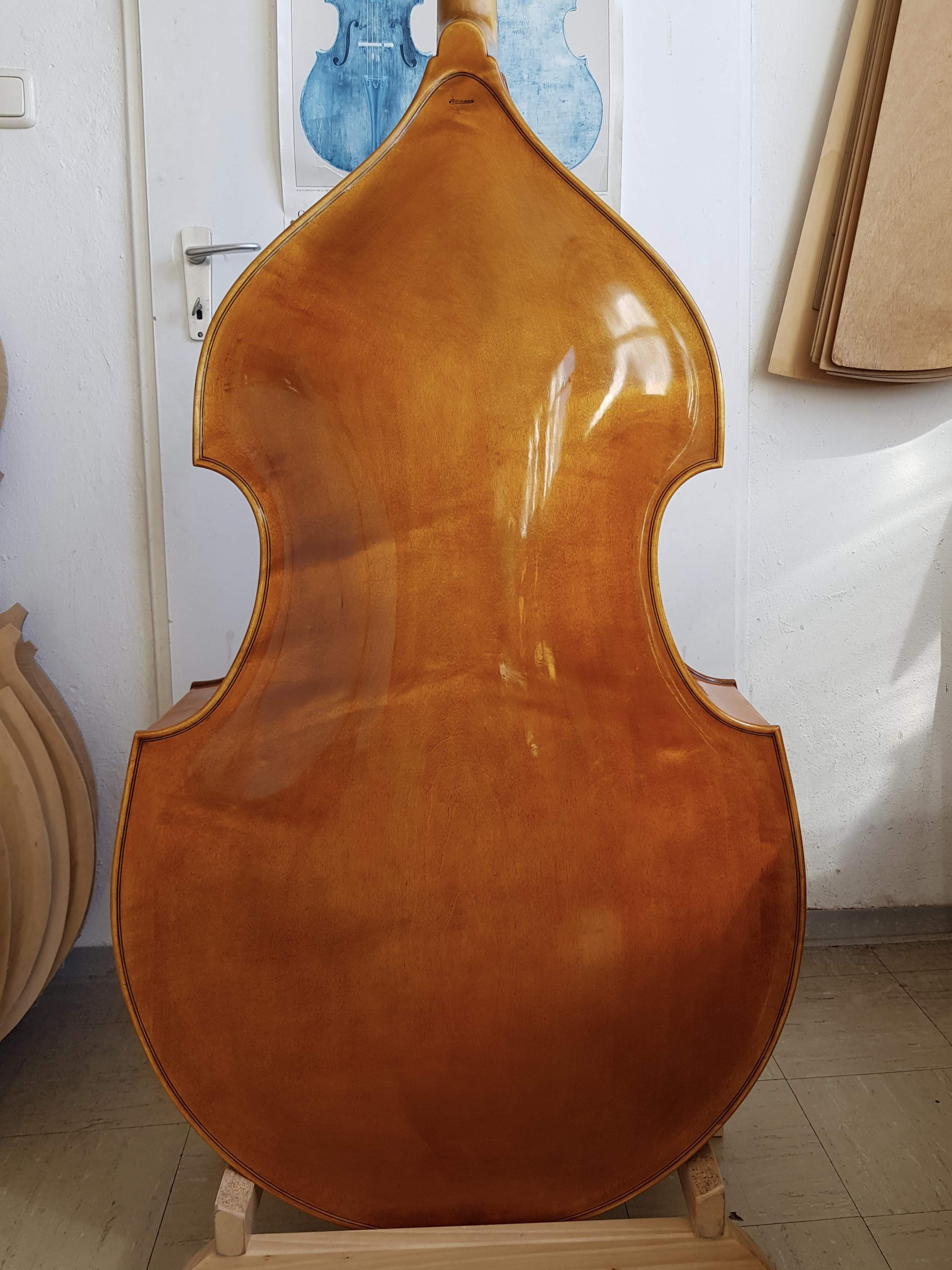
…every wish I threw at the pölllmanns came back just as I had specified:
a one piece back with a very discreet wood pattern
an open scroll
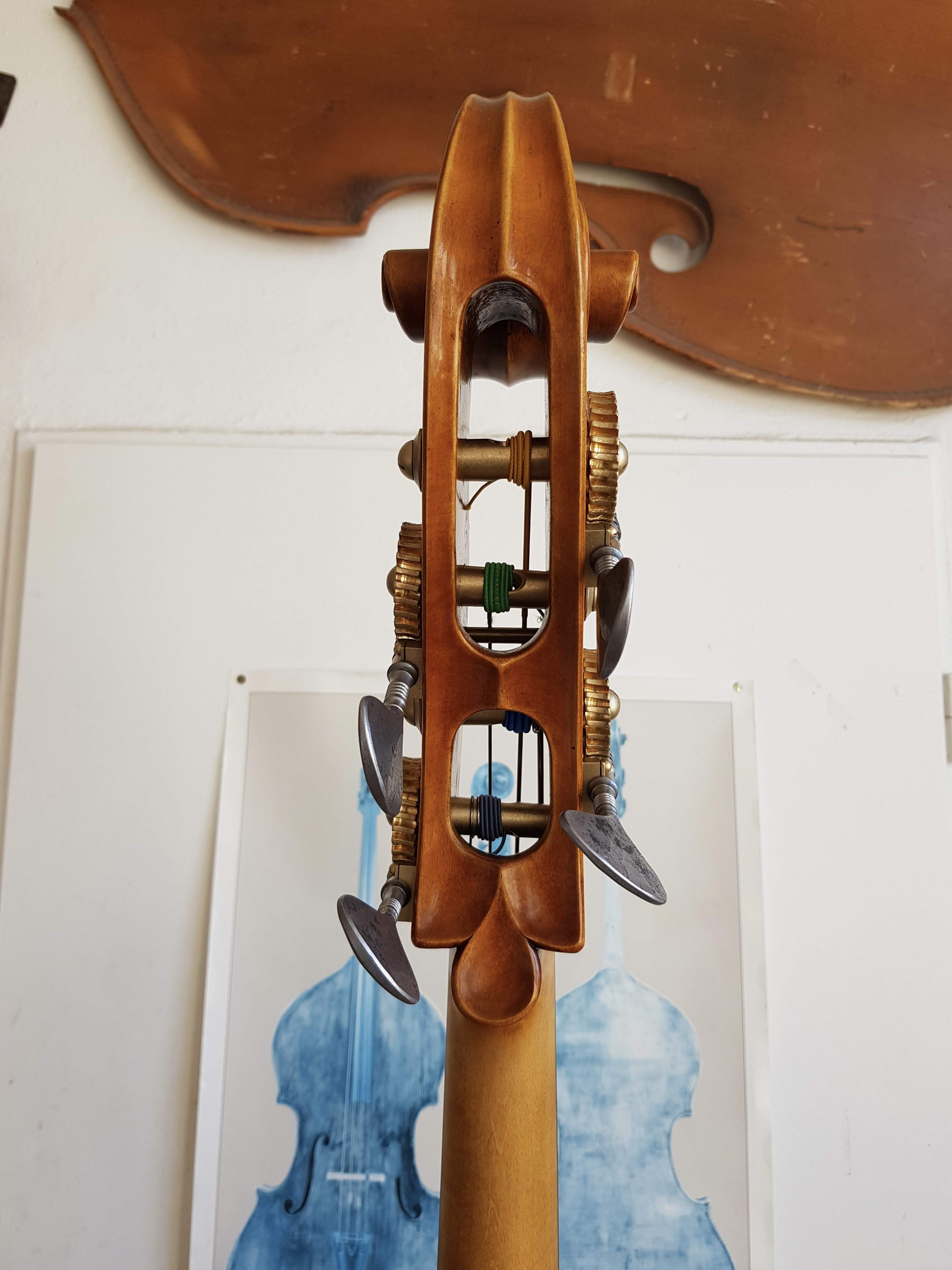
“fairly light reddish golden brown varnish”, a longer tailpiece, titanium endpin, and so on…
a one piece back with a very discreet wood pattern
an open scroll
“fairly light reddish golden brown varnish”, a longer tailpiece, titanium endpin, and so on…

.......I've played d-neck for 40 years, never even tried an eb-neck, my decision to switch are based on pure logic and the feel when playing; the d-neck feels more and more like an annoying obstacle, a road bump. The only reason to stick with the d would be if you have two basses and like to switch seamlessly. Eb is OUTRIGHT better for the modern player!......
Well....everyone is entitled to their own opinion.....
For contrast: I've built basses with necks that have D heels, E flat, and F. Of all of those, the F makes the most sense to me because it puts your left hand directly over the octave harmonic so the next shift is the octave. That particular neck has also received more b!tching and whining and complaining from so called "modern", "educated" players than any instrument I have ever seen in 50+ years of playing and being around musicians & 40+ years of building instruments. I now build all of my bass necks with a D heel and have no plans to change it.
Well....everyone is entitled to their own opinion.....
For contrast: I've built basses with necks that have D heels, E flat, and F. Of all of those, the F makes the most sense to me because it puts your left hand directly over the octave harmonic so the next shift is the octave. That particular neck has also received more b!tching and whining and complaining from so called "modern", "educated" players than any instrument I have ever seen in 50+ years of playing and being around musicians & 40+ years of building instruments. I now build all of my bass necks with a D heel and have no plans to change it.
I still vote for the F neck, largely for the reasons you cited. Over on the EB side we have players who play long scale, medium scale, and short scale and have no trouble making the transition, even on the same gig. On this side we have people who play fractional basses in addition to the standard 3/4. How difficult can it be to mentally re-calibrate when you go from D to Eb to F neck? Especially when we use our ears to assess intonation accuracy rather than exact position along the neck. Many many people on this forum have said that, depending on climate change and other factors, the notes on a DB neck move, which is why side markers can be misleading.
Well....everyone is entitled to their own opinion.....
For contrast: I've built basses with necks that have D heels, E flat, and F. Of all of those, the F makes the most sense to me because it puts your left hand directly over the octave harmonic so the next shift is the octave. That particular neck has also received more b!tching and whining and complaining from so called "modern", "educated" players than any instrument I have ever seen in 50+ years of playing and being around musicians & 40+ years of building instruments. I now build all of my bass necks with a D heel and have no plans to change it.
not a personal opinion, just plain facts: in orchestra playing reaching the first octave without going to thumb position is an advantage. And the heel placement dictates your maximum reach for the highest note. I'm talking from the arco players perspective, don't think the pizz people wander in these quarters very often, the right hand would come in their way.
An f stop would make for a rather long neck, could there be any constructional issues here, a must to build it thicker?
Thank god for people like James Ham, Gary Karr and Albert Einstein who dare to think outside the box!
Last edited:
Thank god for people.......who dare to think outside the box!
Are you really saying that to me??????
Get over yourself.
Are you really saying that to me??????
Get over yourself.
not at all James, that was a general statement, you may well be included in that outside the box gang, doesn’t know you at all!

not a personal opinion, just plain facts: in orchestra playing reaching the first octave without going to thumb position is an advantage. And the heel placement dictates your maximum reach for the highest note. I'm talking from the arco players perspective, don't think the pizz people wander in these quarters very often, the right hand would come in their way.
An f stop would make for a rather long neck, could there be any constructional issues here, a must to build it thicker?
Thank god for people like James Ham, Gary Karr and Albert Einstein who dare to think outside the box!
So explain why, according to your reasoning, an Eb neck is better than James's (outside the box, I might add) F neck?
Is the functional advantage to the open scroll easier access for stringing? Is there a diminishment in structural integrity or in the advantages of having mass where the string terminates for sustain?

I personally really prefer a D neck. The logic of Eb, or even F (had never thought / heard of that until now) are all valid.
but, every time i play an Eb neck it just feels off to me. there's certainly an argument i'd need to "adjust to it," but... i dont want to . besides, the bass I had made for me is a D neck and it's not going anywhere..
an interesting idea, though. i'd certainly encourage folks to explore these other options. I don't think D neck heels are "just traditional," they certainly are a practical thing.
but, every time i play an Eb neck it just feels off to me. there's certainly an argument i'd need to "adjust to it," but... i dont want to
. besides, the bass I had made for me is a D neck and it's not going anywhere..an interesting idea, though. i'd certainly encourage folks to explore these other options. I don't think D neck heels are "just traditional," they certainly are a practical thing.
So explain why, according to your reasoning, an Eb neck is better than James's (outside the box, I might add) F neck?
1. f makes for a much longer weaker neck (every half step prolongs the neck by an inch).
2. The heel intrudes on the upper bout (nothing comes free), placing it to far down means a smaller plate area/air volume.
3. The heel also acts as a reference point for the left hand, putting it to far away from the nut could make you a little "lost".
3. eb is enough for achieving the two main goals: pivot up to the first octave, reaching comfortably all notes on a 3 octave fingerboard.
4. if you want to switch seamless between say 2 basses, there's not a lot f to choose among out there.
5. You could loan your bass to Gary Karr if he should turn up in your hometown for a concert.
Last edited:
1. f makes for a much longer weaker neck (every half step prolongs the neck by an inch).
2. The heel intrudes on the upper bout (nothing comes free), placing it to far down means a smaller plate area/air volume.
3. The heel also acts as a reference point for the left hand, putting it to far away from the nut could make you a little "lost".
3. eb is enough for achieving the two main goals: pivot up to the first octave, reaching comfortably all notes on a 3 octave fingerboard.
4. if you want to switch seamless between say 2 basses, there's not a lot f to choose among out there.
5. You could loan your bass to Gary Karr if he should turn up in your hometown for a concert.
Outside of your second #3 and #5 (should be 6), it seems all those arguments could be used in favor of a D neck over an Eb neck.
Okay, rushing in here where angels fear to tread and fully expecting to be corrected by the real luthiers on this forum, I will address your comments from the perspective of a non-profession, non-orchestral bassist. Which means that much of what I say here applies to the world inhabited by @damonsmith or, apparently, yourself.
1. f makes for a much longer weaker neck (every half step prolongs the neck by an inch).
Necks can be profiled to add the needed strength. Even with D and Eb necks now, there are different profiles (thicknesses). I think a greater issue would be the inevitable making the mensure longer.
2. The heel intrudes on the upper bout (nothing comes free), placing it to far down means a smaller plate area/air volume.
This, the intrusion, I admit I am having a hard time visualizing. Do the heels on the D and Eb necks not intrude? To counter this, one might shave the heel further down, which would weaken the heel. Or one might deepen the mortise to bury the heel further in, which would shorten the mensure. But 3/4 bass mensures already range from 42.5 to 40 inches, so where is the problem? And if one can deepen the mortise without adding appreciably to the size of the neck block, how much will the plate area/air volume be affected?
An even more radical (and much uglier) approach would be to dispense with the visible heel entirely, so that what the eye sees resembles a flat surface. The entire "heel" disappears into the mortise; what we see is what we would see if we looked at a P bass with its neck removed. And I'll bet that would give you your F neck.
3. The heel also acts as a reference point for the left hand, putting it to far away from the nut could make you a little "lost".
But aren't you already pretty far away from the nut even on a D neck? My understanding is that the reference point should be the note at the heel, not distance from the nut.
3. eb is enough for achieving the two main goals: pivot up to the first octave, reaching comfortably all notes on a 3 octave fingerboard.
Point conceded, for bassists who inhabit yours and Damon's world. The opportunities for this sort of variation from the norm are very limited. But folkies like me have more options; if we are curious about something and can find it, go for it! Even in the upper echelons of bass making experiments are departing from the "traditional" bass formula: changes in bracing, in body shape, etc. Some of the luthiers are pushing the envelope.
4. if you want to switch seamless between say 2 basses, there's not a lot f to choose among out there.
You got me here, but if F basses were more accepted there would be more of them. Full disclosure: my two best basses are a ply and a hybrid both out of the same factory. Both have Eb necks. I have small hands and short fingers. If there were a F bass available I would have leapt on it. A G bass would have been even better.
5. You could loan your bass to Gary Karr if he should turn up in your hometown for a concert.
Gary Karr would have to borrow a bass from my (former) Universitiy's music department.
[NOTE]: My replies are the paragraphs not preceded by numbers. Sometimes the TB algorithms love italics far too much.
You guys sound like a bunch of old Martin dreadnought players arguing about a Telecaster in 1953!
You've convinced me to try one. I'll have to make a trip to Upton.
send us a report!
...back to subjekt, any news on Brock? Heard of any new builds by him? Make me sad if such a talent just disappeared off the bass map.
Is the functional advantage to the open scroll easier access for stringing? Is there a diminishment in structural integrity or in the advantages of having mass where the string terminates for sustain?
Easier stringing was one of my concerns. To maintain sufficient structural integrity, Ralph put a bridge in the opening. Finding out the impact of mass is easy; just clamp the scroll (we expect a full report from you Garett!). Seeking sustain, use a bow!

Possibly the 2008 world economy downturn was difficult for a niche luthier.Make me sad if such a talent just disappeared off the bass map.
If one is interested in a Radelet bass just call/email him.
He lives in the beautiful Okanagon valley in tiny Oliver, BC.
From Radelet Double Bass
“If you’re interested in a bass or have any questions, find me on the other end of [email protected] or call/text 250-498-7517. I’m on Pacific time. I’m usually up late.“
Possibly the 2008 world economy downturn was difficult for a niche luthier.
If one is interested in a Radelet bass just call/email him.
He lives in the beautiful Okanagon valley in tiny Oliver, BC.
From Radelet Double Bass
“If you’re interested in a bass or have any questions, find me on the other end of [email protected] or call/text 250-498-7517. I’m on Pacific time. I’m usually up late.“
Thanks. I emailed him a few weeks ago but I think I had the wrong address. Will try this!


