• TalkBass has been independent since 1998. Add your voice.
    Create a free account to reply to discussions, view embedded media, and browse with fewer display ads.
    Join freeLog in
    Want zero display ads or expanded classifieds tools? Compare plans.

Double Bass Broken tuning key

I'm not James, obviously, but:

Solder does not work the same as welding, and, if done correctly, is about as obvious as a glue-seam in wood. Solder works by adhesion, as opposed to fusion, and, provided the joint is close-fitting, and clean, there is no call for a fillet on the outside of the joint, though they are frequently present, just because it is easier to leave them there than to remove them.

Silver-solder usually is a high-temperature solder, and, technically, is a form of brazing (840 deg. F being the line of demarcation between solder and brazing filler metal melting points.)

The Tungsten carbide teeth on "carbide-tipped" tools are fastened there by "silver solder" and they stay connected, usually, even if the operator saws through a nail or worse. Strong connection!

Hmmm. Do you think that those plates are welded? Seems unlikely to me. The joint in the picture is so clean that I see no evidence of welding or solder, and it's so tight that simple pinning also seems unlikely. There is also "forging" or working the iron under heat. Perhaps the plate is simply pressed in? I don't know squat about this, though.
 
Last edited:

No, I think the "silver-solder" is probably correct. If it is a tight-joint, all excess has been cleaned up, and the brazing filler metal (silver solder) is the same color as one or both of the base-metal pieces, what would you expect to see? There is no reason to expect to see it, if it correctly done. BTW, this is how a jeweler repairs a ring, too-- and quite invisible if done correctly.
 
No, I think the "silver-solder" is probably correct. If it is a tight-joint, all excess has been cleaned up, and the brazing filler metal (silver solder) is the same color as one or both of the base-metal pieces, what would you expect to see? There is no reason to expect to see it, if it correctly done. BTW, this is how a jeweler repairs a ring, too-- and quite invisible if done correctly.

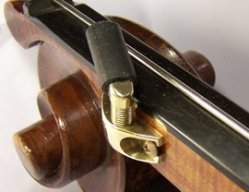
Look at the picture. How would you clean solder off of that porous iron shaft? If silver solder was used, I would expect to see some remnants on the end of the shaft, or at least some marks from clean up, but the shaft shows no signs of having been touched by a torch. If this is indeed a torch/hard solder joint, then it is an exceptionally well done. If it is another joining process, then I'm extremely curious!!!
 
Talk to a Jeweler...don't know what else to tell you.

BTW, iron is not nearly as porous as you may imagine. The surface may look that way, but it all has a very tight body-centered-cubic crystalline structure, and even a very thin sheet of iron or steel is quite impenetrable to liquids or gases.

Gray cast iron does have a slightly porous surface, but it is just the surface, and the only reason it is even important is that oils can lodge in that surface, making it difficult to weld unless the surface is rigorously cleaned OR is preheated to about 900 deg, to vaporize any oils remaining.

The "symptoms" of steel or iron having been heated by a torch are only a few atoms in thickness, as they are actually the discoloration of the naturally occurring oxide film on the metal, and can easily be completely obliterated by wire-brushing.

Beyond that, I have nothing to offer. Metals and metal-joining processes are my specialty, and that is simply what I think I see. Sorry if it isn't convincing enough.
;)
 
Well-- maybe my eyes aren't the best-- but, yes, I expanded the photo as large as it would go on my screen, and I see a very clean joint-- which is what I would expect.

I have zero authority anywhere, but I do have a fair amount of experience and training...and that is just the way I see it.

I really have no further evidence, yeronner...
 
Hey all.
Thanks for the interest and info.
James Condido sent me a replacement. Awesome.
That being said ... I'm still going to get the broken one fixed so that I have a spare.
I'm going to take it to best instrument repairing Oakland CA.
They'll silver solder it I think.
Remember that the N H White company made brass and woodwind instruments. They knew what they were doing in regards to working with and fixing different metals.
In talking with Best Instrument, I'm
Confident they'll due it right.
I'll post a pic of the completed work when I get it done.
Probably not until next week.
Thanks again
 
ImageUploadedByTalkBass1405618201.980424.jpg

Finally !
Had Best Instrument Repair I Oakland silver solder the broken key back on. Seems strong.
Thanks for all the help.
 
  • Like
Reactions: danceswithbass