Hi Everyone,
First of all, I'm a bit of a latecomer here, so I'll recap a couple
of points from a few posts ago.
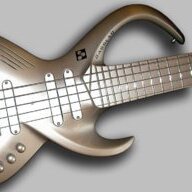
-Modulus necks included truss rods for a few reasons,
chief among which is that they need them. I own and
play a Modulus Q6, and I wish it had one.
It needs it. Too much relief. Period.
Any, any, any neck will deflect under string tension.
It may be too little to notice, but I have yet to come across
a neck that confirms even that. It's always noticeable,
or at least measurable.
-The OPs idea is a "necks for dummies" system. To me,
this need is already met by Warmoth, WD, USACG, etc. etc.
I'm not sure where the advantage is.
-I've built otherwise identical basses where one neck was
noticeably more flexible than the other...same maple from
the same pile, both graphite reinforced (2x 1/4" square bars).
Interestingly enough, 3 of us agreed that the more
flexible neck sounded a little better.
We've all been tempted by the idea of necks without rods.
It's a nice, charming concept, which is kind of risky.
Sometimes it works, but more often IME it doesn't.
We even put rods in our nylon-string guitars, and
I'm glad we do - I often end up using them to adjust
the final action to someone's taste.
-If weight reduction is the goal, you can accomplish that
with an "alternative" rod. Ken Parker's 1-way piano-wire
"rods" were 18-20g or so, and Teuffel makes a 2-way rod
that is under 30g. You can't really ask for lighter.
Adding a graphite fabric skin to the exterior of the neck,
again a la Parker, is the only other way I can think of
to appreciably increase the stiffness of a neck without
invasive routing. This, and possibly the wire rod, are
patented ideas, though...
As ever, my question is this: what are you really trying to
accomplish, and for whom? Is there a market, and how will
the new product be better than what's currently available?
Finally, and I don't mean this to sound cranky - we are all subject to the desire to make something new or different, just
because it's new and different. I've found it's always best to
determine an actual need, and then use available techniques and
materials to meet it, rather than the inverse.
That said - if you have the time, energy, and means to
experiment with this, then go for it! You could end up
with something that really works well and shuts us all right up.
Peace,
Martin