• TalkBass has been independent since 1998. Add your voice.
    Create a free account to reply to discussions, view embedded media, and browse with fewer display ads.
    Join freeLog in
    Want zero display ads or expanded classifieds tools? Compare plans.

Double Bass C-ext. wheel upgrade from Bass Capos

Don Kasper

Gold Supporting Member
Dec 30, 2012
7,646
14,587
71
Los Angeles/Burbank, CA
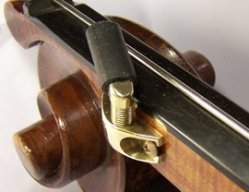
I ordered a new C-ext. wheel from Rob Anzellotti/robobass for my extension. It replaced the POS nylon/plastic one that had been on for 10+ years. Rob's is a polished brass wheel with a "bearing" at the center, instead of just a "thru-hole".
It totally eliminated the "binding" during tuning - ( the wheel and/or string used to get "hung-up" while tuning up or down).
I have an older style of C-ext - it only makes 1 turn into and thru the scroll.
Rob's website also has wheels for the extensions that have multiple turns - the ones that run back under the extension and into the pegbox. FYI.
Problem Solved.
Thanks.
 
Don, congratulations on the new extension. I know it's a significant expense.
I find it interesting that you're continuing with your extension. I've always been warned off by luthiers for extensions and 5-stringers. When do you find the extension useful? Are you playing a classical repetoire? for your jazz tunes? Instruction?
 
Don, congratulations on the new extension. I know it's a significant expense.
I find it interesting that you're continuing with your extension. I've always been warned off by luthiers for extensions and 5-stringers. When do you find the extension useful? Are you playing a classical repetoire? for your jazz tunes? Instruction?

tcl,

I've had an extension on for 20yrs or so - first, a Horst machine for 10 years - ( I was involved in a freelance studio/classical situation - it was a necessity at the time). For the last 10 years or so, I've had a hybrid extension - only a D and E stop; the Db and Eb are finger-operated!
I play primarily jazz, now, (but I still practice a lot with the bow), and I like the low D and Eb for certain tunes and those notes amplify well, and are easily accessible. Less so the low C and Db, ( a little difficult to reach, sometimes), though I will use them on ballads/fermatas.
I also like the open C when practicing, as another useful open string for certain tunes ( ex. "Footprints"), and all those tunes in "C".
It was a significant expense, but Lisa Gass at L.A. Bassworks did a great job on both the Horst Machine and the second "hybrid" version - (it was a totally new "board" that replaced the Horst setup).
Around the time of the hybrid installation, I experimented with the C/E string length, calculating/moving the C nut, and improved the tuning of those 2 notes,(C/E), and the chromatic notes in between. (There is a thread on TB from last year that I participated in, FYI, that explores some of those issues and practices).
My bass is a Juzek carved, and I was fortunate that it sounds good (to me) all the way down to low C. It is a bit of a crapshoot, as you can't predict, to my knowledge, how the bass will respond to the extended range, until after the "operation".
I guess I'm just used to it now.
Thanks for your time and interest.
 
Thanks Don. I really appreciate your input. Thus far, I've respected my luthier's advice but I've always been curious and of course, on some jazz tunes in Eb, I've longed for that continuous line down to Eb - My Funny Valentine, etc.
I bought a 5-string Omnibass a couple of months ago and I'm still getting used to it, but if the low B string makes itself indepensible I'm sure I'll be looking to augment my 4-string acoustic since it's my primary instrument these days.
Thanks again for the info! Much appreciated!
 
My luthier was John - forget his last name at the moment - at World of Strings. John's complaint about the extension was that it would cost as much as my bass - a no-name Chinese carved bass - $3,500 - and the extra length would cause the string to be higher off the fingerboard and be tough to intonate correctly below E.

John similarly discouraged me from a high-C because that string intrudes too much on the guitarists territory and would require reaching around for most of my notes. He felt a low-B 5th string got *kind of floppy* and hard to access.

I deferred to his expertise on my acoustic because he has a ton more experience than I on the acoustic and because I thought his reasonsing seemed, er, reasonable - logical? On the flip-side, I don't think any guitarist I've ever played with cared whether my basses range intruded on their range as long as I was musically valid but, I have to say, that I haven't missed it, either.

As I've become more proficient on the acoustic in thumb position I find that I no longer look for a high-C string because I don't try to play any higher than the G two octaves above the open G in my solo voice, almost always below the E above the G octave on the G-string.

As for the low-B on the Omni, so far, I find it mostly a convenient novelty with the 5th string suprisingly disconcerting when I look at the fingerboard, but maybe as I get used to it, it won't bother me? If I had to guess, I'd say that I will quickly become accustomed to it. Certainly, I've had a lot less trouble getting used to the Omni than many folks I've read about. The scale-length took me a couple of hours and the lack of the neck heel doesn't bother me in the slightest. I still use thumb position even though I don't need too. I think I sight the string half-way, and the octave above the octave, half of the string again. I'm not always dead-on yet, but more often than not, 75% or so. Right now, I'm practicing that accuracy a lot so searching for the octave is something I'm working to avoid.
 
I ordered a new C-ext. wheel from Rob Anzellotti/robobass for my extension. It replaced the POS nylon/plastic one that had been on for 10+ years. Rob's is a polished brass wheel with a "bearing" at the center, instead of just a "thru-hole".
...
Thanks.

Thanks Don. I had planned to stop selling the 1" ball bearing wheel since I've introduced a sleeve bearing design, but the demand seems to still be there so I'll restock. The new pulleys have an Igus plastic sleeve bearing which is rated at 400 lbs. (the ball bearing pulley is 240 lbs., so still plenty strong). Going with the sleeve bearing means lower cost and smaller diameter. I have them in 7/8" and 1/2". I think 7/8" is a bit better than 1" for the main pulley, and the 1/2" is good for secondaries if you don't want to drill the scroll. These pulleys aren't yet up on my site, but you can view them below:

http://s389.photobucket.com/user/robobass/library/Purple%20Heart/Pulleys

As slideshow:

http://s389.photobucket.com/user/robobass/slideshow/Purple%20Heart/Pulleys
 
My luthier was John - forget his last name at the moment - at World of Strings. John's complaint about the extension was that it would cost as much as my bass - a no-name Chinese carved bass - $3,500 - and the extra length would cause the string to be higher off the fingerboard and be tough to intonate correctly below E.....

TCL,
I suppose we're going off topic, but I think your luthier's advice is a bit off the mark. There are thousands of happy extension owners just in the USA. Many of the world's top players use one, and they are widely used in American orchestras. Some basses will respond better than others in the extended range, but I think it's quite uncommon for the low notes to not ring well if the bass sounds good otherwise. To find out just put on a stark E string tuned to D and decide for yourself.

Some extensions are better than others, but if you go to an experienced builder like Lisa Gass you will get it done right. The E will be higher when open to C, but if your board isn't overly scooped the difference is small. Also, when closed at the E you naturally have no more height (less actually) than before.

On price, I don't know who charges what for an extension, but I think most take well under half of what your bass cost. It is a difficult decision to make if your bass is of low to moderate value. It comes down to how long you plan to keep your bass, and how much you value being able to go below E. In NY you see plenty of plywoods with extensions, believe it or not. Many Broadway players want the low notes, but don't want to leave a nice carved bass in the pit!

Fingering on the extension is of course challenging, but with the help of latches or a machine, this problem largely goes away.

Extensions are a blast. Get one today! Even if you don't play bass!!!
 
I also wrestled with the ratio of bass-to-extension cost. I opted for a KC Strings extension kit, which I had installed by my local luthier. Total cost was around $1,000. Can be set up as fully gated, fingered or a combo of both.

I wrote a detailed review of the extension kit, which is attached to this thread in the Accessories forum as a PDF document:

http://www.talkbass.com/forum/f236/product-review-kc-strings-gated-extension-1020779/

Hope this is helpful!

Chris