• TalkBass has been independent since 1998. Add your voice.
    Create a free account to reply to discussions, view embedded media, and browse with fewer display ads.
    Join freeLog in
    Want zero display ads or expanded classifieds tools? Compare plans.

Double Bass C-Extension and Pricing question

Hi all!

I am curious about C-Extensions. I've seen them and they look pretty cool and I understand how they allow you to get real low.

But how much should one cost? I've read some pricing as high as $2000.00 but that seems insanely high.

Can you simply buy a stock C-Extension then have your Luthier install it, or does one have to be hand built by Virgin Monks in some mountain monistary at about 8am while the sun is cresting the mountains and the air is fresh?

Or perhaps somewhere in between? :)

Jason
 
There are generally a few types of extensions- the first, which isn't used very much any more, is a mechanical extension, which uses a set of buttons to lock the different keys.
extension_machine.gif
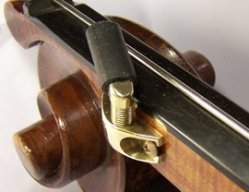
The most common are extensions that do away with the machinery and just give you a set of locking "fingers" or "capos" that can either be on just the low E, or one for each note going down chromatically to a low C.
Double_bass_C_extension.jpg
There's also another kind (that a friend of mine has) that looks like this.
[Invalid or Expired Link Removed]
There are companies that sell extensions that your luthier can put on, but seeing just one bass with one tells me it's pretty much a terrible idea.

Putting on extensions is complicated thing- they have to be calibrated really carefully so that the intonation is perfect for each capo (which can vary with a lot of things), the capos close and open easily/without sticking. Many luthiers are also able to install them without cutting into scrolls, but fitting the assembly for the low c string to fit into the tuning machines also has to be done right. So yes, most quality extensions are made by hand and fitted to each bass individually by a qualified luthier. And yes, most of the luthiers i've been to quote somewhere around $1500-2,000 or more for an extension with four capos, although this can obviously vary from maker to maker, and with less capos, the cost is also less.

I toyed with the idea of getting a cheap extension once, but decided against it, because unless your auditioning for a professional job where you absolutely need one, it's not an absolute necessity. Some bassists (the best example I can give is Max Dimoff) even get by without one.

Bottom line is they're handy to have, and it really is something that, ideally, a bass should have, but it's definitely not worth going cheap on if you're looking at getting one. But if you have the money and are willing, it's a good investment and a damn lot of fun to have one.
 
There are generally a few types of extensions- the first, which isn't used very much any more, is a mechanical extension, which uses a set of buttons to lock the different keys.
View attachment 313128
The most common are extensions that do away with the machinery and just give you a set of locking "fingers" or "capos" that can either be on just the low E, or one for each note going down chromatically to a low C.
View attachment 313131
There's also another kind (that a friend of mine has) that looks like this.
[Invalid or Expired Link Removed]
There are companies that sell extensions that your luthier can put on, but seeing just one bass with one tells me it's pretty much a terrible idea.

Putting on extensions is complicated thing- they have to be calibrated really carefully so that the intonation is perfect for each capo (which can vary with a lot of things), the capos close and open easily/without sticking. Many luthiers are also able to install them without cutting into scrolls, but fitting the assembly for the low c string to fit into the tuning machines also has to be done right. So yes, most quality extensions are made by hand and fitted to each bass individually by a qualified luthier. And yes, most of the luthiers i've been to quote somewhere around $1500-2,000 or more for an extension with four capos, although this can obviously vary from maker to maker, and with less capos, the cost is also less.

I toyed with the idea of getting a cheap extension once, but decided against it, because unless your auditioning for a professional job where you absolutely need one, it's not an absolute necessity. Some bassists (the best example I can give is Max Dimoff) even get by without one.

Bottom line is they're handy to have, and it really is something that, ideally, a bass should have, but it's definitely not worth going cheap on if you're looking at getting one. But if you have the money and are willing, it's a good investment and a damn lot of fun to have one.

Wow man, you went way above and beyond with your reply. Thank you. I am not at a skill level that requires me to have an extension but I'd sure love to get down to those low notes. Right now I tune to DADG and that its self is great. Thanks so much for your reply.
 
Aside from just getting the low notes, an extension can help to improve the way your bass sounds in different keys. If you have a chromatic extension (one with stops every half step) you can open the extension up so that a strong overtone can resonate sympathetically. For example, if you're playing in Eb, or even Ab, open the extension to Eb and your bass might sound a bit more open than it did before in those keys.
 
Mario charges about $2,900 for his extensions, and you have to wait about 9 months. But if you have a $40,000 bass, you don't want anyone else installing an extension.

I have a friend that has an extension of Mario's and it is perfect.
 
does one have to be hand built by Virgin Monks in some mountain monistary at about 8am while the sun is cresting the mountains and the air is fresh?

Maybe not, but I've seen some extensions built by otherwise reputable luthiers that are terrible. There's a bunch of subtle stuff that makes an extension seamless and nice to use, and I think it's hard to get all that stuff right. They can be hard to tune (or even break strings), it can be hard close capos because they don't catch the string right, they can drift in and out of tune depending on the position of the moon, they can be hard to play fingered for various reasons of design, and they can rattle in annoying ways right into your left ear. Or they can work perfectly.

Also, the KC strings extension pictured is really heavy. I don't recommend it unless you want a ten pound scroll. Look at all that brass!
 
Aside from just getting the low notes, an extension can help to improve the way your bass sounds in different keys. If you have a chromatic extension (one with stops every half step) you can open the extension up so that a strong overtone can resonate sympathetically. For example, if you're playing in Eb, or even Ab, open the extension to Eb and your bass might sound a bit more open than it did before in those keys.

+1
Bach sounds quite good with an extension, ironically enough.
 
I've come across a few people who actually advocate for not getting Capos at all- just fingering notes individually.

Why? A chromatic extension still functions as a fingered extension if you keep all the gates open, but sometimes you're really going to want to lock it in on something other than C or E. I can't imagine playing those jumping arpeggios in the first movement of Beethoven 3 without the gates.
 
Why? A chromatic extension still functions as a fingered extension if you keep all the gates open, but sometimes you're really going to want to lock it in on something other than C or E. I can't imagine playing those jumping arpeggios in the first movement of Beethoven 3 without the gates.

Not saying I necessarily agreed with the reasoning, a teacher at a school I auditioned at used only the one capo, saying he preferred the ability to do it all manually. I would never do that, just because a lot of things (Heldenleben, Beethoven 3, etc) would be much more difficult without the additional capos.
 
Not saying I necessarily agreed with the reasoning, a teacher at a school I auditioned at used only the one capo, saying he preferred the ability to do it all manually. I would never do that, just because a lot of things (Heldenleben, Beethoven 3, etc) would be much more difficult without the additional capos.
I also enjoy using it manually sometimes, which is why I have a fingered extension with capos. I don't follow the logic here.
 
I also enjoy using it manually sometimes, which is why I have a fingered extension with capos. I don't follow the logic here.

There are purists out there who somehow consider it cheating to have locks other than E. It is rather silly. Having an extension at all could be argued to be cheating - or steel strings. I must say that I was better at fingering on the extension before I started using capos. But so what? An advantage is an advantage.

Edit: I mean: does the audition committee or conductor care how I physically execute the passage? I think they just want it as clean as possible!