i was wondering what philosophies some luthiers hold in putting on c-extensions. is there a big problem in just putting an extension on with an E gate or just not the full chromatic (for example E and D gates)?

Enjoy the benefits of a premium membership!
Upgrade Account
-
TalkBass has been independent since 1998. Add your voice.
Create a free account to reply to discussions, view embedded media, and browse with fewer display ads.
Join free Log in
Want zero display ads or expanded classifieds tools? Compare plans.
You are using an out of date browser. It may not display this or other websites correctly.
You should upgrade or use an alternative browser.
You should upgrade or use an alternative browser.
Double Bass C Extension Gates??
- Thread starter bcarter
- Start date
More options
Who Replied?
I'm not a luthier but there's no problems with whatever you want to do with the number of gates. It's a personal preference. I had all four gates on my previous extension and on my current one I only have the E and D latches. There are times I miss the other gates but most of the time I am happier I don't have them. If I was playing a lot of classical stuff I would probably miss them more. The fundamental problem is that when the Eb and Db gates are engaged, the bass is in somewhat of an acoustically confused state so it's not really a sonically optimal configuration.


I have always been unhappy with the lack of control over intonation with the gates and with the mechanical extensions. Sure, depending on the design you can adjust them but you need a screw driver and time. And the intonation needs are different depending on how loud you want to play the low notes, the type of string etc...
this is why I just ordered the KC strings "slide extension", I explained my problem to Jeff Bradetich who has had it for a while and he chose it for that very reason. He is very happy with the pitch control this mechanism provides. The drawback is that it isn't as quick as the gates but I am hoping this will be the solution to the intonation thing.
I will review it later when I have it installed, around mid May.
this is why I just ordered the KC strings "slide extension", I explained my problem to Jeff Bradetich who has had it for a while and he chose it for that very reason. He is very happy with the pitch control this mechanism provides. The drawback is that it isn't as quick as the gates but I am hoping this will be the solution to the intonation thing.
I will review it later when I have it installed, around mid May.
the KC strings "slide extension", I explained my problem to Jeff Bradetich who has had it for a while and he chose it for that very reason. He is very happy with the pitch control this mechanism provides.
i've tried out some basses with the KC extensions and haven't liked them very much so i'd be very interested in your review. i'm going to stay away from some of those kinds of extensions regardless.
my worry is more of a technical issue. i will be playing alot of classical repertoire so does anyone have an opinion that pertains to classical repertoire.
i will be playing alot of classical repertoire so does anyone have an opinion that pertains to classical repertoire.
I play only classical, professionally, and if the time frame works out I will be testing the KC strings extension with Mahler 6.
You mentioned that your worry is more of a technical issue, do you mean speed? I believe the slide extension might be a bit more convenient than an extension with a single E gate, but I don't think it will have the convenience of the multiple gates.
If you want speed you might want to try a bass with a mechanical extension to see if you like it. They are out of fashion at the moment, everyone loves to talk about how ugly and ridiculous they are, but many very respectable veterans still use them (Eugene Levinson for example).
Some of the mechanisms have the keys backwards so that you can play C# octaves, I am not a fan of this option. Some machines are noisy when you open them but you can learn to do it quietly (by catching the opening gates with you left hand as the springs open them), somehow many bassists haven't bothered to investigate this and it has given machines a bad rap. Perhaps if you live near a bass shop you can spend an hour playing with one of those while keeping an open mind.
@bcarter, it seems like you may be overanalyzing your needs.
In my experience there are only 2 differences between a gated extension and one w/ only an E gate. Convenience and cost. As far as cost goes, the more gates you have the more you have to pay.
The convenience of the gates is debatable. It's great to not have to hold your arm up there for long notes and they also make some passages easier to play. The downside is that there's more to think about when using one. You need to think ahead of not only what note needs to be closed but also if the other ones are open.
IMHO, there's really no downside to getting a fully gated extension other than cost. They don't get in the way of your hands (unless the wrong one's closed ) and they'll always be there if you need them.
On a side note, I've tried both the slide and gated types of KC Strings extensions. The slide one is an interesting concept. The gated C extension has a stop on the C as well which confused me a bit. Maybe so the string doesn't pop out of the nut? They both worked well. The only downside from my point of view was the weight and possibly aesthetics depending on the person. Personally, I think they look kind of cool but there is a lot of brass in those things. :shrugs:
Meaning no disrespect to Dr. Rod or Jeff Bradetich, I'd also like to address the issue of intonation. As long as the string length stays the same and the stops were installed correctly, I just don't see how the notes can ever get out of adjustment (if that's what you're talking about). Well, other than closing the stops in the wrong place. Even with different string gauges how much could that really alter the pitch? A couple cents? Maybe the issues people have in this regard are related more to playing by themselves (as opposed to an orchestral setting) or maybe tempered pitches.
As far as pitch changing depending on dynamics, I can't argue with you there. That's a fact of life with bowed instruments. I will say, in my experience as an orchestral player, when we're blasting away on a low note I've rarely, if ever, been able to hear myself or anybody else well enough to determine if a note is going sharp. The only times I can think of are if somebody is fingering a note and they're way off. Maybe I'm wrong. I don't know.
my 2 cents
In my experience there are only 2 differences between a gated extension and one w/ only an E gate. Convenience and cost. As far as cost goes, the more gates you have the more you have to pay.
The convenience of the gates is debatable. It's great to not have to hold your arm up there for long notes and they also make some passages easier to play. The downside is that there's more to think about when using one. You need to think ahead of not only what note needs to be closed but also if the other ones are open.
IMHO, there's really no downside to getting a fully gated extension other than cost. They don't get in the way of your hands (unless the wrong one's closed
) and they'll always be there if you need them. On a side note, I've tried both the slide and gated types of KC Strings extensions. The slide one is an interesting concept. The gated C extension has a stop on the C as well which confused me a bit. Maybe so the string doesn't pop out of the nut? They both worked well. The only downside from my point of view was the weight and possibly aesthetics depending on the person. Personally, I think they look kind of cool but there is a lot of brass in those things. :shrugs:
Meaning no disrespect to Dr. Rod or Jeff Bradetich, I'd also like to address the issue of intonation. As long as the string length stays the same and the stops were installed correctly, I just don't see how the notes can ever get out of adjustment (if that's what you're talking about). Well, other than closing the stops in the wrong place. Even with different string gauges how much could that really alter the pitch? A couple cents? Maybe the issues people have in this regard are related more to playing by themselves (as opposed to an orchestral setting) or maybe tempered pitches.
As far as pitch changing depending on dynamics, I can't argue with you there. That's a fact of life with bowed instruments. I will say, in my experience as an orchestral player, when we're blasting away on a low note I've rarely, if ever, been able to hear myself or anybody else well enough to determine if a note is going sharp. The only times I can think of are if somebody is fingering a note and they're way off. Maybe I'm wrong. I don't know.
my 2 cents
Meaning no disrespect to Dr. Rod or Jeff Bradetich
None taken, you exposed your ideas with great respect.
.

Having a D gate is useful for Baroque and Classical era music that usually only goes down to D. It'll make playing things like Corelli's Christmas Concerto and the Messiah Oratorio much easier.
My section mate in Orchestra London has a E only latch type extension but made a detachable D latch from an old fashioned guitar capo to address such music. But once it's on, he has to leave it on for the piece as it's finicky to get it just right.
Before I got my extension, I started tuning my bass DADG. Then I found that D is the most common lower-than-E note followed by Eb (almost never D#!), then C, then C#/Db, then way down the list is low-B. I still use this tuning but with a short extension to get the low-C/C# and I find I infrequently have to open my D latch.
My section mate in Orchestra London has a E only latch type extension but made a detachable D latch from an old fashioned guitar capo to address such music. But once it's on, he has to leave it on for the piece as it's finicky to get it just right.
Before I got my extension, I started tuning my bass DADG. Then I found that D is the most common lower-than-E note followed by Eb (almost never D#!), then C, then C#/Db, then way down the list is low-B. I still use this tuning but with a short extension to get the low-C/C# and I find I infrequently have to open my D latch.
Drop D tuning is much more resonant for the instrument than EADG. Most baroque players use drop D exclusively.
- Aug 1, 2005
- 3,546
- 1,421
- Disclosures
- Private Inventor - Bass Capos
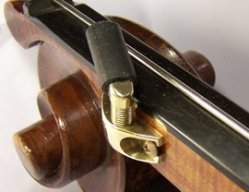
I have an obvious bias toward fully chromatic gated extensions, but I'm surprised by Bejoyous' comment about the D and baroque music. A lot of baroque music (especially Bach) stretches down to the C and C#. I can't imagine playing the B Minor mass without my C# Capo, for example, and I use my open C quite often. Although the C# is the least used of the bunch, there are plenty of times when I can get a passage out acceptably by using it when I don't think I could if I had to finger it.
As far as the sliding gate, I don't see it being practical in any ensemble situation. I understand the purist point of view that equal temperament does not always mean "in tune", but how do you know exactly where that low D will be when it comes up? If there is a sustained low note in the piece that you know is always a bit flat in rehearsal, well you just finger that one!
As for everything else, well made chromatic gates can be flipped open or closed in a quarter note's rest. Using them requires a bit more preparation than with a machine, 5-string, or simple fingered extension, but I find them well worth the inconvenience!
As far as the sliding gate, I don't see it being practical in any ensemble situation. I understand the purist point of view that equal temperament does not always mean "in tune", but how do you know exactly where that low D will be when it comes up? If there is a sustained low note in the piece that you know is always a bit flat in rehearsal, well you just finger that one!
As for everything else, well made chromatic gates can be flipped open or closed in a quarter note's rest. Using them requires a bit more preparation than with a machine, 5-string, or simple fingered extension, but I find them well worth the inconvenience!

I have a KC gated extension and love it. But if they were designed so that I couldn't adjust the gates in all directions, that would have turned me off.
I wanted the slider version, but my scroll doesn't lean back far enough. Hopefully, the slider is at least as easy to adjust for different diameter strings as the gates are.
Anyway I took off the Eb gate but have the rest on, since I can reach that note pretty easily from the neck. I feel being able to finger those extension notes is a big advantage also, but I like having it both ways.
I also hear the bass's resonance change depending on what note the extension stops. I keep mine on the low C most of the time for that reason. Having done 5ths tuning in the past, the hope is that having it there brings back a little of that cello-flavor.
I wanted the slider version, but my scroll doesn't lean back far enough. Hopefully, the slider is at least as easy to adjust for different diameter strings as the gates are.
Anyway I took off the Eb gate but have the rest on, since I can reach that note pretty easily from the neck. I feel being able to finger those extension notes is a big advantage also, but I like having it both ways.
I also hear the bass's resonance change depending on what note the extension stops. I keep mine on the low C most of the time for that reason. Having done 5ths tuning in the past, the hope is that having it there brings back a little of that cello-flavor.
I understand the purist point of view that equal temperament does not always mean "in tune"
This isn't really the point.
Even if you have a plain vanilla extension with only one E gate, the relationship between the nut (open C) and the E gate varies each time you change string brands, or slightly move the bridge, or even just by altering the bridge height.
In most cases, if the E is perfectly in tune then the C isn't, let alone all the other gates in between.
This minute discrepancy does make a difference in the orchestra, especially when you have half a section of players with these things. I understand that some of the bass gods use multiple gates and mechanical extensions, and I don't claim to be better or more in tune than them.
The slide extension is not meant for those who want the convenience of opening and closing and changing the lowest pitch. It is more akin to what Bejoyous used to do before he got his extension, you choose your bottom note, you tune your bass, and the rest is done with your fingers. Perhaps you can make a change between movements.
- Aug 1, 2005
- 3,546
- 1,421
- Disclosures
- Private Inventor - Bass Capos
This isn't really the point.
Even if you have a plain vanilla extension with only one E gate, the relationship between the nut (open C) and the E gate varies each time you change string brands, or slightly move the bridge, or even just by altering the bridge height.
In most cases, if the E is perfectly in tune then the C isn't, let alone all the other gates in between...
I just don't see the problem. If you change the setup, of course you need to reset the intonation of the C-nut and the gates. Many extensions even have an adjustable nut built in. If not, the C-length is not hard to adjust by a competent luthier. Some latches are easier to adjust than others (which is a big reason why I decided to develop and market my invention!), but intonation adjustment comes with the territory. "if the E is perfectly in tune then the C isn't " is a very sad thing for me to hear. It needn't be true, and sets back C-extension adoption by years, giving validation to the naysayers who write it off as a plainly dumb idea.
I just don't see the problem. If you change the setup, of course you need to reset the intonation of the C-nut and the gates. Many extensions even have an adjustable nut built in. If not, the C-length is not hard to adjust by a competent luthier. Some latches are easier to adjust than others (which is a big reason why I decided to develop and market my invention!), but intonation adjustment comes with the territory. "if the E is perfectly in tune then the C isn't " is a very sad thing for me to hear. It needn't be true, and sets back C-extension adoption by years, giving validation to the naysayers who write it off as a plainly dumb idea.
I am pro-extension and pro-gates, just for the record. I am just point out some cons, we all know the pros.
My observations are based on decades of professional orchestral work, and yours are probably based on decades of experience as well. Yes, what you point out may all be true, but out of tune gates and extensions are a daily and sad reality. Some people cannot afford to go to a competent luthier every time the weather changes. Many things needn't be true in theory, but are.
- Aug 1, 2005
- 3,546
- 1,421
- Disclosures
- Private Inventor - Bass Capos
Well, this probably is true, but I don't think it's as bad as you say. I can't say I've ever been disturbed by a stand partner's out of tune gates (but I haven't sat next to any extensions for quite a long time!). As for my own bass, I've only adjusted it about four times in 14 years - only when changing between different types of string (gut-steel-synthetic), and once when I had some major top work done....out of tune gates and extensions are a daily and sad reality. Some people cannot afford to go to a competent luthier every time the weather changes. Many things needn't be true in theory, but are.
If someone's extension is out of tune, I bet very often that it is just carelessness. It was either not reset at the shop after a major repair, (or never properly set in the first place!), or the player has bumped the bridge and not gotten around to fixing it, or something like that. I do not find changes in humidity or small adjustments to bridge height affect my intonation enough to get out my tools.
Perhaps you have more sensitive ears than me, but I do consider myself quite anal about intonation, particularly when on the extension. At least enough so that I will elect sometimes to not use my latch so that I can better match the group, but this is rare.
I will elect sometimes to not use my latch so that I can better match the group, but this is rare.
Thank you, I wish more people did that.
To the original question:
it shouldn't be a problem to request a particular number of gates from a luthier for your custom extension.
Discussion:
I can't help but note that you're all missing the best solution, which is to employ a 5-string bass! No clicking, no groping over your head for nimble passages, no not-quite-right-but-can't-change-it-on-the-fly low notes, no "oops, wrong gate" moments. (Don't pretend you don't have those moments!)
That said, a fully-gated extension gives you the Next Best solution; to gate, or not to gate; vibrato; convenience with All-The Notes. Out-of-tune nuts and gates are *everywhere*, and definitely noticeable, but adjusting a gate is less of a problem than clicking machinery, being out of tune *and* hurting your hand - or not even having the notes to begin with!
Classically speaking, if you want to really Do Your Job without buying a whole different (5-string) bass, I say a fully gated extension is the way to go.
it shouldn't be a problem to request a particular number of gates from a luthier for your custom extension.
Discussion:
I can't help but note that you're all missing the best solution, which is to employ a 5-string bass! No clicking, no groping over your head for nimble passages, no not-quite-right-but-can't-change-it-on-the-fly low notes, no "oops, wrong gate" moments. (Don't pretend you don't have those moments!)
That said, a fully-gated extension gives you the Next Best solution; to gate, or not to gate; vibrato; convenience with All-The Notes. Out-of-tune nuts and gates are *everywhere*, and definitely noticeable, but adjusting a gate is less of a problem than clicking machinery, being out of tune *and* hurting your hand - or not even having the notes to begin with!
Classically speaking, if you want to really Do Your Job without buying a whole different (5-string) bass, I say a fully gated extension is the way to go.


I love this argument. yes, the five stringer, IMHO, is the best way to go...but many of us own four stringers and don't want to play a fiver. I have a fully chromatic capo'ed extension. If they are there, you can use them or not, it's your choice. If you don't have them, then you have to finger every single note. I would say, get all of the capos and if you don't use them, then at least you have them, but I garuntee that you will use them. yes, there are tons of out of tune extension capos. Mine at the moment isn't right on, which I"m in the process of changing, but all in all they are great to use and open up a lot of options.
- Aug 1, 2005
- 3,546
- 1,421
- Disclosures
- Private Inventor - Bass Capos
It's so sad. I played a rehearsal today and there wasn't one extension note in the entire program


