• TalkBass has been independent since 1998. Add your voice.
    Create a free account to reply to discussions, view embedded media, and browse with fewer display ads.
    Join freeLog in
    Want zero display ads or expanded classifieds tools? Compare plans.

Double Bass C extension question?

The only real way to alleviate this issue is to get a completely tuneable extension or have the luthier installing your extension tune the extension to the particular string you are using meaning you can only use one string and one string only. Different extended E strings intonate differently. For instance and original flexocor E string is flat compared to an evah pirazzi e string which is sharp. Sharp or flat meaning that when you tune your open C to pitch and then close your e capo, you'll see how the string intonates. Belcanto & permanent E strings are on the neutral side of the intonation spectrum.

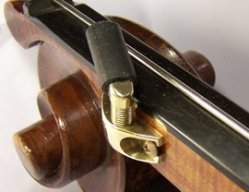
In the picture you see of my personal extension, the nut to tune the open C is adjustable and the capos for the Db, D, & Eb are tracks so you can tune those as well. My extension was made by master luthier Patrick McCarthy in Berkeley, CA. His extensions in my humble opinion (and of many other top level bassists around the world who's resume exceeds mine) are the best in the world. There are a couple of other luthiers I know of that make a tuneable extension but Pat's are number. No one can touch his work within a long shot.
 

Attachments

  • bass 3.jpg
    bass 3.jpg
    44.6 KB · Views: 194
The only real way to alleviate this issue is to get a completely tuneable extension or have the luthier installing your extension tune the extension to the particular string you are using meaning you can only use one string and one string only. Different extended E strings intonate differently

My understanding is that the nut can be adjusted to fix intonation issues associated with varying string gauge.
 
Does anyone find changing string gage effect how well the gates hold down the string?
I thought it might be useful to be able to adjust the downward pressure from the E gate. Perhaps the difference in gage is too small to make a difference.
 
My understanding is that the nut can be adjusted to fix intonation issues associated with varying string gauge.

Yes, the little nut at the end of the extension needs to be adjusted for the the extension to be "in tune" Some builders make very sophisticated adjustment systems, but imo they are unnecessary. I make adjustments to my extension (I don't build them, only hardware) simply by adjusting the offset distance between the end of the extension fb and ex. nut with a shim.

Furthermore, I have not needed to adjust the nut the way others claim when changing string types. I've used Eudoxa, Obligato, and Helicore Orchestra in the last years and never moved the nut more than one or two mm.

Does anyone find changing string gage effect how well the gates hold down the string?
I thought it might be useful to be able to adjust the downward pressure from the E gate. Perhaps the difference in gage is too small to make a difference.

You want to adjust the height of the closer actually. If you switch to a lighter string, for example, the closer will likely stop the new string slightly sharp. How this is done is down to the type of closer. Sometimes you sand down or add to the leather, sometimes it's adding or removing a washer, etc....