• TalkBass has been independent since 1998. Add your voice.
    Create a free account to reply to discussions, view embedded media, and browse with fewer display ads.
    Join freeLog in
    Want zero display ads or expanded classifieds tools? Compare plans.

Double Bass C-extension questions...

Hi Forum.

I’m considering getting a C-extension, and I have 2 questions that I need help with. Hopefully this is the right place for these questions.

First of all, I’m wondering if there is a significant advantage to having a C-extension that requires drilling a hole in the scroll to install over the C-extensions that manage to route the string around the scroll, thus requiring no drilling? Anyone have any experience/info about this?

Secondly, I know that extensions are always custom made, but is there any resale value for a used extension? Maybe the extension can be made to fit another bass?

Thank you for your help!
 
The only advantage to a non-drilled mounting method I know of is that it doesn't require drilling a hole. There are multiple pulley extensions available from some luthiers that route the string through the extension itself, avoiding the hole in the scroll. I personally am not bothered by a hole, as it's the most direct and least fiddly (especially for string changing) way of doing the job. If the aesthetic integrity of a fine old bass is the reason for not drilling, just remember that that instrument has probably had a lot of repairs/alterations done since it was made (neck reset, scroll graft, bass bar replacement, shoulder reduction, etc, etc); a 5mm hole isn't really that big a deal.
 
First of all, I’m wondering if there is a significant advantage to having a C-extension that requires drilling a hole in the scroll to install over the C-extensions that manage to route the string around the scroll, thus requiring no drilling? Anyone have any experience/info about this?
One advantage might be the avoidance of making a tight 180 degree turn at the top of the extension to feed the string back through and under the extension, followed by a sharp 90 degree turn exiting the extension down to the tuner shaft.
I wince whenever I see a large diameter long E/C string have to make these sharp turns and I wonder if friction or "binding" is an issue. I haven't heard of any problems with this design, but I wonder if any users of this design might comment.
I have an extension with a hole drilled through the scroll and I have had no issues with "binding" (or breaking.) But I use Spirocore Mittel long E/C strings - they seem to be virtually indestructible.
Thanks.
 
I have an extension that doesn't go through the scroll. After about 3 years of use it seems to be fine for the string. Also I have a removable neck and my extension just comes off to fit in my neck case. I don't have much experience with long term playing ones that are drilled but I would say maybe it tunes a little easier but probably very slight difference.

I will also add that there is no sign of binding or anything of that sort, Also with mine as others have said there are no other mounting screws. Drilled extensions often have a screw around the nut area to hold them in place. Mine just has a pin that goes into the fingerboard.


As far as a used extension being able to be resold for another bass.... i would say very unlikely. As you probably know basses are very unstandardized and unless there's another bass that has the same exact scroll in all dimensions,as well as string length, neck angle, and a lot of other things it wouldn't be able to work correctly on another bass. Even basses from large almost factory like shops (i.e.: Shen) there are variances in these measurements. It would probably be over half the amount of work to make a pre-existing extension fit a different bass and most luthiers would probably just want to make a new one that they know will work the way it's intended to.
 
Last edited:
One advantage might be the avoidance of making a tight 180 degree turn at the top of the extension to feed the string back through and under the extension, followed by a sharp 90 degree turn exiting the extension down to the tuner shaft.
I wince whenever I see a large diameter long E/C string have to make these sharp turns and I wonder if friction or "binding" is an issue. I haven't heard of any problems with this design, but I wonder if any users of this design might comment.
I have an extension with a hole drilled through the scroll and I have had no issues with "binding" (or breaking.) But I use Spirocore Mittel long E/C strings - they seem to be virtually indestructible.
Thanks.


Mine makes about a 170 degree turn over a 1" pulley and goes straight to the tuner shaft. No chance of binding on anything, string change is a 10 minute job, tops, and tuning is stable.
 
  • Like
Reactions: Don Kasper
One advantage might be the avoidance of making a tight 180 degree turn at the top of the extension to feed the string back through and under the extension, followed by a sharp 90 degree turn exiting the extension down to the tuner shaft.
...
It depends on the build. I offer small pulleys for the internal points which keep the string from bending too sharply. The other advantage of a "no-hole" extension is that the string tension itself holds the extension in place, reducing or eliminating the need for mounting brackets and screws. They are harder to make though, so not all luthiers will agree to do them. This one is from Daniel Mannel in Hamburg. Personally I would have placed the second pulley closer to the "D" to more center the pulling force on the extension body. Daniel probably did it this way to keep the string from interfering with the thumb. This depends on the player, as I never put my thumb up under the extension body, but many do...
IMG_7874.JPG
 
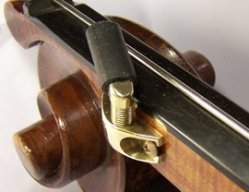
This is the advantage of a mechanical, keyed extension. The extension is built onto its section of "fingerboard, and the luthier then fits another piece of mahogany to that to fit to the scroll. The fingers are all adjustable so you can tune the extension, s to swap it to another bass you just have to have a new piece made to act as a bracket between extension and scroll. I see no issue with drilling the scroll, the hole is almost invisible. I have a section of nut so that I can remove the extension {2 screws} fit a piece of ebony and have a standard 4 string bass. Useful for solo playing
 
Mgaisbacher,
I didn't see the photos before. That is amazing. A full CF extension. Very well made. I imagine it wasn't cheap. Would you share with us who made it?
I actually just added the photos in an edit just so the OP could see what I was talking about. And I don’t Mind at all, It was made by Jed Kriegel in Boston who does amazing work. He did the removable/adjustable neck on my bass as well.
 
  • Like
Reactions: bassmanbrent
I have an extension that doesn't go through the scroll. After about 3 years of use it seems to be fine for the string. Also I have a removable neck and my extension just comes off to fit in my neck case. I don't have much experience with long term playing ones that are drilled but I would say maybe it tunes a little easier but probably very slight difference.

I will also add that there is no sign of binding or anything of that sort, Also with mine as others have said there are no other mounting screws. Drilled extensions often have a screw around the nut area to hold them in place. Mine just has a pin that goes into the fingerboard.


As far as a used extension being able to be resold for another bass.... i would say very unlikely. As you probably know basses are very unstandardized and unless there's another bass that has the same exact scroll in all dimensions,as well as string length, neck angle, and a lot of other things it wouldn't be able to work correctly on another bass. Even basses from large almost factory like shops (i.e.: Shen) there are variances in these measurements. It would probably be over half the amount of work to make a pre-existing extension fit a different bass and most luthiers would probably just want to make a new one that they know will work the way it's intended to.
Mr. Kriegel does beautiful work. I like his use of a counter-bore for the Button Head Cap Screws on the levers - so very user friendly and smooth around fingers & skin.
Thanks.
 
This is the advantage of a mechanical, keyed extension. The extension is built onto its section of "fingerboard, and the luthier then fits another piece of mahogany to that to fit to the scroll. The fingers are all adjustable so you can tune the extension, s to swap it to another bass you just have to have a new piece made to act as a bracket between extension and scroll. I see no issue with drilling the scroll, the hole is almost invisible. I have a section of nut so that I can remove the extension {2 screws} fit a piece of ebony and have a standard 4 string bass. Useful for solo playing

Hi Neil, I'm just wondering who made your remove-able C-extension? Likely in the UK, right? Does anyone know of a US luthier that makes C-extensions with this option? Thank you!
 
Most extensions are pretty easily removeable, but fitting to a different bass depends on how the extension fits to the scroll. Fi the shaped part is part of the main body of the extension, it's much harder to transfer the extension to another bass. My keyed extension was made by Pete Barnaby, who as far as I know is the only maker of these, and fitted by Martyn Bailey. Both of these guys do incredible work. The extension itself is a masterpiece, and the fitting was beautifully done.
 
It is, yes. The original "Fawcett" extensions were made by George Fawcett, who was an aircraft engineer and came up with the wonderfully quiet and elegant internally sprung system that also puts the chromatic notes in the "right" order. I think George died only a few years ago. My extension was made to an exceptionally high standard by Pete Barnaby. I do have an almost complete genuine Fawcett extension lurking in a drawer somewhere. Just needs some mounting brackets making. They are wonderful devices, don't knock them till you try them.
 
It is, yes. The original "Fawcett" extensions were made by George Fawcett, who was an aircraft engineer and came up with the wonderfully quiet and elegant internally sprung system that also puts the chromatic notes in the "right" order. I think George died only a few years ago. My extension was made to an exceptionally high standard by Pete Barnaby. I do have an almost complete genuine Fawcett extension lurking in a drawer somewhere. Just needs some mounting brackets making. They are wonderful devices, don't knock them till you try them.

I always liked the Fawcett better than then Stenholm, personally. They seemed a lot lighter and more responsive to the touch, and YES, it was so much more intuitive to have the keys running in parallel motion with the fingerboard, rather than contrary motion, like the Stenholm.