• TalkBass has been independent since 1998. Add your voice.
    Create a free account to reply to discussions, view embedded media, and browse with fewer display ads.
    Join freeLog in
    Want zero display ads or expanded classifieds tools? Compare plans.

Double Bass C extension technique

There's the fast passage in the development in the first movement of Shostakovitch No. 5 - fast downward then upward scale passage with different notes going each way.

Bottom of page 3 of Death and Transfiguration by R. Strauss has a fast passage that repeatedly starts on low-Eb.

The Db scale passage in the intro of Mozart No. 39

Ach!! the storm scene of Beethoven 6th (unless you choose to fake it like the other 95% of us);) Up and down the C-string until the string heats up from friction!

The end of the development of Beethoven No. 3 has many leaps.

Somewhere in Bach's Magnificat oratorio there is a 1/16 note passage starting on low-C# that goes something like C# D E C#, D E F# D, E F# G# E, F# G # A F# etc. This passage happens 2 or 3 times in the movement.

If you don't have a capo for the low-D, the fast movement of Corelli's Christmas Concerto is rather challenging as there are many jumps from low-D to G.

But start out with Bach's Brandenburg No. 3 first so the above stuff doesn't scare you off. There are a few challenges there to hit the extension range stuff cleanly.

What about Till Eulenspiegel? That's always the first excerpt I think of when I try extensions.

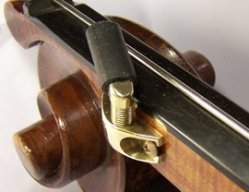
I'm in the market for an extension, and I really can't decide what I want. It's frustrating that there really isn't a surefire best way to go-machine v. gated stick v. stick w/ E-stop...

After reading some of these, I'm beginning to think that a gated stick may be the best compromise, particularly with a thumb seat carved in. Pay attention to your gate changes, keep them efficient, and it seems more than doable. Anything I should be wary of?
 
What about Till Eulenspiegel? That's always the first excerpt I think of when I try extensions.

I'm in the market for an extension, and I really can't decide what I want. It's frustrating that there really isn't a surefire best way to go-machine v. gated stick v. stick w/ E-stop...

After reading some of these, I'm beginning to think that a gated stick may be the best compromise, particularly with a thumb seat carved in. Pay attention to your gate changes, keep them efficient, and it seems more than doable. Anything I should be wary of?

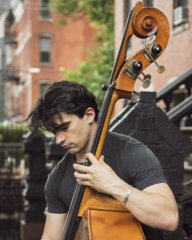
Thou should'th with thine "stick" plan sticketh! I haven't played on a machine enough to say I'm qualified to compare, and the machine vs. gates arguement isn't somewhere I want to go, but the gated stick works great for me.

Thumb seat/thumb rest question:
How many of you out there use thumbrests, or place your thumb directly behind the extension, as opposed to keeping the thumb on the side of the pegbox?

I love the look of some of the thumbrests on recent builds, and I know that many players use them, but my left thumb, even for C#s, stays on the side. I find that opening up my hand and sliding my thumb down the back edge of the pegbox is fast and gives a good reference. To slip the thumb up and over to get to the extension seems counterproductive to me - but that's just me. No endpin to grind!

I'm just curious personally, but feedback on this issue could be valuable to C-Extension builders. Which of you out there does what?
 
This year we will be playing Janacek's Sinfonietta in school.

I might use the classical guitar capo trick for it! There are Db to Low Db octave leaps within quick 16th notes...maybe around 120 bpm? Its a repeating part in the beginning of the 2nd movement that seems like it would be hard with a Db stop. Without one, I question if it's possible to play it clearly...
 
Daphnis (sp?) and Chloe (sp?) Try that on a keyless ext, and you are likely to rip your finger off. Suite 1 especially.

Hilarious to watch guys try to play those pizz c# octaves on a keyless ext.

And no, Lin, I did not go to China this Summer.