Today, I was playing around with winisd for a new cab for me. I was doing my typical attempt at best compromise of SPL/size/weight for a given driver. As usual, I spent way too long juggling bass extension vs box size vs practical port dimensions (size & velocity). I got to wondering about the real world usefulness of some of these limits.
Cone excursion;
I expect that Winisd (and similar programs I've used) show cone excursion in a beautiful graph at the power level you have entered as if the speaker was tested with a sine sweep gen. It would be very unusual for me to ever produce such a pure tone.
Port Velocity;
Similarly port velocity calculations also seem to be related to a swept sine wave type of affair. Trying to maintain reasonable air speed and reasonable port size is a frustrating battle if you are attempting a low weight system.
My question that I'm hoping someone has some input on, is about those two aspects of the design and how electric bass has a much more frequency distributed loading on the cab than a sine wave produces.
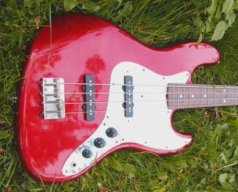
An example: winisd says a driver will reach it's Xmax at 41Hz at 100W. If we were to play an open E on a jazz bass we would have the fundamental 41Hz and some equally large 2nd and 3rd harmonics etc. As these frequencies are simultaneous, wouldn't the spectral distribution of power work in our favour to limit the excursion? Port velocity vs frequency is possibly similarly distributed?
Cone excursion;
I expect that Winisd (and similar programs I've used) show cone excursion in a beautiful graph at the power level you have entered as if the speaker was tested with a sine sweep gen. It would be very unusual for me to ever produce such a pure tone.
Port Velocity;
Similarly port velocity calculations also seem to be related to a swept sine wave type of affair. Trying to maintain reasonable air speed and reasonable port size is a frustrating battle if you are attempting a low weight system.
My question that I'm hoping someone has some input on, is about those two aspects of the design and how electric bass has a much more frequency distributed loading on the cab than a sine wave produces.
An example: winisd says a driver will reach it's Xmax at 41Hz at 100W. If we were to play an open E on a jazz bass we would have the fundamental 41Hz and some equally large 2nd and 3rd harmonics etc. As these frequencies are simultaneous, wouldn't the spectral distribution of power work in our favour to limit the excursion? Port velocity vs frequency is possibly similarly distributed?