• TalkBass has been independent since 1998. Add your voice.
    Create a free account to reply to discussions, view embedded media, and browse with fewer display ads.
    Join freeLog in
    Want zero display ads or expanded classifieds tools? Compare plans.

Can I use a Mesa/Boogie WD-800 for guitar?

Long time lurker, but this is my first post. I immediately became a supporting member because of all the great info I've found around the forum.

I have a pretty dumb question: I've been a guitar player for around 32 years but I'm just learning to play bass. I found a great deal locally on a WD-800 amp head, which I've tentatively paired with a Rumble 210 and I'm pretty happy with this setup so far.

Is there any reason to avoid playing a regular electric guitar through this amp and cab? I mostly tend to play clean jazz kinds of tones and rarely anything overdriven or crunchy, if that makes any difference.

Is there any chance of damaging the head or cabinet by using it outside of its intended frequency / response range?

I briefly plugged in a Suhr guitar and it actually sounds pretty good for warm jazz tones but I'd hate to damage anything due to ignorance. :)

Thanks in advance for any info!
 
Nope, it's totally fine and there are several players I know who do just this.

Your success will be more speaker dependent than limitations of the amp. Add a reverb pedal and you have a decent foundation. You might want to turn the tweeter off on the Rumble cabinet.
 
Long time lurker, but this is my first post. I immediately became a supporting member because of all the great info I've found around the forum.

I have a pretty dumb question: I've been a guitar player for around 32 years but I'm just learning to play bass. I found a great deal locally on a WD-800 amp head, which I've tentatively paired with a Rumble 210 and I'm pretty happy with this setup so far.

Is there any reason to avoid playing a regular electric guitar through this amp and cab? I mostly tend to play clean jazz kinds of tones and rarely anything overdriven or crunchy, if that makes any difference.

Is there any chance of damaging the head or cabinet by using it outside of its intended frequency / response range?

I briefly plugged in a Suhr guitar and it actually sounds pretty good for warm jazz tones but I'd hate to damage anything due to ignorance. :)

Thanks in advance for any info!
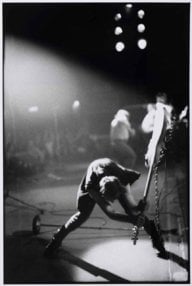
The Fender Bassman was beloved by guitarists back in the 1950s, and tolerated by bassists. ;)

Then some Marshall bloke copied it. The rest is history.
 
  • Like
Reactions: Chronax
Ideally you would probably use a guitar cab and some pedals to get a nice sound. I think the amp will be fine, but a 2-way bass cab may be at some level of risk.

Bass does not put out a lot of highs, so the typical tweeter in a bass cabs has a much lower power rating than the woofer(s). I believe many of tweeters can only handle about 15W RMS, although they can handle short transients of 30W or possibly 60W.

So, I believe the tweeter will be safe with clean guitar unless you play super loud. However, I believe risk to the tweeter increase if you use heavy distortion.

Distortion tends to shift power up higher in the frequency spectrum. So the more saturated your sound is, the more energy is shifted up to the range of the tweeter.

Also distortion goes hand in hand with compression. Although the peak power may be reduced with compression, the average power tends to go up. If the average power exceeds the RMS rating of the tweeter, the voice coil will burn.

If your cab has an L-Pad (rotary level adjuster), the L-Pad may be at risk of damage as well. When adjusted for maximum level, most of the power is dissipated by the tweeter. As the level is turned down, the L-Pad starts to dissipate more and more of the power. My understanding is it depend on the power rating of the control and how the L-Pad is integrated into the crossover.
 
Ideally you would probably use a guitar cab and some pedals to get a nice sound. I think the amp will be fine, but a 2-way bass cab may be at some level of risk.

Bass does not put out a lot of highs, so the typical tweeter in a bass cabs has a much lower power rating than the woofer(s). I believe many of tweeters can only handle about 15W RMS, although they can handle short transients of 30W or possibly 60W.

So, I believe the tweeter will be safe with clean guitar unless you play super loud. However, I believe risk to the tweeter increase if you use heavy distortion.

Distortion tends to shift power up higher in the frequency spectrum. So the more saturated your sound is, the more energy is shifted up to the range of the tweeter.

Also distortion goes hand in hand with compression. Although the peak power may be reduced with compression, the average power tends to go up. If the average power exceeds the RMS rating of the tweeter, the voice coil will burn.

If your cab has an L-Pad (rotary level adjuster), the L-Pad may be at risk of damage as well. When adjusted for maximum level, most of the power is dissipated by the tweeter. As the level is turned down, the L-Pad starts to dissipate more and more of the power. My understanding is it depend on the power rating of the control and how the L-Pad is integrated into the crossover.

This is incredible information, thank you for the detailed explanation! And I'm flattered to receive a response from @agedhorse on my first post. One of the reasons I pulled the trigger on the WD-800 was all of the great customer support on this forum, so I really appreciate it.

Is a two-way bass cab just a cab with a tweet driver and a bass driver? If I turn off the tweeter and run distortion through the sub only, will that cause any damage?

Sometimes I try to duplicate a Mike Stern / John Scofield kind of a fusion sound, with some thin crunch.

I have another valve amp that I normally use solely for guitar, but I'm wondering if I could get rid of some gear and get down to a single amp + cab with my HX Stomp.
 
  • Like
Reactions: Wasnex
The WD 800 has a nice flexible mid range to play with, and it can be a little woolly which may sound good for guitar. I would use the low pass filter to decrease any low end that doesn't sound good. Not being a guitar player, would the dampening sound like sag?
I have Mesa 112 90 watt closed back and 110 45 watt closed back guitar speakers. I thought about trying them with mine. But even with safety glasses I thought with 800 watts I might get hurt by flying speaker parts.

I have the Mesa Rosetta and Subway preamps very similar. So would the D350 work as a guitar amp. It's only 50 watts more than the Mesa Rosetta acoustic guitar amp. Both bass eq are at 80 hz. These preamps take stomp boxes very well. The D350 could be marketed as the new and improved Bassman for the 21'st century.
 
  • Like
Reactions: Wasnex
No reason it would not sound great. Years ago, many jazz guitarists used the Walter Woods heads for guitar and it sounded lovely. I have a friend who plays 7 string guitar (low A) and it sounded great with the WW amp.

I owned a WW amp and now have a WD-800. The Mesa head has much more EQ available and loads of power. It should sound terrific with guitar. I suspect the SW115 would be perfect for that application.
 
If aged horse added some of the features of the Mesa guitar amps it may be a hit. I have run my WD800 on a battery operated inverter, it could be vary portable. With the D350 being tubeless it would last a long time on battery. Probably separate it from the tube amps on the web sight don't want to get the tube guys to excited.
 
The WD 800 has a nice flexible mid range to play with, and it can be a little woolly which may sound good for guitar. I would use the low pass filter to decrease any low end that doesn't sound good. Not being a guitar player, would the dampening sound like sag?
I have Mesa 112 90 watt closed back and 110 45 watt closed back guitar speakers. I thought about trying them with mine. But even with safety glasses I thought with 800 watts I might get hurt by flying speaker parts.

I have the Mesa Rosetta and Subway preamps very similar. So would the D350 work as a guitar amp. It's only 50 watts more than the Mesa Rosetta acoustic guitar amp. Both bass eq are at 80 hz. These preamps take stomp boxes very well. The D350 could be marketed as the new and improved Bassman for the 21'st century.
We actually tested the D-350 with a jazz guitar set-up, reverb pedal and the 112/115 cabinets. It was similar to the Rosette and the voicing control was quite useful.
 
Long time lurker, but this is my first post. I immediately became a supporting member because of all the great info I've found around the forum.

I have a pretty dumb question: I've been a guitar player for around 32 years but I'm just learning to play bass. I found a great deal locally on a WD-800 amp head, which I've tentatively paired with a Rumble 210 and I'm pretty happy with this setup so far.

Is there any reason to avoid playing a regular electric guitar through this amp and cab? I mostly tend to play clean jazz kinds of tones and rarely anything overdriven or crunchy, if that makes any difference.

Is there any chance of damaging the head or cabinet by using it outside of its intended frequency / response range?

I briefly plugged in a Suhr guitar and it actually sounds pretty good for warm jazz tones but I'd hate to damage anything due to ignorance. :)

Thanks in advance for any info!

The TT800 boogie channel is very very blackface… sounds awesome with guitar
 
the subway cabs are certainly intended for bass guitar. Sounds decent clean but very unnatural distorted.

Question is would a two notes torpedo X / cab clone be safe to use with the TT800. My guess is no.
but you can't really plug in to a guitar cab safely either. What to do?

the TT800 has a very nice sweet spot on guitar around with master at 11:00 when the yellow light just starts to flicker and the gain relatively high. All I can say is it sounds to me like a high wattage late 60s fender amplifier.

I've run the DI out into a vst cab sim and it sounds very very good with an appropriate cab but I'm stuck because I don't like using a DAW everytime I play.

i know this thread is about the WD800 but for me I'd say go for it. im thinking of selling my Mark V because the TT800 boogie channel does blackface without the mark muddyness that's so prevelant.

My confusion is why is a Princeton reverb muddy? Everyone suggests it has to do with the phase inverter design being ineffecient. Does that really carry over to the mark I and the FAT sound on a modern mark?

The mark V fat channel and it's still very very dark relative to a twin. In fact I'd say you can happily turn the bass up to 9 on a twin with the volume on 4 and you'll have less bass and less mids than the mark 1/ Fat.

to my ear this seems true of the TT800, but I havnt tested it much nor have I tried to understand the circuit by opening it. Seems too complicated for me to try to follow with the 2 Channels being so different in design.
but it seems the TT800 is closer to the 'big' blackface sound than the Princeton or mark I despite all of them having the fender tone stack.

anyone have any insight onto these circuits?

OP want to buy a mark V ?