• TalkBass has been independent since 1998. Add your voice.
    Create a free account to reply to discussions, view embedded media, and browse with fewer display ads.
    Join freeLog in
    Want zero display ads or expanded classifieds tools? Compare plans.

Can lightweight tuners cause dead spots?

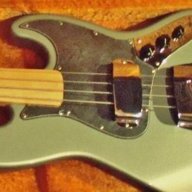
I recently picked up a really nice used Mexican 50's pbass as a gigging instrument, and would really like to swap the tuning machines for the lightweight Gotoh ones. At this point the little bit of torque I feel in my back (for the slight neck-heaviness) isn't an issue, and I'd like to avoid rushing to the day when it will be . . .

If adding weight sometimes fixes dead spots, does that mean remove weight sometimes causes them? Has anyone heard of this happening?

Thanks!
Nick
 
Adding weight doesn't actually "fix" dead spots, it just moves them somewhere else on the neck. Best case scenario, the dead spot is moved to a location you never use on the fretboard.

Removing weight does the same thing. So it is possible to have a "new" dead spot after putting lightweight tuners in. But it's not that they caused the dead spot--they just relocated it someplace noticeable.

I wouldn't worry about it because there's no way to predict.
 
I recently picked up a really nice used Mexican 50's pbass as a gigging instrument, and would really like to swap the tuning machines for the lightweight Gotoh ones. At this point the little bit of torque I feel in my back (for the slight neck-heaviness) isn't an issue, and I'd like to avoid rushing to the day when it will be . . .

If adding weight sometimes fixes dead spots, does that mean remove weight sometimes causes them? Has anyone heard of this happening?

Thanks!
Nick

I've done that exact mod on quite a few basses using Hipshot Ultralight and Gotoh Res-O-Lite 350 tuners and checked specifically for any such changes and I found no difference in response.
 
I recently picked up a really nice used Mexican 50's pbass as a gigging instrument, and would really like to swap the tuning machines for the lightweight Gotoh ones. At this point the little bit of torque I feel in my back (for the slight neck-heaviness) isn't an issue, and I'd like to avoid rushing to the day when it will be . . .

If adding weight sometimes fixes dead spots, does that mean remove weight sometimes causes them? Has anyone heard of this happening?

Thanks!
Nick

Does your bass have dead spots? If not, don't worry about it. If it dies, look into having the frets leveled, dressed and polished. You can also try using different strings- the weight/diameter/tension of the core make a difference.
 
I've put Ultralites in all my vintage Fender, and yes, sometimes it can make deadspots more noticeable or move them to different frets. For example, a bass had a deadspot in the G string, 5th fret, and after installing the Ultralites the deadspot moved to the 7th fret.

If weight it's really an issue, it's worth trying and worth the compromise, IMHO.
 
Thanks for the reassurance! Res-o-lites are on the way, and I'm so excited to gig a balanced instrument that's not a boat anchor!

Off-topic: has anyone else found themselves strangely inspired to compose new material with the stock Fender round set (100-to-45)? While there's something I find a bit unpleasant in the upper-mids, and all the overtones make the fundamental harder to hear (TI Jazz flats user here), it seems like something new and unlike anything I usually come up with comes out of them? Or do you think it's probably the "new guitar high" and the particularities of that instrument?
 
Off-topic: has anyone else found themselves strangely inspired to compose new material with the stock Fender round set (100-to-45)? While there's something I find a bit unpleasant in the upper-mids, and all the overtones make the fundamental harder to hear (TI Jazz flats user here), it seems like something new and unlike anything I usually come up with comes out of them? Or do you think it's probably the "new guitar high" and the particularities of that instrument?

Does it matter? Take inspiration anywhere you can find it.
 
Adding weight doesn't actually "fix" dead spots, it just moves them somewhere else on the neck. Best case scenario, the dead spot is moved to a location you never use on the fretboard.

Removing weight does the same thing. So it is possible to have a "new" dead spot after putting lightweight tuners in. But it's not that they caused the dead spot--they just relocated it someplace noticeable.

"Cause" and "relocate" essentially leading to the same result; but I agree with you completely. Dead spot locations depend on the resonance frequency of the instrument, which in turn is dependent upon the ratio of the mass of the headstock to the mass of the body.

Adding or removing mass from the headstock may result in a favorable relocation of an annoying dead spot (which happened on my 4003FL when I switched from stock tuners to Hipshot ultralites), it may result in the occurrence of a dead spot in a new location that is undesirable, or it may make no noticeable difference. It depends on the current headstock to body mass ratio and how much you change it. That and which way the wind blows on Thursday.

Best o' luck with the new tuners.
 
Back in the 80s they took the opposite approach about mass and used to sell something called a Fathead that was a big brass plate you could put on the back of your headstock to increase the mass pretty significantly. As described above, this was to move around the dead spots of the day to a less-obvious location.

Because of course, brass made everything better in the 80s....from headstock plates to nuts to heavy tone blocks.
 
Well, the tuners made a beautiful difference in balance, even though by the numbers they're only 30% (or something like that) lighter. If the headstock was any lighter I'm not sure if it would still feel like a P-bass. Are MIM and MIA Standards based on the '70s ones, but without the U neck profile? They feel much more heavy, stiff, and solid than this MIM '50s model; this one is very light and lively.

While it's not really a dead spot, now fretting C# on the 1st string doesn't sound as lively as most every other note I've played in this bass. I suspect that tightening the truss-rod an 1/8th of a turn will fix this, since it needs this anyway…but I'm moving to a more humid climate, so am putting this off for a month or so. It's not a huge deal, it's only one note, and you can always hit it ever so slightly harder to compensate…

But yeah, wow, res-o-lite tuners on this P-bass took it from something special, to what I hoped it would be. Bar-none, my favourite instrument to gig!