• TalkBass has been independent since 1998. Add your voice.
    Create a free account to reply to discussions, view embedded media, and browse with fewer display ads.
    Join freeLog in
    Want zero display ads or expanded classifieds tools? Compare plans.

Can you change tuning on a multiscale neck ?

n30g30

Supporting Member
Aug 6, 2013
122
64
If a multiscale bass is set up BEADG can you change it to EADGC? I realize I may need to adjust the truss rod etc. My question is more geared towards the placement of the pickups and the bridge - and if the placement assumes a low B.

Thanks for advice/comments
 
  • Like
Reactions: bassasaurus
It makes no more difference than it would on a standard bass. However, You will have to adjust your intonation and truss rod for sure. You may also need a new nut, if there is too much play in the string slots for the narrower strings.
This ^ Dingwall basses, I think, have "counterbored" tuners so there may be less concern over the down angle over the nut, as there is, for example, the A string on a "standard" Fender-style in-line headstock.

I've never tried going higher on my Dingwall 5-string as I have no use for a high C string... but I would be curious to know how a longer scale E string feels. You may find it too tight. Or maybe it'll be nice. Only one way to find out...
The tension of a string is a function of mass^2 X scale length ^ X pitch, divided by a constant. Yes, increasing the scale length by moving the string up to the next notch of the slightly longer scale will make a difference. BUT...if a B-G string set is optimized for the fanned fret scales, from experience of designing my own fanned fret bass, see this thread: A Different Custom P-style Bass , the @ 1/2 to 5/8 inch difference in scale string-to-string should not make an appreciable difference in tension, and may even help the stability as each string is positioned up to the next longer position on the neck; maybe if necessary a slight tweak to the truss rod.
 
Last edited:
  • Like
Reactions: NKBassman
The tension of a string is a function of mass^2 X scale length ^ X pitch, divided by a constant. Yes, increasing the scale length by moving the string up to the next notch of the slightly longer scale will make a difference. BUT...if a B-G string set is optimized for the fanned fret scales, from experience of designing my own fanned fret bass, see this thread: A Different Custom P-style Bass , the @ 1/2 to 5/8 inch difference in scale string-to-string should not make an appreciable difference in tension, and may even help the stability as each string is positioned up to the next longer position on the neck; maybe if necessary a slight tweak to the truss rod.
Honestly, for me personally I think I would appreciate the longer scale E string. But it might not suit everybody, depending on personal preference.
 
I once tuned my dingwall

Z D G C G

I shook the earth
Yeah, but have you tried this tuning?
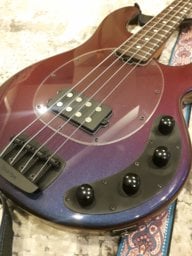
IMG_2662.jpeg


To quote Bo Diddley, you should have heard just what I seen.
 
Yes absolutely, you will need to adjust the truss rod, adjusting individual saddle heights, and perhaps even replacing the nut.
You will want to check intonation as well.

Pickups and bridges should not need to move.
Think of multiscale as each string being an individual.