
Enjoy the benefits of a premium membership!
Upgrade Account
-
TalkBass has been independent since 1998. Add your voice.
Create a free account to reply to discussions, view embedded media, and browse with fewer display ads.
Join free Log in
Want zero display ads or expanded classifieds tools? Compare plans.
You are using an out of date browser. It may not display this or other websites correctly.
You should upgrade or use an alternative browser.
You should upgrade or use an alternative browser.
Can You Read Music?
- Thread starter EtoG
- Start date
More options
Who Replied?
Being self taught/taught by my dad who has played for 30+ years, neither of us learned how to read.
I would like to though. I don't think it's completely necessary to be able to play well/be a good musician though.
I would like to though. I don't think it's completely necessary to be able to play well/be a good musician though.

I know what a lot of the stuff on sheet music means, but as far as putting it all together, it's very difficult. I also have ADD, which makes it very, very difficult for me to sit there for any extended length of time and concentrate on learning anything, let alone reading.
I haven't seen anyone bring this up yet. There's "reading" music which is just understanding the notation. You'll hear it called "sight reading," too.
Then there is "sight playing" which is being able to play the piece as written. That's notes and rhythm. It's a tough skill.
I think that most people can get the coordination between seeing a note, decoding it as "C4" and playing it pretty quickly. The work is in getting the consciousness out of the loop - instead of "read," "translate," "play," making it "see," "play" - that's the goal and what makes you a master of the fretboard.
Then add in the rhythm. That's where I'm really weak and why I can claim to be a "sight reader" but not a "sight player" on the violin. On the bass, I'm neither. I know the notes on the clef from playing the cello but still panic at times finding them on the fret. It doesn't help that the strings are upside down (GDAE on the violin and EADG on the bass).
Then there is "sight playing" which is being able to play the piece as written. That's notes and rhythm. It's a tough skill.
I think that most people can get the coordination between seeing a note, decoding it as "C4" and playing it pretty quickly. The work is in getting the consciousness out of the loop - instead of "read," "translate," "play," making it "see," "play" - that's the goal and what makes you a master of the fretboard.
Then add in the rhythm. That's where I'm really weak and why I can claim to be a "sight reader" but not a "sight player" on the violin. On the bass, I'm neither. I know the notes on the clef from playing the cello but still panic at times finding them on the fret. It doesn't help that the strings are upside down (GDAE on the violin and EADG on the bass).
Yup, I can read. But I've learned that if I stop trying to sight read for long periods of time, you lose it. You have to keep using that skill to keep it sharp.
I can, though I mostly used it for tuba. I once played bass using the tuba music when the regular pep band bassist was ill, which was a novel experience to say the least. I still like using tuba stuff as bass practice because it's more fun than trying to play Mary Had a Little Lamb (not SRV style, that's always good).

Just got back from a big-band rehearsal. I sight-read fluently. I also gravitate towards genres and playing situations that use this skill.
Yes, I can read music (classically trained on other instruments), but most of what I play on electric bass is either composed by me and played from memory or else improvised with others (jams). If I ever did a jazz gig or something that involved reading from a fake book, though, I'd want to make sure my sightreading chops on bass were up to snuff (and make a point of practicing it).
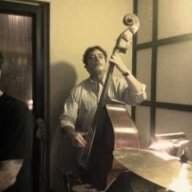
Almost all of my gigs now are musical theater which requires the ability to read pretty well. I never had any formal musical instruction as a child or young adult, played mostly by ear for the rock stuff. In my early twenties I started playing with jazz musicians so I began to teach myself theory and how to read chord charts.
I think I was 25 when I was doing a wedding band gig and the piano player/bandleader, who was also a bass player, asked me if I could cover for him ther next weekend. Thinking it was another society gig I said sure. It turned out to be a pit gig for the musical "Shenandoah". I got the music a couple of days before and penciled in the names of all of the notes. Fortunately, the rhythms weren't too difficult. My ear got me through the gig - but very stressful!!! I sat next to the piano player and listened with the biggest ears I could muster. Whatever she played with her left hand, I played. I messed up alot, but I guess not too badly since the musical director hired me back for their next show (I suppose bass players were in extremely short supply!).
I decided if I wanted to expand my musical possibilities, it would be best to learn how to read. It has been an ongoing process and 33 years later I still try and read some new music everyday to keep my reading chops up. Other than, literally, two lessons with Mahavishnu Orchestra bass player, Rick Laird, I didn't have any formal musical training until I was in my forties and that was on classical guitar.
I had a language professor in college, who was also a substitute violinist for the Atlanta Symphony Orchestra, tell me that learning how to read music can only help; it greatly expands the musical repertoire available to you, as well as reduces the time it takes to learn new music and vastly broadens your employment opportunities. I have to agree!
So, it is both ears and dots that gets me through.
Cheers,
Dennis
I think I was 25 when I was doing a wedding band gig and the piano player/bandleader, who was also a bass player, asked me if I could cover for him ther next weekend. Thinking it was another society gig I said sure. It turned out to be a pit gig for the musical "Shenandoah". I got the music a couple of days before and penciled in the names of all of the notes. Fortunately, the rhythms weren't too difficult. My ear got me through the gig - but very stressful!!! I sat next to the piano player and listened with the biggest ears I could muster. Whatever she played with her left hand, I played. I messed up alot, but I guess not too badly since the musical director hired me back for their next show (I suppose bass players were in extremely short supply!).
I decided if I wanted to expand my musical possibilities, it would be best to learn how to read. It has been an ongoing process and 33 years later I still try and read some new music everyday to keep my reading chops up. Other than, literally, two lessons with Mahavishnu Orchestra bass player, Rick Laird, I didn't have any formal musical training until I was in my forties and that was on classical guitar.
I had a language professor in college, who was also a substitute violinist for the Atlanta Symphony Orchestra, tell me that learning how to read music can only help; it greatly expands the musical repertoire available to you, as well as reduces the time it takes to learn new music and vastly broadens your employment opportunities. I have to agree!
So, it is both ears and dots that gets me through.
Cheers,
Dennis

I can read music, but I almost never have to, so I don't get much practice. I'd have difficulty sight reading.
I play almost exclusively from chord charts.
I play almost exclusively from chord charts.
I find this is the hardest part by far, and also the most rewarding and useful part of reading music. Tips? Keep practicing. Also a drummer friend showed me how to program complex 16th note rhythms into a drum machine so you can hear how they sound.ok weird question. I can read the notes dead on. But reading rhythm is a problem . Any tips ??

It took piano lessons when I was younger, so I'm capable of sight reading while playing. I'm not to good though, since it's been quite a few years since I've used it and piano doesn't quite transfer over to bass.

I haven't seen anyone bring this up yet. There's "reading" music which is just understanding the notation. You'll hear it called "sight reading," too.
I've never heard the term "sight playing." To me, "sight reading" is being able to read in real time with a high level of accuracy.
a drummer friend showed me how to program complex 16th note rhythms into a drum machine so you can hear how they sound.
+1
I'd say that's a really important factor in being able to read rhythm. Having a device that lets you notate and play back rhythms is a veritable boon.
I've never heard the term "sight playing." To me, "sight reading" is being able to read in real time with a high level of accuracy.
This.


