• TalkBass has been independent since 1998. Add your voice.
    Create a free account to reply to discussions, view embedded media, and browse with fewer display ads.
    Join freeLog in
    Want zero display ads or expanded classifieds tools? Compare plans.

Can you switch between short and regular scale without constantly being a half step off?

Bridge position is a bigger factor than scale length IME. I’ve owned/flipped a bunch of shorties:

- I don’t like the bridge when it’s closer to the middle of the body. Feels off in the upper register despite easier access. Had several hollow bodies that have all the mojo but just felt off to my ergonomics.

- I prefer the bridge to be in relatively the same position as a long scale bass. Feels closest to a long scale all up & down the neck.

I currently play my Rob Allen Mouse 30” Fretless chambered piezo bass the most. Such a delight to see & play.

I leave my Danelectro Longhorn 30” (in Daddy-O Yellow) in the living area to plunk away on for fun through the day.

Almost identical ergonomics to the RA Mouse. The more I play it, the more it helps playing other shorties on autopilot. I get much better intonation on the
30” Fretless Mouse as I can “see” in my minds eye where the invisible fret lines would be.
 
Fretless, I can see the problem, but I gave up on that years ago (after being told by my best friend that I suck at it!)
I am primarily a 34" player, but have a couple 30" shorties (Mustangs). I go back and forth pretty much mindlessly (as I live much of my life :bassist:).
I do find it harder to go back to 34 if I've been playing a short scale really a lot, but the transition is a matter of minutes. I am also a reader, so I glance at the FB only on significant moves. Your brain will figure it out.

(I also play 25 1/2" Fender and 24 3/4" Gibson guitars - mindless :bassist:) :D
 
Not exactly what you asked about, but related to it:
I switch frequently and seamlessly between upright bass (42') and (fretless) bass guitar (34') (and sometimes U-bass !).

The reason why it works, in my opinion, is that even when playing always on the same instrument, we are anyhow accustomed to accomodate the change of spacing between successive notes as we move up and down along the fingerboard.

Possibly it is easier for an upright bassist, because playing DB implies much more shifting than BG, so adapting to variable note spacings is a more familiar task...
 
  • Like
Reactions: Watchootognbout
Yep. I bring these two to most gigs. The Jackson Minion is my "hope-I-don't-need-it-backup", but I can switch between them without issue. FWIW I also find the Minion more comfortable to play seated when I'm practicing at home.
IMG_0618.jpeg
 
I just scored a cool old bass that I posted about here
https://www.talkbass.com/threads/50-on-marketplace-scored-me-a-vintage-et280.1647072
I'm already playing a lot of notes 1/2 step sharp because of the fret spacing.
Can anyone play both scales? or must one commit to a scale length forever?

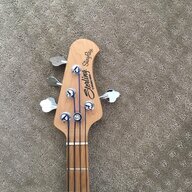
Given that you are only a couple of days in I wouldn't sweat it too much. Just focus on the short-scale for a couple more days and you should be fine. If not, it looks like there could be decent profilt should you decide to move the ET280 on - $50 is essentially theft!!

As @Lobster11 noted above, the fret spacings coincide from fret 2 onwards. If you don't believe it, stand your shorty face to face with a long-scale, align the bridges and check where the frets fall. Bottom is a 34" FSO and top is a 30" Hofner Club with bridges aligned. The 30" nut lines up with the 2nd fret of the 34":
20240411_094558.jpg
 
Maybe think of it this way: The fret spacing in the lower frets on a short-scale is similar to the fret spacing on higher frets on a long-scale. If you can play up and down the neck on a long-scale bass you should easily adapt to a short-scale bass.
Yep, these days I’m mostly on a Mustang bass because of hand issues, but I occasionally pick up a standard Jazz to see if it still hurts to play one (it does), but I don’t have any problem with being out of position when moving up and down the neck, just the usual discomfort after about 5~10 minutes on the longer scale.