
Enjoy the benefits of a premium membership!
Upgrade Account
-
TalkBass has been independent since 1998. Add your voice.
Create a free account to reply to discussions, view embedded media, and browse with fewer display ads.
Join free Log in
Want zero display ads or expanded classifieds tools? Compare plans.
You are using an out of date browser. It may not display this or other websites correctly.
You should upgrade or use an alternative browser.
You should upgrade or use an alternative browser.
Double Bass Carbon Fiber Endpins
- Thread starter CBFinet
- Start date
More options
Who Replied?
Charles,
With the exception of drilling a keeper hole in a sacrificial wooden table on the drill press (to keep the untethered end from cavitating), the same technique worked perfectly on the camelopards I installed on my Juzek and Cleveland. Additionally, I like the fact that the titanium rod does not need to be ringed with grooves to get a positive lock down on the rod. Flatback is dead on target with the KC strings rubber tip modification. Far superior to the crutch tip for sound and stability. Am currently turning a piece of lignum vitae for an experiment/alternative to the pizz titanium. Evaluation to follow.
Jim
With the exception of drilling a keeper hole in a sacrificial wooden table on the drill press (to keep the untethered end from cavitating), the same technique worked perfectly on the camelopards I installed on my Juzek and Cleveland. Additionally, I like the fact that the titanium rod does not need to be ringed with grooves to get a positive lock down on the rod. Flatback is dead on target with the KC strings rubber tip modification. Far superior to the crutch tip for sound and stability. Am currently turning a piece of lignum vitae for an experiment/alternative to the pizz titanium. Evaluation to follow.
Jim

Anyone want carbon fibre rods, hollow or solid, in the UK try this:
Link Removed
The Contrabass shoppe sells an endpin only for £65 (ouch) where one metre of 10mm solid rod costs about £8 plus postage (a tad more if its hollow).
Link Removed
The Contrabass shoppe sells an endpin only for £65 (ouch) where one metre of 10mm solid rod costs about £8 plus postage (a tad more if its hollow).
Hello--
In response to your enquiry on types of carbon fibre endpins, I have been using the one designed by Paris luthier Christian Laborie for the past 3 years. This is a carbon fibre rod about 10mm in diameter and set into a 5/8 inch conical-shaped hole drilled at a 45 degree angle through the bottom block immediately behind the extisting end pin and halfway to the outer edge.
This system was a collaboration between Laborie and Francois Rabbath who promotes this endpin system for all of his students and at all of his seminars. It completely changes the center of gravity of the instrument and brings the bass up and back into your body in a manner enabling the player to really for the first time have both hands free to concentrate on playing technique. Although I am predominantly a jazz bassist, when I saw that Rufus Reid was also using this system on his beautiful old 1805 German bass, I decided to try it myself.
The first thing you notice is that all of a sudden you can really HEAR your instrument. I mean HEAR IT! The F-holes are now directly beneath your ear rather than facing straight out to the audience. The next thing you notice is that your left hand intonation is truer than you ever thought it could be. With proper left arm and hand technique, this angle allows you to move your fingers across the positions effortlessly and its much less stressfull on the wrist.
I understand too that Don Robertson can drill and install a fibre endpin, but I have not see a Robertson one, and can't comment on whether it works or acts the same as the Christian Laborie endpin system. You can however purchase the Laborie carbon-fibre rods (with black rubber ball tip that can be replaced by a good old fashioned crutch tip) from George Vance's Slava Publishing Company in Maryland. I had Cristian install these on both of my carved basses three years ago when he was accompanying Francois Rabbath at a stateside double bass seminar. I can honestly say that I would not-- could not-- go back to a straight type of endpin again. The Laborie pins that George sells or which you can get directly from Christian is you meet him at a Rabbath seminar come in a standard "blank" size that is about 18 inches long, and each must be measured and cut back to accomodate the individual height of the player. If you buy a blank, you can just trim it down with a standard hacksaw, but remember, it needs to be fairly long as it is going to support your instrument at a fairly radical angle of 45 degrees.
Christian charged me $75: $15 to drill sand and shape the hole in the block and $60 for the carbon-fibre endpin, which he measured and adjusted to my height.
I had him drill both of my basses so that I could remove and switch this endpin between them. I finally got tired of that and ordered a second pin at $60 from George Vance and cut it down to match the length of the original, and now have one for each of my basses.
Hope this is helpful or of interest.
In response to your enquiry on types of carbon fibre endpins, I have been using the one designed by Paris luthier Christian Laborie for the past 3 years. This is a carbon fibre rod about 10mm in diameter and set into a 5/8 inch conical-shaped hole drilled at a 45 degree angle through the bottom block immediately behind the extisting end pin and halfway to the outer edge.
This system was a collaboration between Laborie and Francois Rabbath who promotes this endpin system for all of his students and at all of his seminars. It completely changes the center of gravity of the instrument and brings the bass up and back into your body in a manner enabling the player to really for the first time have both hands free to concentrate on playing technique. Although I am predominantly a jazz bassist, when I saw that Rufus Reid was also using this system on his beautiful old 1805 German bass, I decided to try it myself.
The first thing you notice is that all of a sudden you can really HEAR your instrument. I mean HEAR IT! The F-holes are now directly beneath your ear rather than facing straight out to the audience. The next thing you notice is that your left hand intonation is truer than you ever thought it could be. With proper left arm and hand technique, this angle allows you to move your fingers across the positions effortlessly and its much less stressfull on the wrist.
I understand too that Don Robertson can drill and install a fibre endpin, but I have not see a Robertson one, and can't comment on whether it works or acts the same as the Christian Laborie endpin system. You can however purchase the Laborie carbon-fibre rods (with black rubber ball tip that can be replaced by a good old fashioned crutch tip) from George Vance's Slava Publishing Company in Maryland. I had Cristian install these on both of my carved basses three years ago when he was accompanying Francois Rabbath at a stateside double bass seminar. I can honestly say that I would not-- could not-- go back to a straight type of endpin again. The Laborie pins that George sells or which you can get directly from Christian is you meet him at a Rabbath seminar come in a standard "blank" size that is about 18 inches long, and each must be measured and cut back to accomodate the individual height of the player. If you buy a blank, you can just trim it down with a standard hacksaw, but remember, it needs to be fairly long as it is going to support your instrument at a fairly radical angle of 45 degrees.
Christian charged me $75: $15 to drill sand and shape the hole in the block and $60 for the carbon-fibre endpin, which he measured and adjusted to my height.
I had him drill both of my basses so that I could remove and switch this endpin between them. I finally got tired of that and ordered a second pin at $60 from George Vance and cut it down to match the length of the original, and now have one for each of my basses.
Hope this is helpful or of interest.
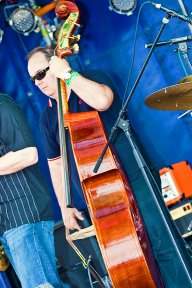
I got a Carbon Fibre End Pin today, from the Contrabasse Shoppe...
www.contrabass.co.uk
I wanted to replace mine, looked at their website and thought hmmm...why not?
I'm getting it fitted by a local guy - next week!!
www.contrabass.co.uk
I wanted to replace mine, looked at their website and thought hmmm...why not?
I'm getting it fitted by a local guy - next week!!
STRONGBOW said:Hello--
This system was a collaboration between Laborie and Francois Rabbath who promotes this endpin system for all of his students and at all of his seminars. It completely changes the center of gravity of the instrument and brings the bass up and back into your body in a manner enabling the player to really for the first time have both hands free to concentrate on playing technique.
I understand too that Don Robertson can drill and install a fibre endpin, but I have not see a Robertson one, and can't comment on whether it works or acts the same as the Christian Laborie endpin system. You can however purchase the Laborie carbon-fibre rods (with black rubber ball tip that can be replaced by a good old fashioned crutch tip) from George Vance's Slava Publishing Company in Maryland.
I/QUOTE]
I recently had the carbon fiber endpin put in by Robertson & Sons of Albuquerque. I was at a bass fest with Francois Rabbath and he recommended this after hearing me play at a master class The endpin put in seems to be the one you mention and has a rubber ball type of tip.
At least a dozen people at the fest got this installed and I cannot begin to describe what a difference having the endpin at a 44 degree angle makes (I think he did mention 44, not 45, slight difference anyway). Playing is so much easier, positioning is so much better, my sound is so much better too, whether its from the endpin itself or the new positioning.
Bruce Lindfield said:I got a Carbon Fibre End Pin today, from the Contrabasse Shoppe...
www.contrabass.co.uk
I wanted to replace mine, looked at their website and thought hmmm...why not?
I'm getting it fitted by a local guy - next week!!
Have you got the bass back and noticed any differrence Bruce? £65 seemed a bit much but I was tempted. I liked the thicker pin on Olie's bass myself.
Mike Crumpton said:Have you got the bass back and noticed any differrence Bruce? £65 seemed a bit much but I was tempted. I liked the thicker pin on Olie's bass myself.
Yes it has been fitted and the bass feels much more secure now - I used to get a sort of "fluttering" on the G string...
It is definitely louder as well - they guy who did it was really surprised at how loud - he kept plucking opens strings and looking amazed. (He mostly does Cellos
 )
)It is also lighter (overall weight) and sounds bassier to me...?
I thought £60 wasn't bad - so I thought I might not notice a difference with another steel one and the picture on the Contrabasse shop looked really "robust"!!
I really like how the rubber boot grips the floor and doesn't leave holes in the carpet!!
I could never have "worked" a carbon fibre blank rod with the necessary grooves (or whatever you call them) and I wanted to get it right, as I don't expect to change it again!
I'm really pleased as it has made my bass "perfect", from my point of view...
Now it's just down to me to play the thing well enough ....
Well it might only have been louder in my case, as it was the poor original endpin making it quieter - Olie mentioned this to me and my teacher as well - i.e. that it would be louder with a better endpin.
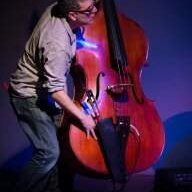
I took the plunge and got the Laborie/Rabbath endpin installed this weekend. So far I'm appreciating the ergonomic and (I think) sonic improvements. Not only is the left hand freed from holding up the bass but, since the bass is at a more acute angle, gravity helps transmit weight through the bow-it's more like letting the bow rest on the strings than directing the bow into the strings (when the bass is more vertical).
But, here's the question: since the bass is leaning back so much more, my bow quiver rests on the top, interfering with the sound of the bass and making sounds of its own. Also, because the balance of the bass on the endpin has changed so much, the bass seems much less stable on its stand (it's this one: Invalid Link Removed). Obviously these aren't deal-breakers, I'm just curious if this happened to anyone else.
But, here's the question: since the bass is leaning back so much more, my bow quiver rests on the top, interfering with the sound of the bass and making sounds of its own. Also, because the balance of the bass on the endpin has changed so much, the bass seems much less stable on its stand (it's this one: Invalid Link Removed). Obviously these aren't deal-breakers, I'm just curious if this happened to anyone else.
Jeff Schwartz said:I took the plunge and got the Laborie/Rabbath endpin installed this weekend.
But, here's the question: since the bass is leaning back so much more, my bow quiver rests on the top, interfering with the sound of the bass and making sounds of its own. Also, because the balance of the bass on the endpin has changed so much, the bass seems much less stable on its stand (it's this one: Invalid Link Removed). Obviously these aren't deal-breakers, I'm just curious if this happened to anyone else.
Hi Jeff,
The first thing I noticed when I had the Rabbath endpin installed was this instability with the bass, but that seems to have changed over time. I don't think that's what you asked at all, but just a comment about adjusting to this endpin. Yes, I too wondered about the bow quiver but I am not getting sounds and it don't think it is affecting the overall sound of the bass. My bow quiver is the standard one that Lemur sells and it is rather flat, so gravity seems to keep it in one place. What bow quiver at you using?
Yes, putting it on the stand is kind of tricky. I don't have the same stand you do. I have the Meisel stand bought from Lemur where the ball at the end of the endpin does fit into the cup at the bottom of the stand. Sorry, not famliar with this stand.
Jeff, just curious where you got the endpin installed. I had this done at a bass conference in Tucson, so am looking for someone closer to install this on my other bass.
World of Strings does 'em. I bet a lot of luthiers will, but John does a lot of them and has built a special rig for drilling the correct angle etc.

Got the big reality slap trying a bass with this angled endpin recently. Amazing; no need to do the tango to get up the neck. All the good stuff they said above is true. Can't wait to get my basses drilled for the setup.
- Mar 1, 2002
- 4,237
- 52
- 74
- Disclosures
- Owner: Ken Smith Basses, Ltd.
DZ said:Am i reading you right that they have an endpin for the pizz player and one for the arco player ?
So when I am playing in the Orchestra with the Bow and a part comes up and says 'Pizz', I grab the frog of my Bow, point it upwarst and pluck.. Now, I have to yell "Time Out" and lay my Bass down and Change Endpins?..
I can see Strad mixing his Varnish asking the buyer, it this Violin for Pizz or Arco, as he stirrs the Pot...
I hear a difference between a rubber tip and a Spike depending on what type of Floor I am on. So now you need a Pizz for different Floors and an Arco pin for Dirfferent Floors. Why not just make them in Sets of 6 and an Endpin with an automatic Tool Changer like a CNC machine has? Then program the music into your Bass and it will change the pin as you play and move.
What's wrong with the Olde Broom stick pin? Now enough Profit in if for the dealers?
Now don't forget to put $500 tuners and a $200 tailpiece first or the Endpin will look like a Guy in a Tux with Sneakers and a T-shirt!!

KSB - Ken Smith said:What's wrong with the Olde Broom stick pin? Now enough Profit in if for the dealers?
I think only you and I are the only ones old enough to remember "The Olde Broom Stick Pin" Kenny Boy.

*Ye* Olde, Paul, it's Ye Olde....Paul Warburton said:I think only you and I are the only ones old enough to remember "The Olde Broom Stick Pin" Kenny Boy.
Oh I'd love to know what Arnold said when you asked him to fit one of those to your Martini Ken!
Great to see you around Paul - I drove through Warburton recently on the way to a gig and I thought about you which is a standard thing to do. ;-)
Great to see you around Paul - I drove through Warburton recently on the way to a gig and I thought about you which is a standard thing to do. ;-)


