• TalkBass has been independent since 1998. Add your voice.
    Create a free account to reply to discussions, view embedded media, and browse with fewer display ads.
    Join freeLog in
    Want zero display ads or expanded classifieds tools? Compare plans.

Carbon rods in Fender AmStd line

I'll be watching this thread, some people I know get really worked up about graphite in bass necks.

I personally haven't noticed any negative effects, especially considering graphite necks I've had that sounded great - G Gould and Zon in particular.

 
I believe they've been doing it since the mid-to-late '90s.
I know my '99/'00 hot-rod American precision was marketed as having them.
Also, in an issue of BP, the September '02 issue with John Entwistle on the cover, there was a Fender factory tour.
IIRC, they mention the "posiflex" graphite rods, and how they're only a bit of CF fabric, wrapped around a maple dowel.

I'm fairly certain they were introduced in 1995 when Fender revamped their American series of basses with the string thru bridge, truss rod adjustment via their "T-Bar" tool and the carbon graphite rods in their necks. I have a 1995 Fender American P and that's how it is.
 
  • Like
Reactions: LUCE
Had a 1998 American Standard Jazz with the graphite rods. Great playing and very stable neck.

Only got rid of the bass cuz I wasn't playing much and needed the money. That's the one bass I miss out of a crap ton of nice basses that I have owned and let go.
Same here, except I sold mine because it was way too heavy and wrecked my shoulder for years. But to this day, it's the one bass I ever sold that I almost regret selling.

Almost.
 
  • Like
Reactions: Dave Leighton
I'm fairly certain they were introduced in 1995 when Fender revamped their American series of basses with the string thru bridge, truss rod adjustment via their "T-Bar" tool and the carbon graphite rods in their necks. I have a 1995 Fender American P and that's how it is.

daddys-home-jpg.jpg


1995 is correct. I was there :) They did a complete reworking of the bass line during 1994. Resulting in the 1995 "Daddy's Home" campaign. First time, the new Fender company really listened to their customers.
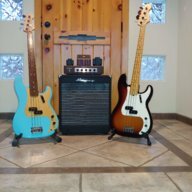

Just imagine: you couldn't buy a US Fender that looked like a REAL P or J bass before 1995. With the exception of the US Vintage series and Custom Shop instruments. But these were financially out of reach for many young players.
They gave up all the pseudo-"innovations" many players didn't want and the Js and Ps looked very traditional again. But - as you mentioned - added the strings-through-body feature and the graphite reinforced necks.

From the 1995 catalogue:
[Invalid or Expired Link Removed]
 
Last edited:
My 2000 MIA P has them along with the thicker headstock and it’s only needed a couple of neck adjustments in the 20+ years I’ve owned it.
My 1963 Jazz doesn't have carbon rods and has never needed a truss rod adjustment while I have owned it. Similarly my CS 64 Jazz with a roasted neck and body has never ever needed adjustment. While I am inclined to agree that carbon rods do affect response/feel in some way, I have no empirical data to support this - simply based on a wide variety of basses I have owned over the years. That said, a good bass is a good bass regardless....
 
2008 The American Standard line (passive 20 fret necks) got carbon rods. "Warmoth" offers carbon as an uncharge but they use steel otherwise. My .02 the rods seem to move hot spots or dead spots around or negate them. We all know a "stiff" neck is better...... right?
 
Sure there are many ways to improve neck stability, and the best would probably be to only use top quality cured wood, but aside from that I'd take a "typical" Fender neck with stabilization over a "typical" Fender neck without it any day.

When you look at the premium premium builders and their basses that exceed $5k, I very much hope that they only use top quality cured wood. But most of them still use carbon rods, too.
When you ask me, a neck simply cannot be stiff enough. There's nothing to gain from a softer neck.

So when you take typical Fender quality (i.e. mass produced) and add carbon rods, you get a better neck -
the same goes for cheaper necks - and for more expensive ones.
 
The amount of wood removed is minimal, typically a pair of 1/8" x 5/16" slots that are then filled with CF rods that are lighter and stiffer than an equivalent section of steel, and massively stronger than the wood removed. I have used them on two builds, and just installed them on a third, and they just plain work. Stiff enough to add a lot of rigidity to the neck, but dont prevent a normal range of adjustment for relief. If there is a downside, i cant see it. To those who do, please explain your specific concern. Its good insurance against unforseen problems, even the most carefully selected wood can have internal stresses that only surface over time. There's always a certain amount of marketing hype attached to.any new "feature", but a lot of bass brands include CF stiffeners now, and it isnt just hype.
 

Latest posts